Guides· 10 min read· Dishment team
How to create a restaurant menu: structure, pricing, descriptions and design
How to create a restaurant menu in 8 steps: concept, sections and menu size, pricing from food cost, names and descriptions, print and QR menus. Examples in AZN from Baku.
A new cafe is almost ready: the fit-out is done, the chef is hired, the equipment has arrived. Only the menu is left, and it often gets written in Word the night before opening. Yet knowing how to create a restaurant menu properly gives you the cheapest and strongest sales tool you have: the menu decides what guests order, what the kitchen buys and what the owner earns from every table.
This guide is about building a menu from scratch: concept and sections, pricing, names, descriptions and the design of print and QR menus, with examples from Baku in AZN. If your menu is already running and you want to analyse it with sales data, we have a separate guide: restaurant menu engineering.
What a menu is, and what it sells
A menu is not a price list. It does three jobs at once:
- Explains the concept. In two minutes the guest knows whether this is a family place with national cuisine or a quick lunch spot.
- Steers the choice. Which dish is seen first, which gets a description, which gets a photo: all of it changes what people order.
- Shapes the kitchen. Every line is ingredients, prep, a station and labour hours. A 90-item menu means 90 recipe cards, dozens of ingredients and a big store room.
That's why the owner, the head chef and the manager should build the menu together, not a designer alone.
How to create a restaurant menu: 8 steps
- Describe your guest. Who comes, when, and how much do they spend? Office lunches need quick dishes at 8–12 AZN; family dinners need big sharing plates.
- Write the concept in one sentence. For example: "Home-style Azerbaijani food, tandoor and grill, average check 20–25 AZN". A dish that doesn't fit the sentence doesn't go on the menu.
- Choose the sections. Cold starters, salads, soups, mains, grill, dough dishes, desserts, tea and drinks.
- List everything, then cut. Trim by what the kitchen can do, shared ingredients and speed of service.
- Write a recipe card for every dish. Gross weight, waste %, net weight, yield. Without it you have neither a food cost nor a consistent taste. Example: restaurant recipe card template.
- Calculate cost and price. Formula below.
- Write names and descriptions. In three languages, using one rule.
- Test it. Run a soft opening for friends and staff: what is slow, what do people ask about, what comes back.
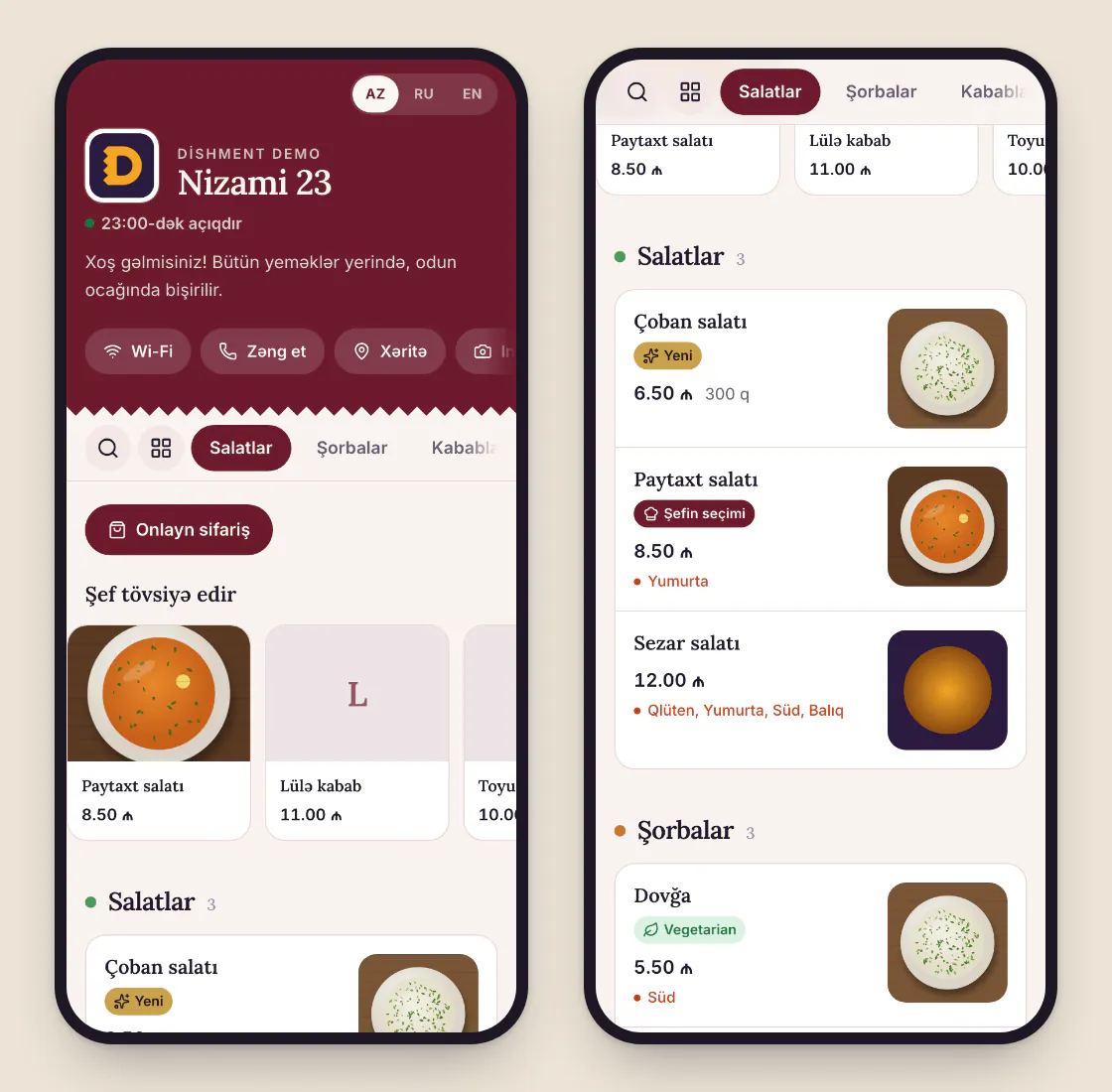
Menu structure: how many dishes and which sections
The most common mistake is a menu that's too long. Guests struggle to choose, the kitchen has to stock everything, and ingredients spoil. Our practical guideline, not an official standard:
| Format | Sections | Approx. number of items |
|---|---|---|
| Family restaurant (national cuisine) | Starters, salads, soups, mains, grill, dough, desserts, drinks | 40–60 |
| Cafe | Breakfast, salads, mains, desserts, drinks | 25–40 |
| Coffee shop | Coffee, other drinks, pastries, sandwiches | 20–30 drinks + 8–12 food items |
| Fast food | Core product, combos, sides, drinks | 15–25 |
| Tea house | Tea sets, jams, sweets, light snacks | 15–25 |
Five to eight items per section is easy to read. If a section runs past 12 lines, split it in two or drop the weak dishes.
A cafe menu is not a cut-down restaurant menu but a job of its own: an omelette and coffee for the guest who comes in at 9 am, two or three hot dishes for lunch, dessert and tea in the evening. Keep the bar menu on a separate sheet or in its own section of the QR menu. There the cost is counted in millilitres rather than grams: 50 ml of brandy, 330 ml of beer, the share of brewed tea in one glass.
Reuse ingredients. If herbs go into qutab, salads and kuku, they don't sit in the store room and spoil, and you buy them fresh every day. A rare ingredient bought for one dish is a source of waste.
Pricing: food cost and margin
A price comes from three numbers: cost, target food cost percentage and the market.
Calculated price = dish cost ÷ target food cost %
We show how to calculate food cost step by step in our food cost calculation guide. The figures below are examples:
| Dish | Cost | Target food cost | Calculated price | On the menu |
|---|---|---|---|---|
| Chicken plov (portion) | 2.70 AZN | 30% | 9.00 AZN | 9.00 AZN |
| Herb qutab (2 pcs) | 0.75 AZN | 25% | 3.00 AZN | 3.00 AZN |
| Dovga | 0.80 AZN | 25% | 3.20 AZN | 3.50 AZN |
| Lyulya kebab | 3.90 AZN | 35% | 11.14 AZN | 11.50 AZN |
| Tea set for two, with jam | 1.60 AZN | 20% | 8.00 AZN | 8.00 AZN |
A few rules:
- The percentage doesn't have to be the same everywhere. Meat dishes usually run a higher food cost; dough dishes, soups and tea run lower. What matters is the average across the menu.
- Think in manat. Lyulya kebab at 35% food cost earns 7.60 AZN a portion; qutab at 25% earns 2.25 AZN. The percentage is worse, but the kebab brings the money.
- Check the market. If the calculated price is far above your neighbours', change the portion or the recipe; don't fudge the food cost.
- Remember tax. The menu price also carries tax: simplified tax or VAT is paid on turnover. See restaurant taxes in Azerbaijan 2026.
- Round it. Not 11.14 but 11.50: easier for guests to read and for the cashier to give change.
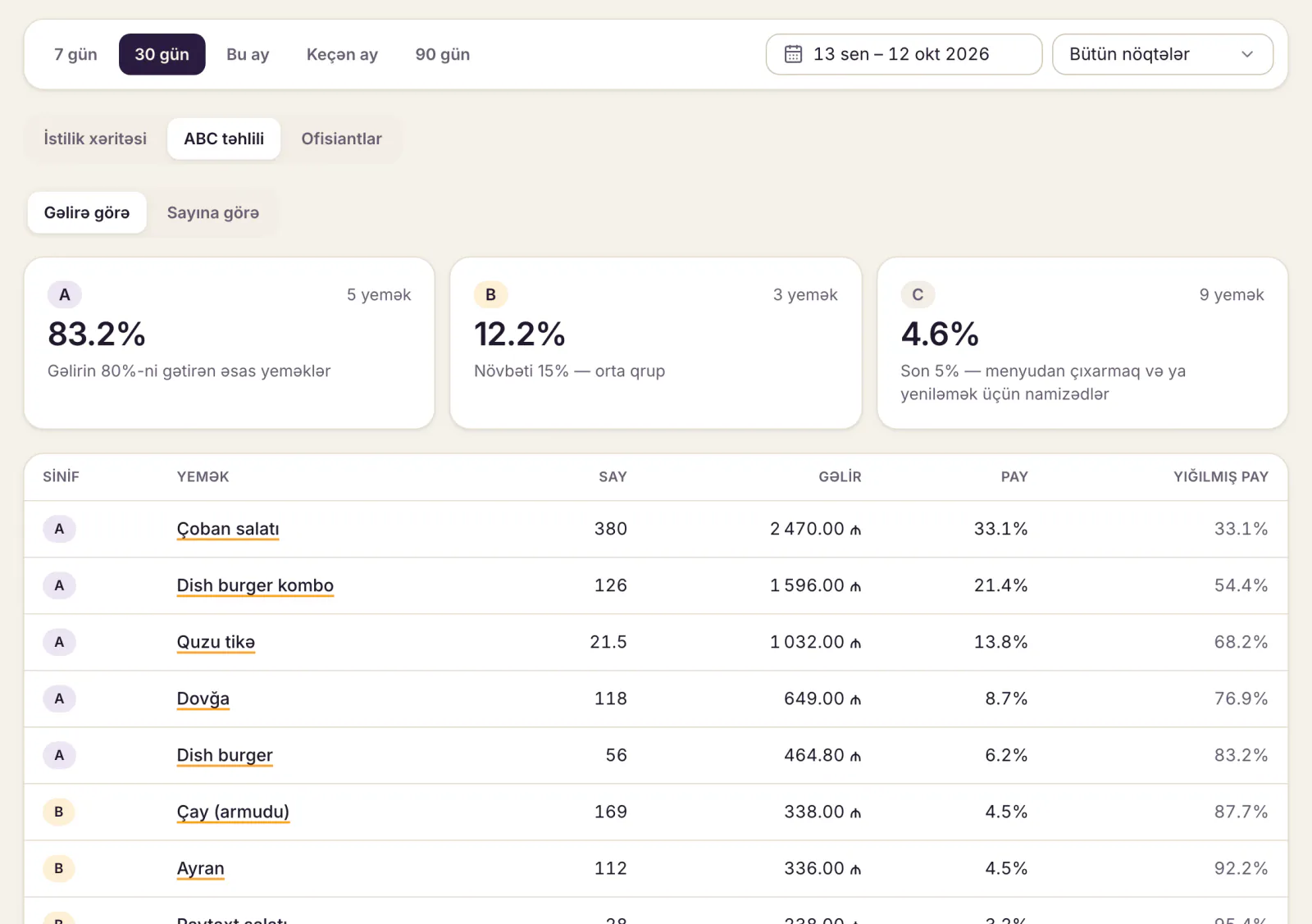
Two or three months after launch, check with sales data which dishes really earn. That is what menu engineering is for.
How to write menu names and descriptions
A good description has a simple formula: name + 2–3 key ingredients + cooking method + weight or count.
| Weak | Better |
|---|---|
| Qutab | Herb qutab: fresh dill, coriander and spinach, cooked on the saj, 2 pcs |
| Kebab | Lamb lyulya kebab: over charcoal, with sumac and onion, 250 g |
| Plov | Chicken plov: saffron rice, roasted chestnuts and raisins, 350 g |
| Tea | Tea set for two: black tea in armudu glasses, white cherry jam |
Checklist:
- Give the weight or count. Guests know what they'll get, and the kitchen doesn't over-portion.
- Mark allergens: nuts, milk, gluten, eggs, fish. It's about safety and trust.
- Three languages, one rule. Don't translate word for word: for dovga, one line of explanation such as "warm yoghurt soup with herbs" is enough.
- Skip the hype. "Best ever" and "legendary" say nothing. Ingredients and method sell better.
- Keep names identical everywhere. The menu name should match the name on the till and the kitchen ticket, or wrong orders go out.
Print and QR menu design
We covered the psychology of placement (first lines, no price columns) in menu engineering. Here is the practical side.
Printed menu:
- at least 11–12 pt type with strong contrast: dining rooms are often dim;
- A4 or folded A3, 2–4 pages; a thick book tires people;
- laminated or wipeable paper: greasy fingerprints show within a week;
- put dishes with changing prices on a separate insert so you don't reprint everything.
QR menu:
- no reprinting when a price or the stop list changes;
- three languages, photos and allergens in one place;
- placement and size of the code matter: guests should see it from their seat.
| Printed menu | QR menu | |
|---|---|---|
| When a price changes | Reprint | Updated in a minute |
| Sold-out dish | The waiter has to say | Marked on the menu |
| Languages | A menu per language or a thick book | Guests pick their language |
| Photos | Expensive to print | Easy |
| Older guests | Comfortable | Sometimes harder |
The best answer is often both: a QR code on the table and a few printed menus for those who ask. We explain how to launch one in QR code menu for restaurants.
When to update the menu
- With the seasons. Pomegranate, chestnut and pumpkin in autumn; cold soups and herbs in summer. Put seasonal dishes on an insert or in their own QR section.
- When purchase prices move. If meat, oil or rice go up, recalculate costs. With recipe cards and purchase prices in your system, that takes minutes.
- Quarterly, with data. Use ABC analysis to find dishes that sell poorly and earn little.
- Not all at once. Regulars look for their favourite. Changing 10–20% of the menu at a time is safe.
Common mistakes
- Everything for everyone. A 120-item menu kills speed, quality and stock control.
- Copying the neighbours' prices. Their cost, rent and portions are different.
- Pricing without a recipe card. "It costs about 3 manat" eats your margin within months.
- Descriptions without weight or ingredients. Guests get something unexpected, send it back or write a review.
- Leaving translation for later. Machine translation turns dolma into "stuffed" and nobody knows what it is.
- Print and forget. Prices change, the menu stays, and losses begin.
Menus in Dishment: write it once, use it everywhere
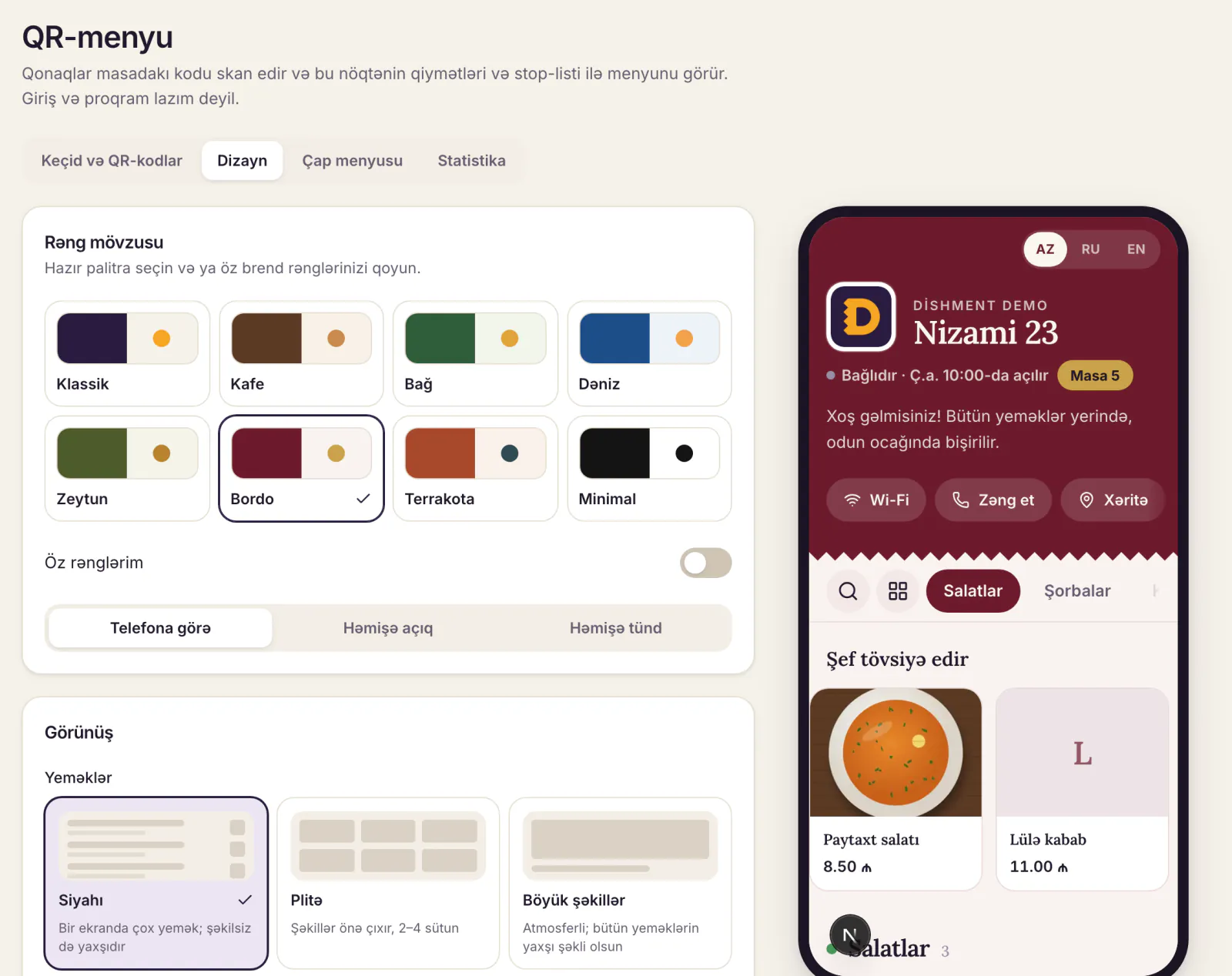
In Dishment the menu is set up once in the Back Office and flows everywhere: the till, waiter tablets, the kitchen display and the QR menu. Change a name, price or the stop list, and the till and the guest's phone show the same thing.
- The QR menu module shows the menu in Azerbaijani, Russian and English, with photos and allergens, and marks sold-out dishes. You can also download the printed menu as a PDF in several styles.
- In the inventory and recipes module, each dish's cost is calculated at the average purchase price and the margin is visible. When meat goes up, you see straight away which prices to review.
- At the till, notes such as "not spicy" or "no onion" are added with one tap, from a list you set up yourself.
DISHMENT
Want to see this in your restaurant?
We'll show you Dishment on your own menu in 30 minutes.
Free demoFAQ
What is a restaurant menu?
The list of dishes and drinks a restaurant offers, with prices. In practice it is also a sales tool: it shapes what guests choose, how the kitchen works and what the business earns.
How do you write a menu?
For each dish: the name, 2–3 key ingredients, the cooking method, weight or count and, where needed, allergens. Use one rule across all three languages and avoid hype.
How many items should a menu have?
It depends on the format. Our practical guideline: 25–40 items for a cafe, 40–60 for a family restaurant, and 5–8 lines per section. A short, well-cooked menu is easier for guests and the kitchen alike.
What software should I use to make a menu?
Any design tool will do for layout. But if prices change often, it is less work to keep the menu in your POS system and generate the QR menu and a printable PDF from there.
How often can I change prices?
Review costs monthly and change prices when you need to, but not too often: regulars notice monthly increases. On printed menus, keep changing prices on a separate insert.