Finance· 15 min read· Dishment team
Payroll in Azerbaijan 2026: how to calculate restaurant wages, tax and overtime
How to calculate payroll in Azerbaijan in 2026: income tax, social, unemployment and medical insurance, gross and net pay, worked examples for a waiter, cook and manager, shifts, night work and overtime.
At the end of the month a waiter asks why 696 manat reached their card instead of 800. A cook wants to know how night shifts and a public holiday are paid. This guide walks through payroll in Azerbaijan under the 2026 rules, using a restaurant as the example: gross and net pay, income tax, social insurance, unemployment and compulsory medical insurance, shift rotas, night work and overtime. Rates come from official sources; the examples are illustrative.
Waiter motivation, commission and tips are covered in a separate article. This one is about the calculation.
Gross and net: two numbers, two questions
- Gross pay is what the employment contract and the time sheet add up to: salary or hourly pay, commission on sales, bonuses, and supplements for overtime and night work. Under the Labour Code, pay includes supplements, bonuses and other payments on top of the base amount.
- Net pay is what is left after the employee's income tax and contributions are withheld.
- Employer cost is gross pay plus the contributions the employer pays on top. That is the number your restaurant budget needs.
Tell new staff up front which figure the contract states. When someone hears "800 manat", they almost always think of take-home pay.
Payroll in Azerbaijan: what a private restaurant withholds in 2026
The rates below apply to employers outside the oil and gas sector and outside the state sector. Most private restaurants and cafes fall into this group, but check your status with your accountant. The source is the State Tax Service's 2026 flyers and booklet (listed at the end).
Income tax (withheld from the employee):
| Monthly pay | 2026 | 2027 | from 2028 |
|---|---|---|---|
| up to 2,500 ₼ | 3% | 5% | 7% |
| 2,500–8,000 ₼ | 75 ₼ + 10% of the part above 2,500 | 125 ₼ + 10% | 175 ₼ + 10% |
| over 8,000 ₼ | 625 ₼ + 14% of the part above 8,000 | 675 ₼ + 14% | 725 ₼ + 14% |
At the employee's main place of work, if monthly income is up to 2,500 ₼, 200 ₼ is deducted from the taxable amount. So on an 800 ₼ wage, tax is calculated on 600, not 800. The tax must reach the budget by the 20th of the following month.
Contributions:
| Contribution | Withheld from employee | Paid by employer |
|---|---|---|
| State social insurance, up to 200 ₼ | 3% | 22% |
| Social insurance, 200–8,000 ₼ | 6 ₼ + 10% of the part above 200 | 44 ₼ + 15% of the part above 200 |
| Social insurance, over 8,000 ₼ | 786 ₼ + 10% of the part above 8,000 | 1,214 ₼ + 11% of the part above 8,000 |
| Unemployment insurance | 0.5% | 0.5% |
| Compulsory medical insurance, up to 2,500 ₼ | 2% | 2% |
| Medical insurance, over 2,500 ₼ | 50 ₼ + 0.5% of the part above 2,500 | 50 ₼ + 0.5% of the part above 2,500 |
From 2026 the medical insurance threshold dropped from 8,000 to 2,500 ₼, and social insurance gained a third tier for pay above 8,000 ₼. For wages up to 2,500 ₼, contributions are the same as before.
Accountants and staff often call social insurance simply "DSMF", after the State Social Protection Fund. So the answer to "what percentage is DSMF" is in the table above: on pay up to 200 ₼, 3% from the employee and 22% from the employer; between 200 and 8,000 ₼, 6 ₼ plus 10% of the part above 200 from the employee, and 44 ₼ plus 15% from the employer.
When to pay. Income tax withheld from wages is due by the 20th of the following month, and social and medical insurance contributions by the 15th. Once a quarter, by the 20th of the month after the quarter ends, you file the unified return on withholdings from employment income with the tax office. So October's contributions are due by 15 November, October's income tax by 20 November, and the October–December return by 20 January. Income tax as a whole, its exemptions and other kinds of income are a big topic of their own; here we only cover what applies to wages.
How to calculate payroll: four examples
All at the main place of work, a full month worked, amounts in manat:
| Line | Minimum wage | Waiter | Cook | Manager |
|---|---|---|---|---|
| Gross pay | 400.00 | 800.00 | 1,200.00 | 3,000.00 |
| Income tax | 6.00 | 18.00 | 30.00 | 125.00 |
| Social insurance (employee) | 26.00 | 66.00 | 106.00 | 286.00 |
| Unemployment insurance (employee) | 2.00 | 4.00 | 6.00 | 15.00 |
| Medical insurance (employee) | 8.00 | 16.00 | 24.00 | 52.50 |
| Net pay | 358.00 | 696.00 | 1,034.00 | 2,521.50 |
| Social insurance (employer) | 74.00 | 134.00 | 194.00 | 464.00 |
| Unemployment insurance (employer) | 2.00 | 4.00 | 6.00 | 15.00 |
| Medical insurance (employer) | 8.00 | 16.00 | 24.00 | 52.50 |
| Total employer cost | 484.00 | 954.00 | 1,424.00 | 3,531.50 |
The waiter's figures step by step:
- Income tax: (800 − 200) × 3% = 18 ₼.
- Social insurance: 6 + (800 − 200) × 10% = 66 ₼.
- Unemployment insurance: 800 × 0.5% = 4 ₼.
- Medical insurance: 800 × 2% = 16 ₼.
- Net: 800 − 18 − 66 − 4 − 16 = 696 ₼.
The manager earns more than 2,500 ₼, so the 200 ₼ deduction doesn't apply: tax is 75 + (3,000 − 2,500) × 10% = 125 ₼, and medical insurance is 50 + 500 × 0.5% = 52.50 ₼.
Employees entitled to tax reliefs (Article 102 of the Tax Code) will have different figures; your accountant handles those separately.
Minimum wage in 2026
Since 1 January 2025, an employee who works the full monthly hours cannot be paid less than 400 ₼. On 2 October 2026 the President announced that the minimum wage will be raised next year; the new amount has not been published yet. Under the Labour Code, the minimum wage is reviewed at least once a year. Check any contracts tied to the minimum once the new figure is out.
One detail matters: under Article 155 of the Labour Code, bonuses, supplements and pay for work beyond normal hours don't count towards the minimum wage. A "300 ₼ base plus bonus" scheme cannot be used to reach it.
Payroll for shift work
Restaurants rarely run nine to six. What the law says:
- A normal working day is at most 8 hours and a normal week at most 40 hours (Article 89).
- Shift rotas can use summarised working-time accounting: the reference period is at most a year, a shift at most 12 hours, and hours over the period must not exceed the legal norm (Article 96). The rules go into a collective agreement, internal work rules or the employment contract.
- The employer must keep an accurate record of each employee's actual hours and overtime (Article 102).
Example: a 2-on, 2-off rota of 12-hour shifts. A cook works 15 shifts a month: 15 × 12 = 180 hours. If the month's norm is, say, 168 hours, that is 12 hours over. Under summarised accounting they are settled at the end of the reference period: a shortfall in another month can offset them, and any hours still over the norm are paid as overtime. Take each month's norm from the official working calendar published every year.
The hourly rate is the monthly salary divided by that month's hours norm: 1,200 ₼ ÷ 168 hours ≈ 7.14 ₼.
Night shifts: how they are paid
Night time is 10 pm to 6 am (Article 97). Night work and multi-shift work are paid at a higher rate: the minimum is set by the relevant government body, and the actual supplement is written into the employment contract or collective agreement (Article 166). Under-18s may not work at night; pregnant women, women with children under 14 and some other employees may do so only with their written consent (Article 98).
Example: a bar opens from 4 pm to 1 am, so each shift includes 3 night hours. 20 shifts a month means 60 night hours. At an hourly rate of 7 ₼, every 10% of night supplement in the contract adds 60 × 7 × 10% = 42 ₼ a month. Put the percentage in the contract and check with your accountant or lawyer that it isn't below the legal minimum.
Overtime and public holidays
Overtime requires the employer's order and the employee's consent (Article 99) and is allowed only in the exceptional cases the law lists, for example when nobody can replace the employee and the work cannot stop (Article 101). No one may work more than 4 hours of overtime across two consecutive working days (Article 100).
Pay: on time-based pay, every overtime hour is paid at no less than double the hourly rate, and it cannot be swapped for a day off (Article 165). Example: a cook works 6 hours of overtime at 7.14 ₼ an hour: 6 × 7.14 × 2 ≈ 85.71 ₼ extra.
Rest days and non-working public holidays (Article 164): hourly or daily-paid staff get at least double the rate. A salaried employee working within the monthly norm gets at least one extra day's (hour's) pay on top of salary; beyond the norm, at least double. If the employee prefers, another day off can be given instead of money. Example: a waiter on 800 ₼ a month in a month with 21 working days has a daily rate of about 38.10 ₼; working a holiday within the norm adds at least 38.10 ₼.
DISHMENT
Want to see this in your restaurant?
We'll show you Dishment on your own menu in 30 minutes.
Free demo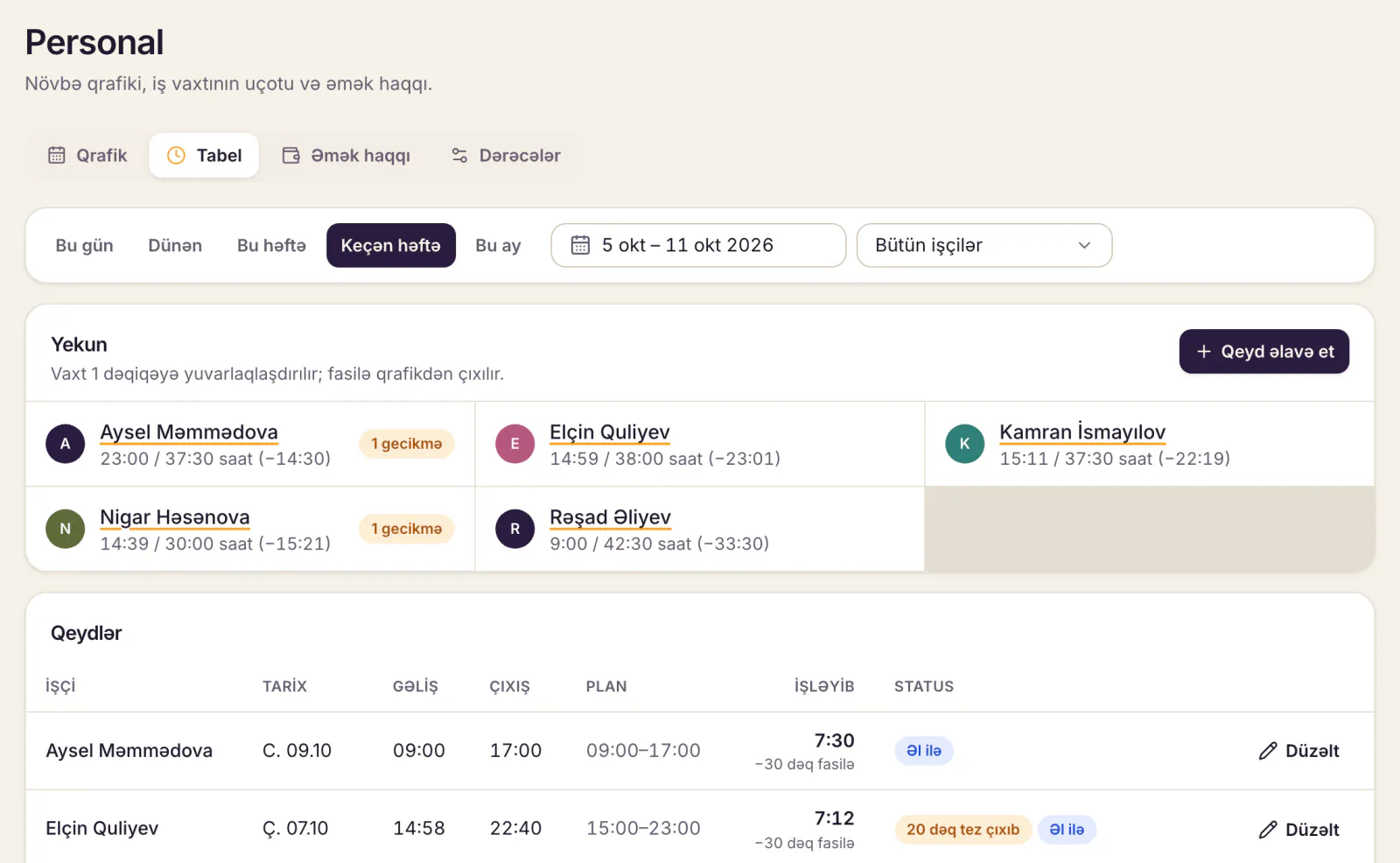
Commission, bonuses and deductions
- Commission and bonuses are part of pay: they go into gross, and tax and contributions are calculated on them. The formulas are in our article on waiter pay and tipping.
- Tips. Check with your accountant how tips are taxed and whether they belong in payroll.
- Deductions. On the employer's order, only the amounts the law lists may be deducted from pay: taxes and contributions, amounts under enforcement orders, damage caused by the employee's fault (up to one month's average pay, except where the employee carries full material liability) and a few other cases (Article 175). Anything else needs the employee's written consent. You cannot simply take a till shortage out of someone's wages.
- When to pay. Wages are paid at least once a month; by mutual agreement they can be paid twice a month, as an advance and the balance, no more than 16 days apart. A leaver is paid everything on their last day. For each day of delay caused by the employer, the employee is owed at least 1% of their pay (Article 172).
If you'd rather not do it by hand, the salary calculator uses the same 2026 rates to go from gross to net and back: income tax, DSMF, unemployment and medical insurance, and the employer's total cost.
Payroll spreadsheet template
Copy these columns into Excel, one row per employee:
| Employee | Role | Hours worked | Overtime hours | Night hours | Gross | Income tax | Social (employee) | Unemployment (employee) | Medical (employee) | Net | Employer contributions | Total cost |
|---|---|---|---|---|---|---|---|---|---|---|---|---|
| Aysel M. | waiter | 168 | 0 | 24 | 800.00 | 18.00 | 66.00 | 4.00 | 16.00 | 696.00 | 154.00 | 954.00 |
Put base pay, commission, bonuses and the overtime and night supplements together in the gross column (F). If you want to see them separately, add columns before F and change the letter in the formulas. With gross pay in column F, the 2026 formulas are (main place of work, no reliefs):
- Income tax:
=IF(F2<=2500, MAX(0, F2-200)*0.03, IF(F2<=8000, 75+(F2-2500)*0.1, 625+(F2-8000)*0.14)) - Social insurance, employee:
=IF(F2<=200, F2*0.03, IF(F2<=8000, 6+(F2-200)*0.1, 786+(F2-8000)*0.1)) - Social insurance, employer:
=IF(F2<=200, F2*0.22, IF(F2<=8000, 44+(F2-200)*0.15, 1214+(F2-8000)*0.11)) - Unemployment insurance, each side:
=F2*0.005 - Medical insurance, each side:
=IF(F2<=2500, F2*0.02, 50+(F2-2500)*0.005)
Depending on your Excel language settings, the separator may be a semicolon rather than a comma. Rates change, so update the formulas every January.
Common mistakes
- Net in the contract, gross in the payroll. The most common cause of disputes with staff.
- No time sheet. When late arrivals, early departures and overtime live only in memory, payroll turns into an argument.
- "Paying" overtime with a day off. The law doesn't allow overtime to be replaced by time off.
- No night supplement in the contract. The actual amount or percentage has to be written down.
- Topping up to the minimum with a bonus. Bonuses don't count towards the minimum wage.
- Deducting a shortage without consent. Find the cause first; a deduction is possible only where the law allows it.
Staff and payroll in Dishment
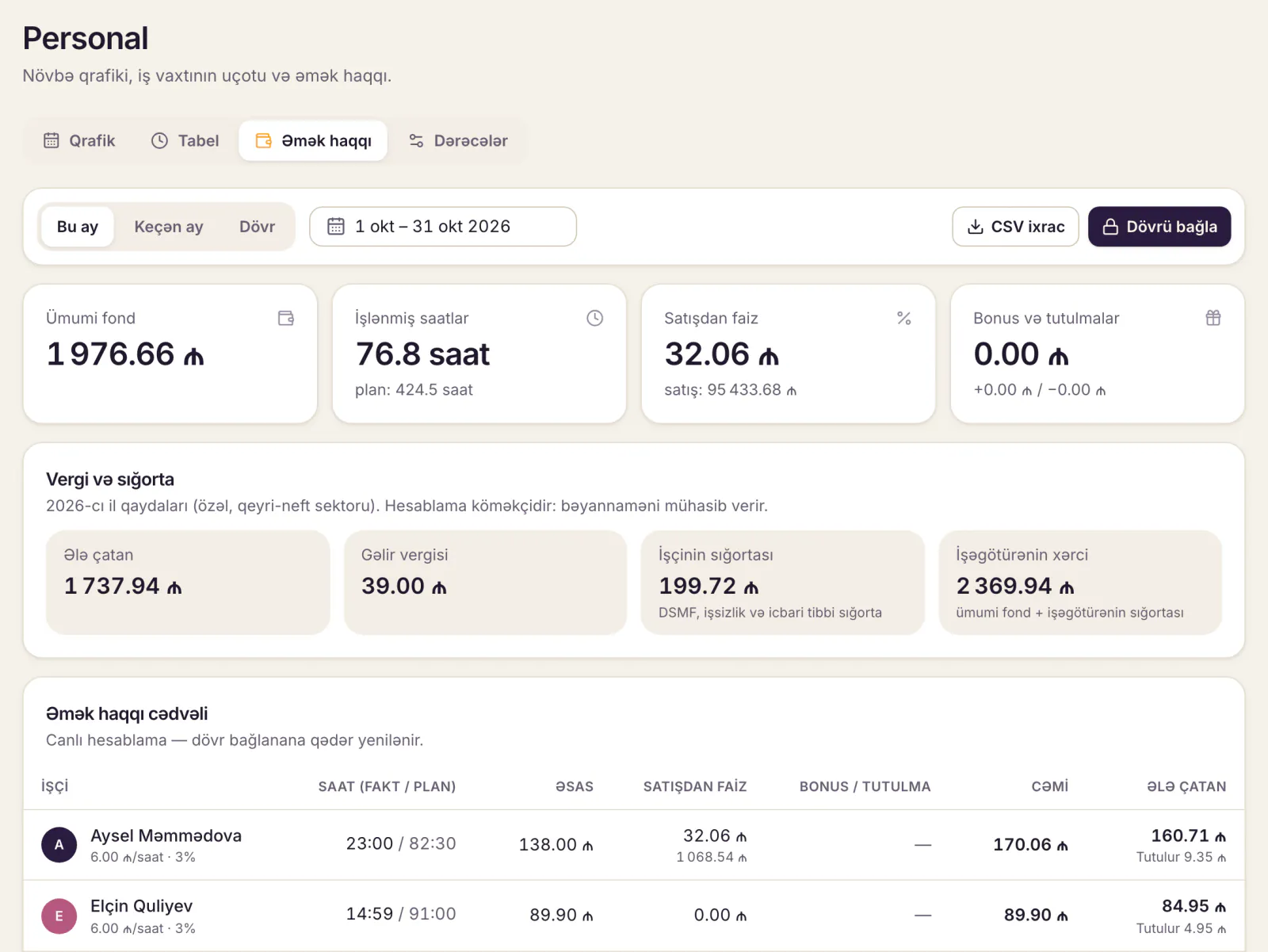
Dishment's Staff and payroll module takes the most disputed part of payroll, hours and sales, off paper:
- Weekly rota: drafts, publishing, copying last week; overlapping shifts are flagged at once. Everyone sees their own shifts on the till.
- Clock in and out at the till: on the POS lock screen with a PIN, card or QR badge, even without internet.
- Time sheet: late arrivals, early departures, missed clock-outs. Corrections need a reason and go into the audit log.
- Pay rates: hourly or monthly salary, commission on sales, set per venue; time rounding and a weekly norm.
- Payroll sheet: hours worked and scheduled, hours over the weekly norm shown separately, base pay, sales and commission, bonuses and deductions. Locking the period freezes the numbers, and the sheet exports to CSV.
- Tax and insurance: when the period is a whole calendar month, the sheet applies the 2026 rules from the table above and shows each employee's income tax, contributions, take-home pay and the employer's cost. You pick the sector and the main workplace under Pay rates.
To be clear: Dishment doesn't count night hours separately or add the overtime premium by itself. You enter those as a bonus, and the tax is worked out with the bonus included. Returns and official reporting stay with your accountant; Dishment's figures give them a ready base to check against. With the Finance module switched on, payroll lands under To pay automatically. The module's price is on the pricing page.
FAQ
What is the income tax on wages in Azerbaijan in 2026?
In the private sector outside oil and gas, 3% on monthly income up to 2,500 ₼ (with 200 ₼ deducted at the main place of work). Social insurance, 0.5% unemployment insurance and 2% medical insurance are also withheld from the employee.
How do I work out gross pay from a net figure?
For pay between 200 and 2,500 ₼ at the main place of work: gross = (net − 20) ÷ 0.845. For example, for 700 ₼ take-home, gross pay needs to be about 804.73 ₼. Employees with tax reliefs will get a different result.
How is a night shift paid?
Hours between 10 pm and 6 am are paid at a higher rate. The actual supplement is written into the employment contract and cannot be below the legal minimum.
Can I give a day off instead of paying overtime?
No. Overtime is paid at least double. A day off instead of money is only possible for work on a rest day or public holiday, and only if the employee asks for it.
What is DSMF, and how much is deducted from wages?
DSMF is the everyday name for compulsory state social insurance. In the private sector, on pay above 200 ₼ the employee pays 6 ₼ plus 10% of the part above 200, which is 66 ₼ on 800 ₼. The employer pays 44 ₼ plus 15% of the same part on top.
What is the minimum wage in Azerbaijan in 2026?
400 ₼. That is the floor for an employee who works the full monthly hours; at the main place of work it leaves 358 ₼ in hand. The President has announced a rise next year; update your contracts once the new amount is published.
Sources
- State Tax Service, flyer for non-state employers with hired staff (2026, in Azerbaijani): taxes.gov.az
- State Tax Service, booklet on income tax, social, unemployment and medical insurance withheld from employment income (2026, in Azerbaijani): taxes.gov.az
- State Tax Service, flyer on compulsory medical insurance (2026, in Azerbaijani): taxes.gov.az
- State Tax Service, booklet on social insurance contributions and the unified return: payment and filing deadlines (in Azerbaijani): taxes.gov.az
- State Tax Service, on medical insurance payment deadlines (in Azerbaijani): taxes.gov.az
- State Tax Service, "Changes to the Tax Code in questions and answers" (2026, in Azerbaijani): taxes.gov.az
- State Tax Service, explanation of unemployment insurance rates (in Azerbaijani): taxes.gov.az
- Labour Code of the Republic of Azerbaijan, Articles 89, 96–102, 155, 164–166, 172 and 175 (in Azerbaijani): e-qanun.az
- Ministry of Labour and Social Protection, on the minimum wage (in Azerbaijani): sosial.gov.az
- AZERTAC, the President's announcement that the minimum wage will be raised next year (in Azerbaijani): azertag.az
DISHMENT
Try it free for 30 days
We open the account and move your menu over together. No card needed.
30 days free