Management· 13 min read· Dishment team
Waiter job description and service standards: a free template
Copy-ready templates: waiter and restaurant manager job descriptions with duties, rights, accountability and KPIs, a 10-step service standard and till rules for voids and discounts.
In their first week a new waiter asks about everything: how we split the tables, who can give a discount, what to do when a guest sends a dish back. Every manager answers differently, and a month later the team runs on three different "rules". A written waiter job description and service standard end that: who is responsible for what, what good service looks like and who may do what at the till.
This article gives you a free waiter job description template and a restaurant manager version to copy and adapt, followed by a 10-step service standard from greeting to bill and a set of till rules for voids, discounts and checks. The examples come from restaurants and cafés in Baku, but the templates work anywhere.
What a job description is for (and what it isn't)
A job description answers "what" and "how far": duties, rights, accountability and how performance is judged. In a restaurant it does three jobs:
- Hiring and onboarding. New staff know what is expected from day one, and the manager stops repeating the same explanations.
- Settling disputes. "That's not my job" has a written answer.
- Performance reviews. Bonuses and warnings rest on agreed measures, not on mood.
What it is not:
- Not an employment contract. Pay, hours, leave and other terms belong in the contract and the law. The job description should not repeat or contradict them.
- Not a recipe or plating guide. How to serve dolma belongs in the recipe card and the service standard.
- Not a list of punishments. If it contains nothing but prohibitions, nobody reads it.
Waiter job description template
1. General
- Position: waiter.
- Reports to: the shift manager, or the restaurant manager in their absence.
- Cover: when absent, the waiter is covered by another waiter named by the manager.
- The waiter follows this job description, the service standard, the till rules and food hygiene rules.
2. Requirements
- Fluent Azerbaijani and Russian; basic service phrases in English.
- Knows the menu, the ingredients of each dish and the allergens.
- Can work with the POS and the waiter tablet.
- Neat appearance and uniform.
3. Duties
Before the shift:
- Arrive on schedule and clock in.
- Check the assigned section: tables, chairs, condiments, napkins, table cards.
- Attend the briefing: stop-list, specials, details of any booking or banquet.
During service:
- Greet and serve guests according to the service standard.
- Enter orders in the system at once, never keep them on paper; record allergies and special requests in the dish note.
- Fire courses in the right order and keep an eye on the tables.
- Print bills only from the system; take payment and hand the guest their receipt.
- Listen to complaints, resolve them within their authority and pass anything else to the manager straight away.
At the end of the shift:
- Leave no open tables or checks.
- Hand over cash and tips according to the agreed procedure.
- Hand the section over to the next shift in order and clock out.
4. Rights
- To receive the information needed for the job (menu, stop-list, changes) in time.
- To be given the necessary equipment and uniform.
- To suggest service improvements.
- To hand a rude or unsafe guest over to the manager.
5. Accountability
The waiter is accountable for failing to perform their duties, breaching the till rules and for property entrusted to them, in line with the employment contract and the law.
6. Performance measures (examples)
- Average check and the share of desserts or drinks sold.
- Number of guest complaints.
- Number of voids with a reason, especially after an item went to the kitchen.
- Late arrivals and missed clock-outs.
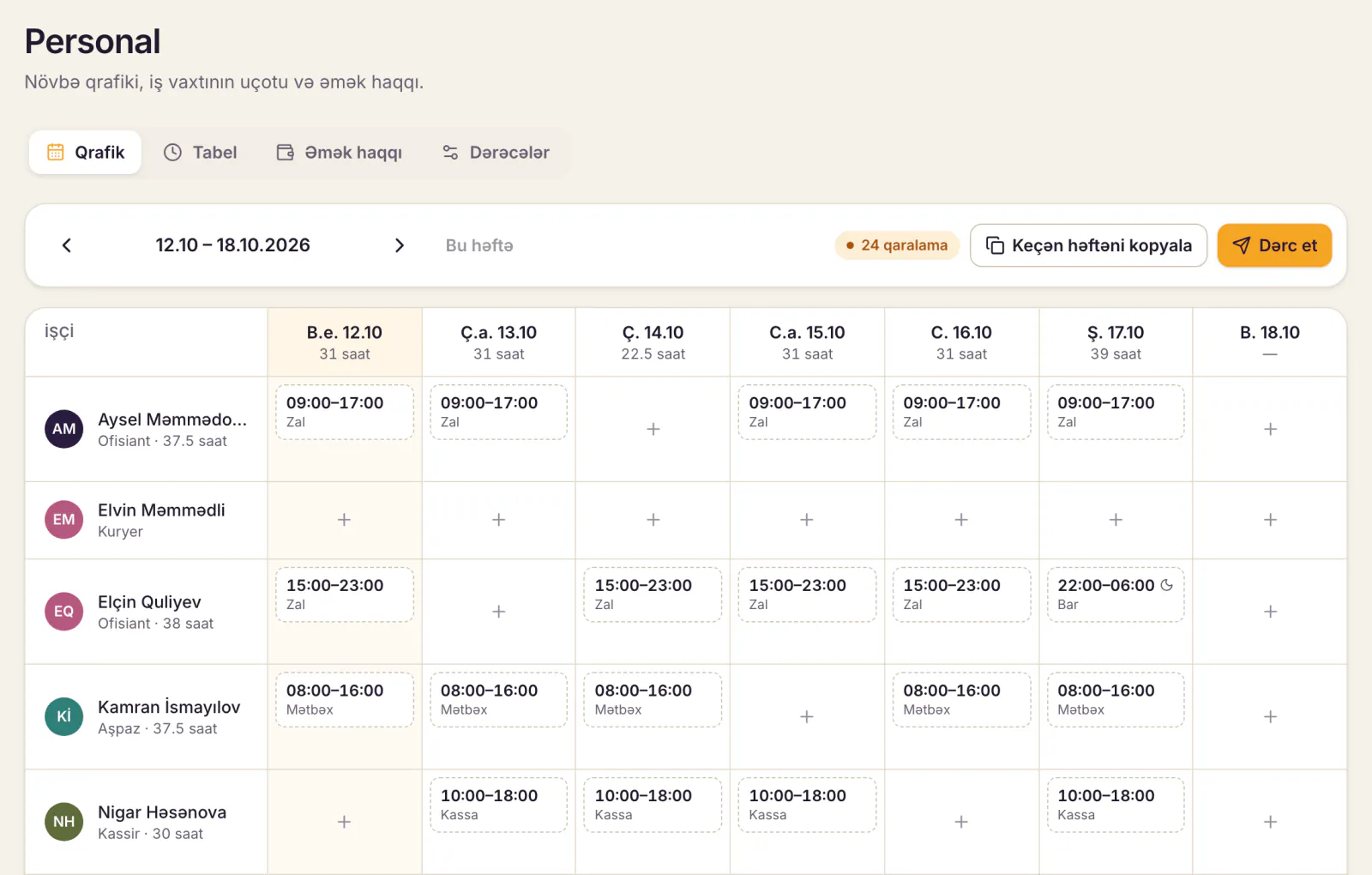
How to tie waiter pay and motivation to these measures is covered in waiter pay and tipping in Baku.
Rules for waiters: what makes a good waiter
A good waiter is tidy, attentive and calm: guests never have to look for them, orders arrive right and the bill holds no surprises. The job description lists the duties; the short rules below cover everyday behaviour on the floor. Print them as an appendix to the job description and pin them up in the staff room.
- Appearance. A clean uniform that matches the rest of the team and the venue's style, neat hair, a name badge; keep perfume and jewellery to a minimum.
- No phone on the floor. Personal phones stay away during the shift.
- Keep your section in view. Guests shouldn't have to look for you: scan your tables regularly and spot a raised hand at once.
- Know the menu. Ingredients, allergens, cooking times. If you don't know, don't guess; ask the kitchen.
- Take allergies seriously. Note them on the order and tell the kitchen in person too.
- Don't rely on memory. Enter the order in the system straight away, not on paper.
- Repeat the order back. Send it once the guest has confirmed.
- Don't argue with guests. Listen to the complaint, apologise, and pass it to the manager if it's beyond your authority.
- Bills come only from the system. Count change in front of the guest and hand in tips the way the venue requires.
- Your PIN is personal. Never share it and never work under someone else's.
- Never walk empty-handed. Take dirty plates to the kitchen and bring ready dishes back.
- Arrive on time and hand over a tidy section. The start and end of the shift are part of the service too.
Restaurant manager job description template
1. General
- Position: restaurant manager.
- Reports to: the general manager or owner.
- Direct reports: waiters, cashiers, bartenders, host; kitchen work is organised together with the head chef.
2. Duties
Team:
- Draw up and publish the shift rota, arrange cover.
- Onboard new staff: these job descriptions, the service standard, the till rules.
- A daily briefing and a short weekly training session.
Service:
- Make sure the service standard is followed; do the "two-minute check" on the floor.
- Resolve complaints and record the outcome.
- Organise banquets and large groups.
Till and cash:
- Open and close the till shift and check the X and Z reports. More: X and Z reports.
- Approve voids of items already sent to the kitchen and discounts, and check the reason.
- Investigate cash differences the same day.
Stock and costs:
- Receive deliveries against the invoice, checking quantity and quality.
- Check and approve write-off records: restaurant food write-off log.
- Take part in the weekly and monthly stock counts.
Reporting:
- Daily: a short summary of revenue, number of checks, average check, voids and complaints.
- Monthly: results against plan and the three main priorities for next month.
3. Rights
- To give staff instructions on service and discipline.
- To recommend hires, bonuses and warnings.
- To make small purchases within the approved budget.
- To ask the general manager to take a staff member who broke the till rules off the shift.
4. Accountability
The manager is accountable for service quality, till discipline, property entrusted to them and the accuracy of reports, in line with the employment contract and the law.
5. Performance measures (examples)
| Measure | How it is calculated |
|---|---|
| Revenue vs plan | Actual revenue ÷ plan |
| Average check | Revenue ÷ number of checks, weekly |
| Labour cost | Payroll ÷ revenue |
| Voids and discounts | Amount and share of revenue |
| Cash differences | Total across shifts |
| Write-offs | At cost, by reason |
| Complaints | Number and time to resolve |
The owner and manager set the targets together, based on the venue's own history.
Service standard: 10 steps from greeting to bill
The timings are examples; they will differ for fast food, a family restaurant and fine dining. What matters is that they are written down and everyone works to the same ones.
| No. | Step | Standard (example) |
|---|---|---|
| 1 | Greeting | Eye contact and a hello within 30 seconds of the guest walking in |
| 2 | Seating and menu | Menu, or point out the table's QR menu, within 1 minute |
| 3 | Drinks order | Within 3 minutes; suggest tea, water and the drink of the day |
| 4 | Drinks served | Within 5 minutes of ordering |
| 5 | Food order | Ask about allergies, recommend, repeat the order back |
| 6 | Food served | As soon as it's ready, without asking "who had what?" |
| 7 | Two-minute check | Two minutes after serving: "Is everything all right?" |
| 8 | Clearing | Remove empty plates, suggest dessert and tea |
| 9 | The bill | Within 3 minutes of being asked, printed from the system and checked |
| 10 | Goodbye | Thank the guest and invite them back; tell the manager if they were unhappy |
Three conditions make the standard work:
- A link to the kitchen. Step 6 only works if the waiter knows the moment a dish is ready. A kitchen display system helps far more than paper tickets.
- Training. A standard is practised, not read: a new waiter spends the first two shifts alongside an experienced colleague.
- Checking. Once a week the manager watches a few tables against this table and discusses the results at the briefing.
Till rules: voids, discounts, checks
Most money lost in a restaurant is lost at the till, and not all of it is theft. The simplest protection against mistakes and abuse is to write down who may do what:
| Action | Waiter | Cashier | Manager |
|---|---|---|---|
| Void an item not yet sent to the kitchen | Yes, with a reason | Yes, with a reason | Yes |
| Void an item already sent to the kitchen | With manager approval | With manager approval | Yes, with a reason |
| Discount | With manager approval | With manager approval | Yes |
| Change a check after the bill is printed | With manager approval | With manager approval | Yes |
| Reopen a closed check, refund | No | With manager approval | Yes |
| Open and close the shift, X report | No | Yes | Yes |
| Z report and closing the day | No | No | Yes |
Three more rules:
- Every void has a reason, chosen from a list rather than typed freely: "guest changed their mind", "entered by mistake", "kitchen error".
- Everyone works under their own code. Using someone else's PIN is a serious breach of the rules.
- Bills are printed only from the system. No handwritten bills.
These rules shut down the most common forms of theft; more in restaurant theft prevention.
How the rules work at the till in Dishment
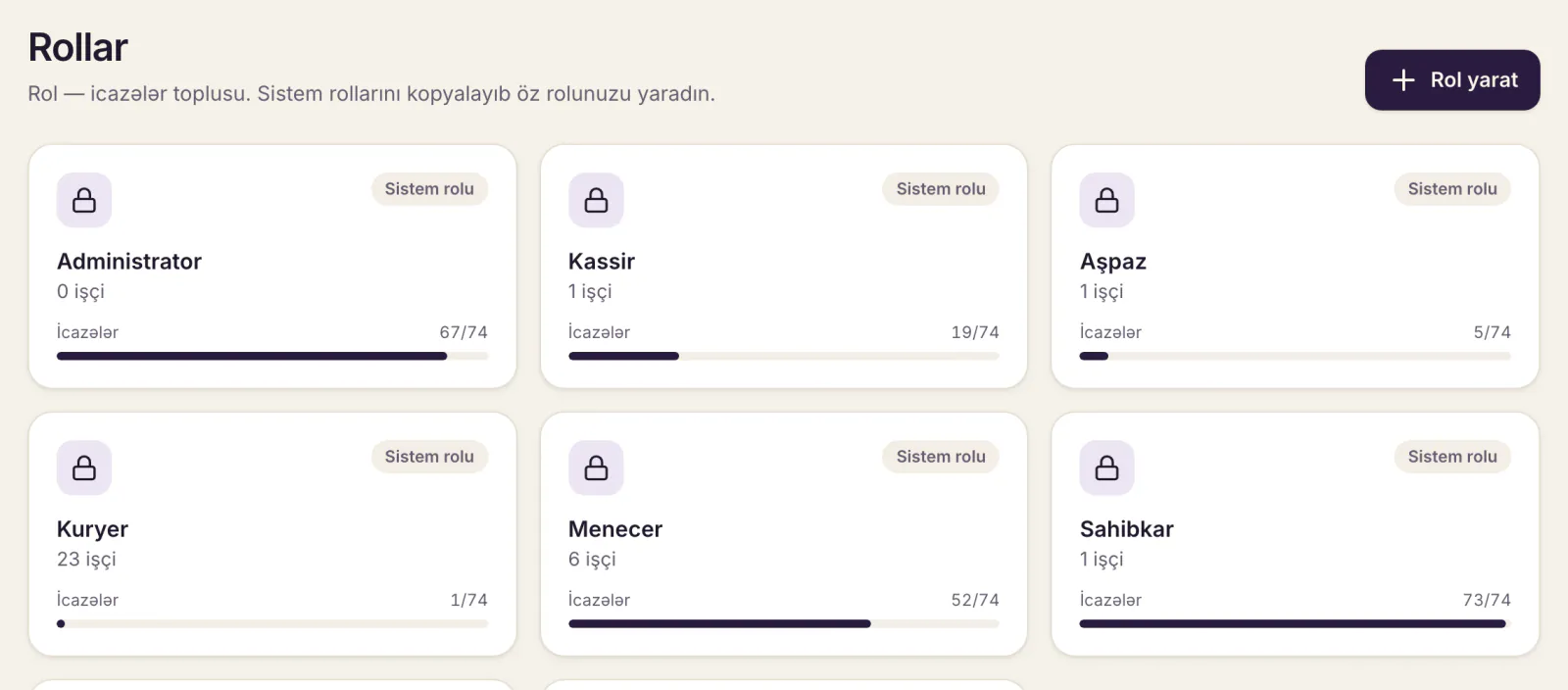
A rule on paper is stronger when the till enforces it. In Dishment's POS, the table above largely matches the ready-made role templates, and you can adjust them to your own rules:
- Roles and permissions. Waiter, cashier, manager, cook and other roles each have their own set: for example, the standard waiter role can void an item not yet sent to the kitchen but cannot give a discount or reopen a closed check.
- Manager approval. When a staff member lacks the permission for an action, a manager can approve it right at the till with their PIN, and the approver is recorded.
- A list of reasons. You set up the reasons for voids, refunds and discounts in Back Office, and staff pick one from the list at the till.
- Sign-in by PIN or staff card, plus an audit log: who did what, and when.
- Shifts and time sheets. With the Staff and payroll module, staff clock in and out at the till and see their published shifts there; late arrivals show up in the time sheet.
- Suspicious activity. The Loss prevention module finds voids after the bill was printed, reopened checks and cash differences on its own.
Staff, roles, permissions and PINs come with the base plan; module terms are on the pricing page.
DISHMENT
Try it free for 30 days
We open the account and move your menu over together. No card needed.
30 days freeRolling it out
- Adapt the template to your venue. A fast-food place has no host; a fine-dining room has a sommelier.
- Read it through with the team. Experienced waiters often add unwritten but important rules.
- Have every staff member sign that they have read it, and keep a copy where people can find it.
- Set till permissions to match the document, or the paper rule will be broken at the till.
- Review it twice a year, and whenever the menu, format or team changes.
FAQ
What are a waiter's main duties?
In short: greet and serve guests to the standard, enter orders in the system straight away, record allergies and requests, print the bill from the system and take payment, keep the section tidy and hand over cash properly at the end of the shift. The full list is in the template above.
What makes a good waiter?
Being tidy, attentive and calm: knowing the menu, entering and repeating every order, taking allergies seriously, never arguing with guests and printing bills only from the system. The twelve floor rules are in the "Rules for waiters" section above.
What should a restaurant manager's job description include?
The team and the rota, service quality, till discipline (shifts, X and Z reports, approving voids and discounts), receiving deliveries, write-offs and stock counts, and daily and monthly reporting to the owner.
Can I download this waiter job description template in Word?
Copy the text and tables above into Word or Google Docs and add your venue name and an approval line to the header. Have a lawyer check it before you use it as a formal HR document.
How often should job descriptions be updated?
At least once or twice a year, and whenever the format, the menu or the till rules change.
Information as of October 2026. The templates are not legal advice.
DISHMENT
Want to see this in your restaurant?
We'll show you Dishment on your own menu in 30 minutes.
Free demo