Finance· 11 min read· Dishment team
Cash Book Template: Format, Excel Version and Rules in Azerbaijan
The official cash book form (KK-1), one day of receipts and payments in manat, the cashier's report, an Excel template and the Cabinet of Ministers rules for keeping it.
Free Excel templateCash bookThe article’s tables and formulas, ready to use — opens in Excel and Google Sheets.Download (.xlsx)Cash changes hands in a restaurant a dozen times a day. In the morning the cook takes money for herbs from the bazaar, at lunch the courier asks for small notes for change, in the evening the cashier closes the shift, and the next day someone takes the takings to the bank. The document that records all of it in one place, in order and signed, is the cash book. Without one, nobody can answer "why are we 500 manat short this month?", because nothing says on which day and through whose hands the money left.
Below are the official cash book form used in Azerbaijan, a filled-in day in manat, Excel columns for a working copy, and the rules for keeping it. The rules are summarised from the official text; the source is at the end.
What a cash book is and who keeps it
The cash book is the accounting record of every cash receipt into the business's till (mədaxil) and every payment out of it (məxaric), written up daily. Each line rests on a document: cash comes in on a cash receipt order and goes out on a cash payment order. At the end of the day the book shows the day's totals and the closing balance.
The rules call the person keeping it the treasurer (xəzinədar). A small café rarely has one, so the owner or director assigns cash operations to another employee by order and signs an individual full material liability agreement with them. In restaurants that is usually the senior cashier, the manager or the owner. One restriction: an accountant who signs cash documents may not act as treasurer. The person recording the money and the person checking it should be different people.
A key distinction: a POS shift at the front-of-house till is not the cash book. A shift is one till's session. The cash book covers all of the business's cash: the takings the cashiers hand in, expenses paid from the safe, money taken to the bank.
The official rules for keeping a cash book
Cash accounting and cash operations for taxpayers are governed by the Rules approved by Cabinet of Ministers Decision No. 365 of 30 September 2020. They don't apply to the Central Bank, budget-funded bodies or credit institutions. For everyone else, the main cash book requirements are:
| Requirement | Clause |
|---|---|
| A separate cash book for each currency | 4.1 |
| The book is laced and its sheets numbered; each sheet has two parts, the second being the treasurer's report | 4.2 |
| The page count is signed by the head or chief accountant and sealed | 4.2 |
| Filled in with a ballpoint or ink pen; the second part is torn off and handed to the chief accountant with supporting documents | 4.3 |
| No unannotated corrections; corrections are confirmed by the treasurer's and chief accountant's signatures | 4.4 |
| The treasurer records orders during the day, totals the day, carries forward the balance and hands the report to the chief accountant | 4.5 |
| No cash in without a receipt order, no cash out without a payment order | 4.7 |
| Cash that doesn't belong to the business isn't kept in its till | 4.9 |
The toughest clause is 3.19: if cash movements aren't documented with the cash book, orders, receipts, purchase acts and similar papers, it is treated as hiding cash from the accounts or failing to record it. "I bought it at the bazaar and got no receipt" is not just an internal matter.
There is also a time limit for staff holding advances: cash is advanced for no more than 5 working days (business trips excepted), unspent money goes back, and an advance report is due within 5 working days (clause 2.6). In a restaurant that mostly means the cook who shops at the bazaar and the buyer.
The cash book form: which columns
The official form is KK-1, annex 3 to the Rules. The sheet header carries the date and sheet number; the table has four main columns: document number (of the order), received from or paid to, receipts, payments. At the bottom are "total for the day", "balance at the end of the day" and "of which, wages", the treasurer's signature, and a line where the accountant notes that the entries were checked and how many receipt and payment documents were accepted. The balance moves to the next sheet as "carried forward". The tear-off second part has the same number and becomes the treasurer's report.
Example: one day of entries in manat
Example: a 40-seat café in Narimanov, two till shifts, the senior cashier also acting as treasurer. Figures are illustrative. The day opens with 250.00 ₼ in the safe.
| Document | Received from / paid to | In | Out |
|---|---|---|---|
| CPO-64 | Cook R. (advance holder): bazaar herbs and vegetables | 150.00 | |
| CPO-65 | Supplies: napkins, detergent (with receipt) | 38.60 | |
| CRO-118 | Cashier N.: cash takings, shift 1 | 1,180.00 | |
| CRO-119 | Cook R.: unspent advance returned (with advance report) | 12.40 | |
| CRO-120 | Cashier R.: cash takings, shift 2 | 1,640.00 | |
| CPO-66 | Cash handed over for deposit to the bank account | 2,400.00 | |
| Total for the day | 2,832.40 | 2,588.60 | |
| Closing balance | 493.80 |
Check: 250.00 + 2,832.40 − 2,588.60 = 493.80. That evening the senior cashier counts the safe, and it should hold exactly 493.80 ₼. If it doesn't, find out the same day; in a week nobody will remember.
Note that the 150 manat given to the cook is an advance, not an expense, until he reports with purchase acts and receipts. And each shift's takings go into the book as one amount; the detail lives in the shift report.
The cashier's report and the cash book
People search for "cash book and cashier's report" together because physically they're one sheet. The first part stays at the till; the second is torn off and goes to the chief accountant with the orders, receipts and acts. The accountant checks it, notes the number of documents and signs.
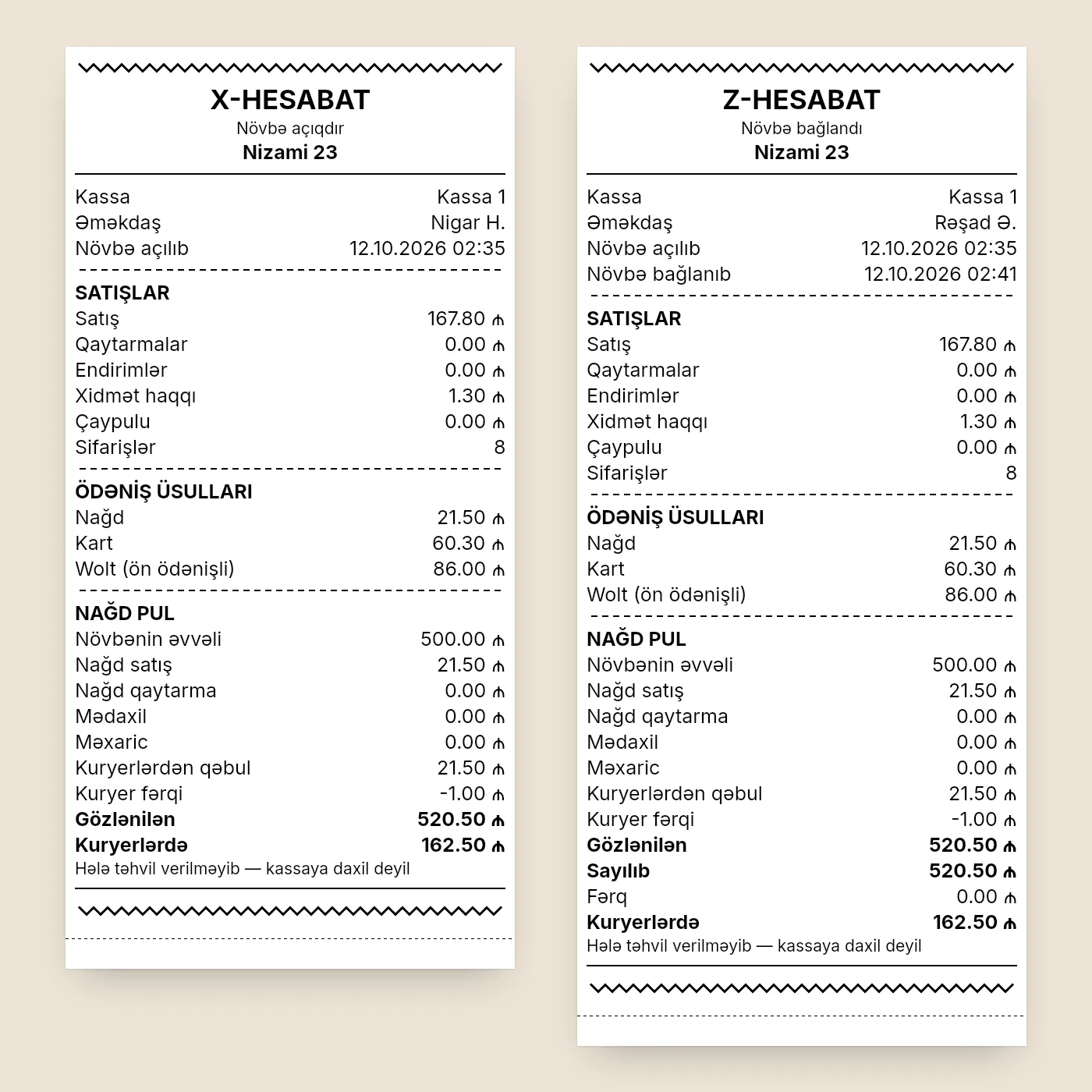
Restaurants add one more layer: the front-of-house cashier's shift report. The cashier counts the drawer, checks it against the X and Z reports and hands the cash to the senior cashier or manager, and that is when the receipt order is written. How the shift report differs from the fiscal register's Z report is explained in X and Z reports.
Cash book template in Excel
The paper book is what the Rules require, but many owners keep a spreadsheet alongside for daily control:
| A: Date | B: Doc type | C: No. | D: From / to | E: Purpose | F: In | G: Out | H: Balance |
|---|---|---|---|---|---|---|---|
| 05.11 | balance | Opening balance | 250.00 | ||||
| 05.11 | CPO | 64 | Cook R. | Bazaar advance | 150.00 | 100.00 | |
| 05.11 | CPO | 65 | Supplies | Napkins, detergent (with receipt) | 38.60 | 61.40 |
Formulas: running balance =H2+F3-G3 copied down; the day's receipts with the date in a cell such as J1 and =SUMIFS(F:F,A:A,J1), payments the same on column G; the cash count in J2 against the last balance with =J2-H9 (in the example, row 2 is the opening balance, rows 3–8 the day's six orders and row 9 the closing balance). Keep a second sheet of advance holders: who took how much and when, whether they reported, how many working days have passed, red after five.
A caveat: a spreadsheet doesn't replace the official cash book. The Rules describe a laced book filled in by pen. If you want to keep it electronically, check with your accountant whether that is acceptable for you.
Cash in a restaurant: deposits, petty cash, differences
Small expenses. Ten manat for the courier's fuel, the manager buying lavash at the bakery. Each one is a payment order and a receipt. A weekly petty-cash advance to one person who reports with receipts works better. Taking "small change" from the front-of-house till is the worst option: the shift won't balance and nobody will find out why.
Bank deposits. Set your own limit for how much cash can sit in the safe and bank the rest regularly. Example: during Ramadan, iftar brings in more cash than usual, and skipping the bank for a few days leaves a week's takings in the safe. Beyond the theft risk, a big balance hides mistakes in the book.
Differences. Don't "fix" a shift shortage in the cash book. Record the cash that is actually there, document the difference separately and investigate it. Deducting it from the cashier's wages automatically isn't allowed; deductions are only possible where the law permits.
Cash book, Z report and POS: who answers what
| Document | Shows | Kept by |
|---|---|---|
| Fiscal register (NKA) Z report | Fiscal sales reported to the tax authority | The NKA, at shift end |
| POS Z report | Shift sales, payment methods, cash and difference | Cashier at shift close |
| Cash book | All of the business's cash movements and balance | Treasurer or assigned employee |
| Profit and loss statement | The month's revenue, costs and profit | Owner, manager, accountant |
The Z report answers "what did we sell"; the cash book answers "where did the cash go".
Shifts, till expenses and X/Z in software
Dishment doesn't print the official KK-1 form and isn't a fiscal register. What it does is prepare the numbers that go into the cash book.
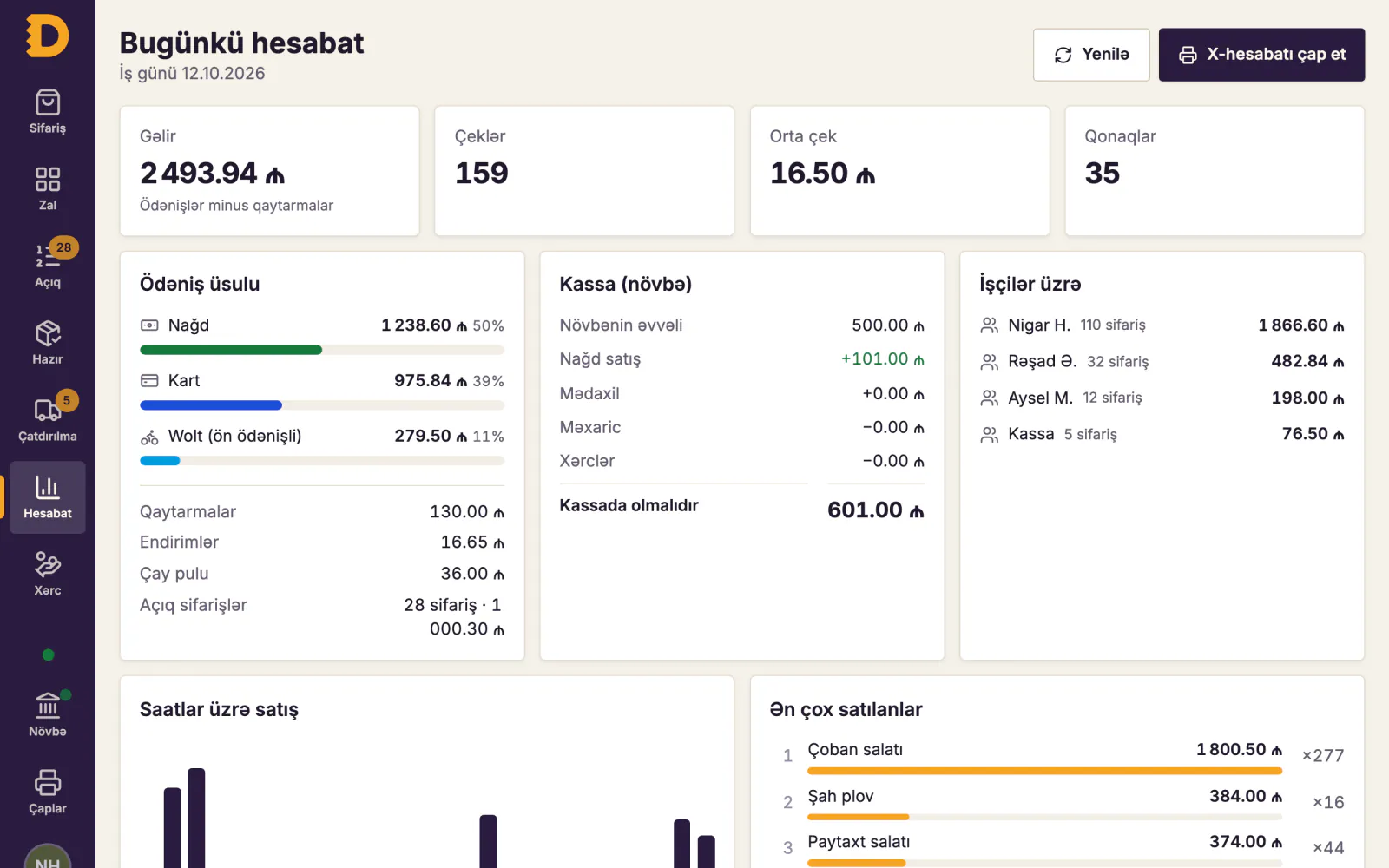
In the POS each till opens and closes its own shift, and a new shift offers the previous closing amount as its float. Cash in, cash out and till expenses are recorded at the till with a category and "paid to", and the system won't let you take out more than the drawer holds. A manager can fix a wrong expense while the shift is open or delete it with a reason, and a deleted one never just disappears. The Z report shows the opening float, cash sales, cash in, cash out, expected and counted cash and the difference side by side. Opening a shift, X, Z and cash movements are separate permissions, and each action stays in the audit log under the employee's name.
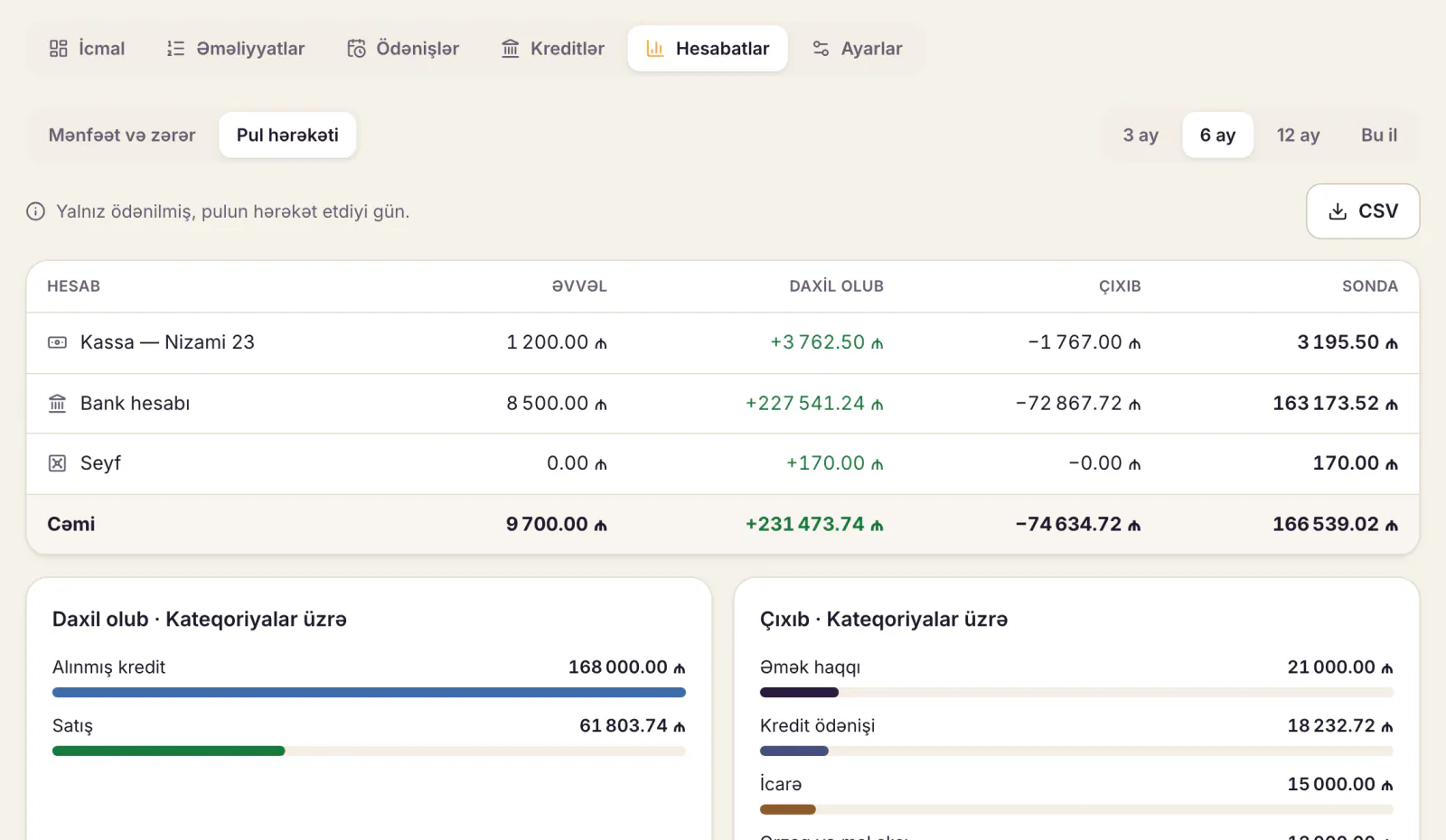
With the Finance module, balances for each venue's till, the safe, the bank and the card sit on one screen, and till takings and bank deposits come in on their own. The senior cashier doesn't add up shifts by hand in the evening. Terms are on the pricing page.
DISHMENT
Want to see this in your restaurant?
We'll show you Dishment on your own menu in 30 minutes.
Free demoCommon mistakes
- Bazaar purchases with no receipts or purchase acts.
- Filling the book once a week from memory.
- Leaving advances open for weeks.
- Crossing out entries without signatures.
- One accountant both signing documents and holding the cash.
- The owner's personal money in the café safe.
FAQ
Can a cash book be kept electronically?
The Rules describe a laced book filled in by pen, while allowing receipt and payment orders to be filled in on a computer. If you plan an electronic book, confirm it with your accountant or the tax authority.
Who signs the cash book?
The head or chief accountant signs and seals the page count. The treasurer signs the daily entries; the accountant checks them and notes how many documents were accepted.
How is a cash book different from a Z report?
A Z report shows one till shift's sales. The cash book shows all cash movements of the business: shift takings, expenses, advances, bank deposits and the balance.
Where can I get a cash book template?
The official KK-1 form is annex 3 to Cabinet of Ministers Decision No. 365. The table above shows how to fill it in.
Sources
- Rules on cash accounting and cash operations for taxpayers, approved by Cabinet of Ministers Decision No. 365 of 30 September 2020, clauses 2.6, 3.19, 4.1–4.14 and annex 3 (form KK-1): nk.gov.az