Finance· 10 min read· Dishment team
How to increase the average check in a restaurant: 10 practical ways
How to calculate the average check per bill and per guest, which one to watch, and how to raise it without discounts: tea sets, the dessert moment, combos and QR menu photos. Ten ways with AZN maths.
Two cafes stand on the same street. Each gets about 150 guests a day, yet at the end of the month one takes noticeably more money. The difference is usually not the number of guests but the average check: in one place a guest orders plov and tea and leaves, in the other the same guest also takes qutab, a dessert and a tea set with jam.
The average check is the simplest number in a restaurant and one of the most often misread. This article shows how to calculate it properly, which version to track, and how to increase the average check in a restaurant through service and menu rather than discounts: ten practical ways with examples in Azerbaijani manat. All prices are illustrative, so use the numbers from your own menu.
How to calculate the average check: per bill and per guest
There are two formulas and you need both:
- Average check per bill = revenue for the period ÷ number of checks.
- Average check per guest = revenue for the period ÷ number of guests.
An example. On Friday revenue was 4,200 ₼, 120 checks were closed and there were 310 guests. The average per bill is 4,200 ÷ 120 = 35.00 ₼ and per guest 4,200 ÷ 310 = 13.55 ₼.
Why both? Because the per-bill number is easily fooled. A table of four paying 80 ₼ on one check gives an average of 80 ₼; the same table splitting the bill four ways creates four checks and the average drops to 20 ₼, although nothing has changed. So:
- for restaurants and cafes with table service, the per-guest average is the honest number, and the waiter must enter the guest count when opening the order;
- for coffee shops, fast food and counters, per bill is fine, because one check is usually one guest.
There is a rule for comparisons too: compare Friday with Friday and lunch with lunch. Keep banquets and large corporate orders separate, or one banquet will change the picture for the whole week. Track delivery separately from the dining room as well.
Guest count and average check are different levers
Revenue = guests × average check per guest. You can grow revenue in two ways, and they cost different amounts:
| Lever | What it takes | Risk |
|---|---|---|
| More guests | Advertising, location, ratings, seating capacity | Costs money and works slowly |
| A higher average check | Menu, the waiter's suggestion, sets | Pushy selling drives guests away |
The average check works with guests who are already sitting in your dining room, so it is usually the cheaper lever. The maths is simple: 300 guests a day at 13.55 ₼ per guest come to 121,950 ₼ over a 30-day month. Just 1 ₼ more per guest is 9,000 ₼ a month, without a single extra guest.
One condition: look at margin, not only at revenue. If the average check grows by 10% while food cost grows by 15%, you earn less. Know the cost of every add-on you sell: see how to calculate food cost.
10 ways to increase the average check
1. Menu layout and the "anchor" price
Guests do not read a menu, they scan it. Put high-margin dishes where the eye lands first in each category. The most expensive dish in a category works as an anchor: next to a 32 ₼ lamb chanakh, an 18 ₼ family portion of plov looks reasonable. Do not line prices up in a column that makes it easy to hunt for the cheapest; put the price at the end of the description.
2. Sets and combos
A set makes choosing easier for the guest and lifts the check for you. Examples: "two qutab and ayran" (5.50 ₼ separately, 5.00 ₼ as a set), a business lunch of soup, a main and tea, or "cappuccino and croissant" in a coffee shop. Build the set around items that rarely sell on their own but carry a high margin: ayran, tea, salad. Keep the set discount small; the real value is convenience.
3. Modifiers and add-ons
Paid add-ons raise the check most quietly: cheese in qutab, extra lavash and sauce with lula kebab, syrup or plant milk in coffee, extra qovurma with plov. Each one needs a price, and the waiter must be able to add it in one tap. If an add-on is free, that is a decision too, but make it on purpose, not because someone forgot.
4. The tea set
For an Azerbaijani guest, tea is not the end of the meal but a ritual of its own. There is a big difference between selling a glass of tea for 1.50 ₼ and serving a pot with lemon, two kinds of jam, nabat (rock sugar) and sweets as a 12–16 ₼ set. Give the set its own menu category, add a photo and state the size (for two, for four). When the waiter asks "shall I bring the tea as a set with jam, or by the glass?" instead of "would you like tea?", the choice changes by itself.
5. The dessert moment
Dessert sells best at the moment the main plates are cleared. Miss it and the guest asks for the bill. The maths: 120 tables a day; if the share of tables taking dessert rises by 15 percentage points and a dessert averages 6 ₼, that is 18 × 6 = 108 ₼ a day, over 3,000 ₼ a month. Pakhlava, shekerbura, napoleon, and in season a dessert with pomegranate or quince: a display or a small sample plate in the waiter's hand sells better than words.
6. An autumn menu
A seasonal menu gives guests a reason to come back and you a new price point. Autumn in Azerbaijan is the season of pomegranate, quince, pumpkin and chestnuts: pomegranate juice, kebab with narsharab, salad with pomegranate seeds, pumpkin desserts, hot drinks. Put seasonal items in the most visible spot on the menu and mark them "autumn only". Write a recipe card for every new dish, or you will not know what the seasonal special costs you.
7. The waiter's words and motivation
"Anything else?" almost always gets a "no". A specific suggestion works: "Shall I bring pickles and ayran with the plov?", "We have fresh shekerbura today, would you like some with your tea?". Write one suggestion line for each dish with your team and practise it for five minutes before the shift. And remember the waiter's own interest: without a commission on sales or a monthly bonus, suggesting more is just extra work.
8. Photos in the QR menu
A dish with a photo gets chosen more often than a dish with only a name, especially by tourists: the word "dovga" tells an English-speaking guest nothing, a photo and a one-line description tell them everything. Dish photos in the QR menu, descriptions in three languages and a separate dessert category all work directly on the average check. More in QR code menus for restaurants.
9. Portion and price architecture
Two sizes of one dish widen the choice: plov for one and a family size for 3–4, a kebab platter for two and for four. A large sharing portion lifts the table's total and still looks like good value to the guest. Keep a sensible gap between prices: if the small and large differ too little, everyone takes the large; if too much, nobody does.
10. Offers for dead hours
In many cafes the room is half empty between 15:00 and 18:00. Build an offer for those hours: "tea set and dessert", "coffee and a sweet", a student set. The aim is not to cut the check with a discount but to fill empty tables and give the guest a reason to take two items. Find your dead hours from sales by hour, not by feel.
DISHMENT
Want to see this in your restaurant?
We'll show you Dishment on your own menu in 30 minutes.
Free demo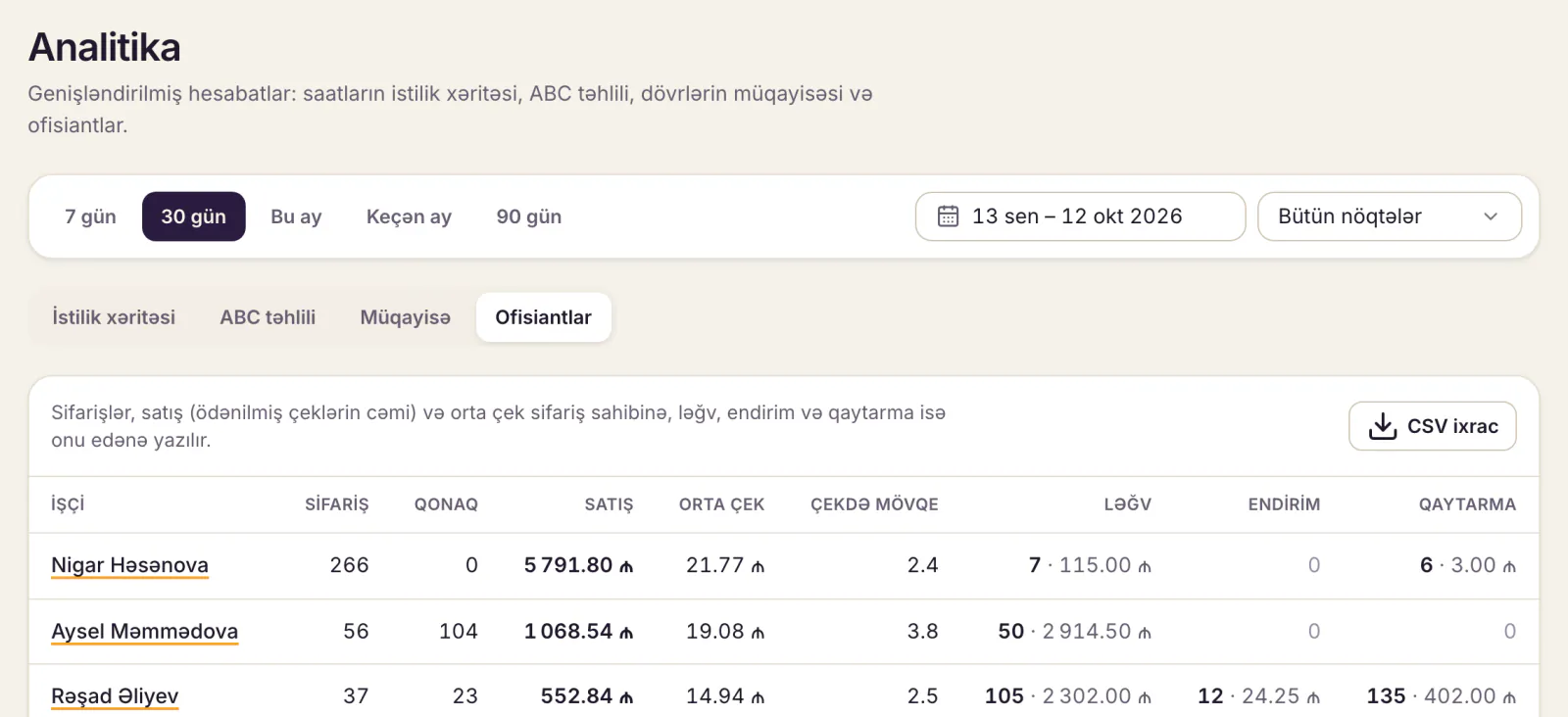
Measure every week, by waiter and by hour
The average check as one number at the end of the month is useless. Track it every week in the same table:
| Week | Checks | Guests | Revenue, ₼ | Per bill, ₼ | Per guest, ₼ | Tables with dessert | Tea sets sold |
|---|---|---|---|---|---|---|---|
| 1 | |||||||
| 2 | |||||||
| 3 | |||||||
| 4 |
Three cuts are especially useful:
- By waiter. If, in the same room and the same shift, one waiter's average check is 20% higher than another's, find out what they say and teach it to the rest of the team.
- By hour. A lower average at lunch than at dinner is normal; but if only tea sells between 15:00 and 18:00, you need an offer.
- By dish. The number of desserts and tea sets shows how healthy your average check is.
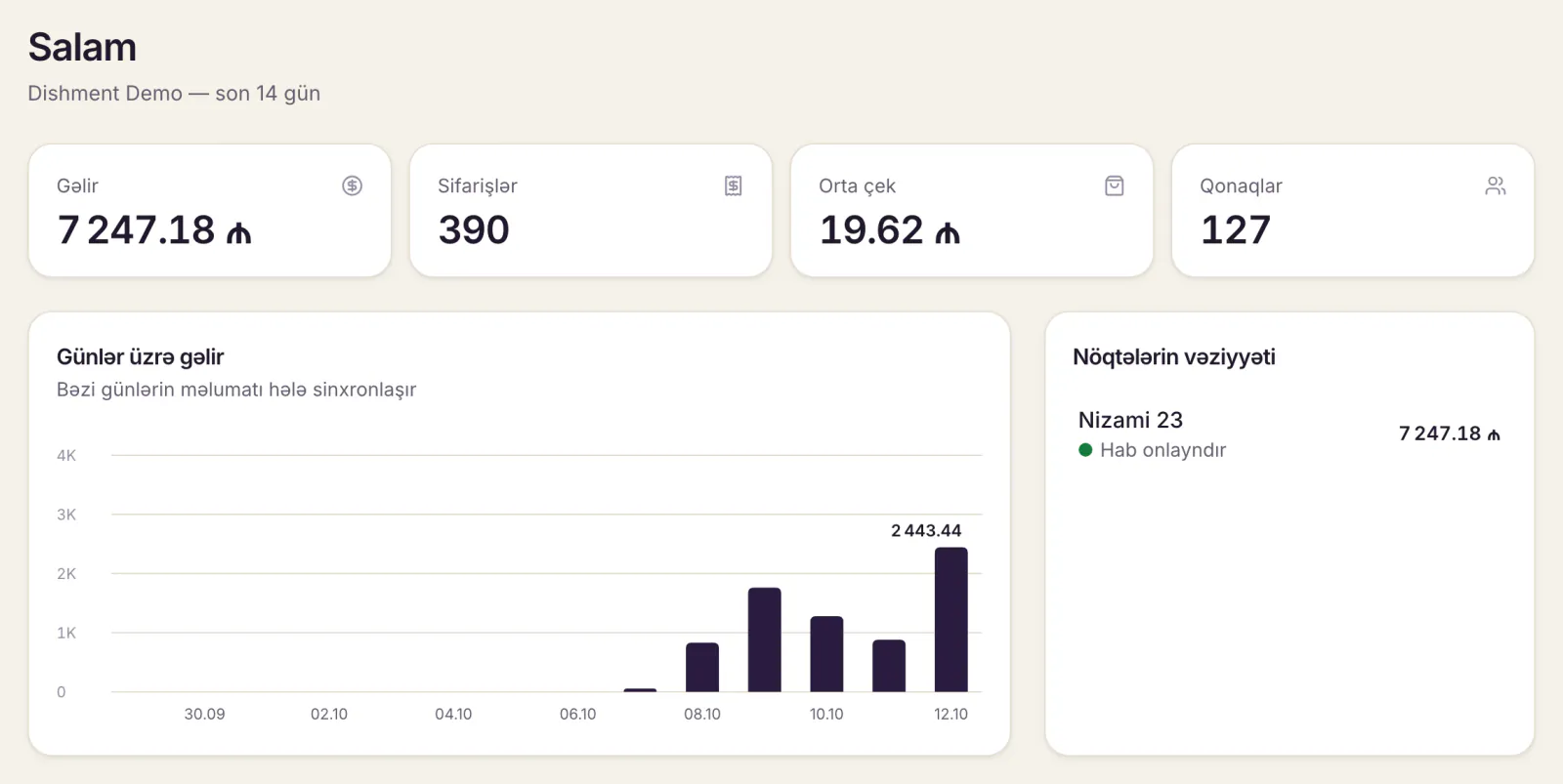
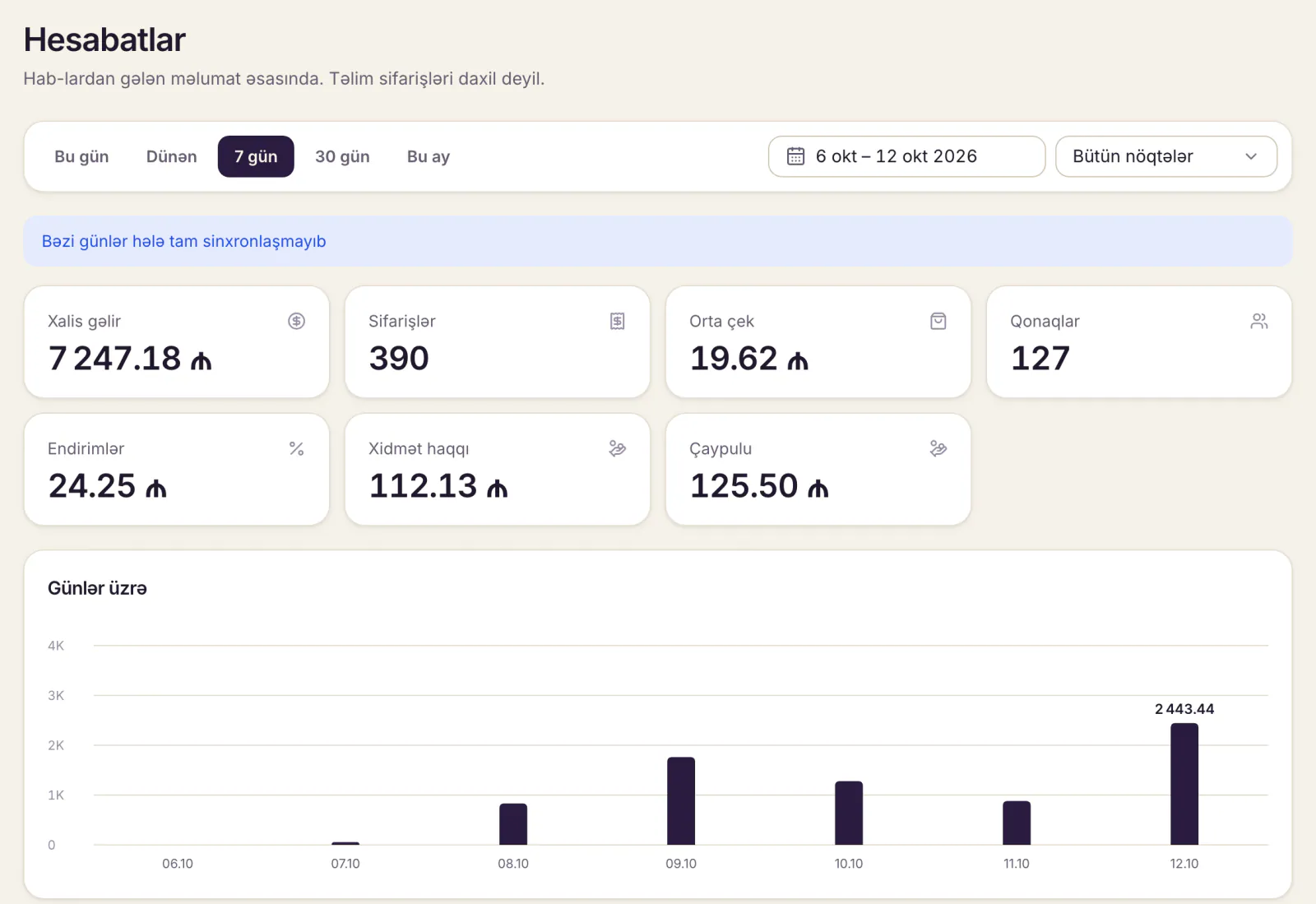
In Dishment the average check is in the reports. In the Advanced reports module, the Live section shows today's revenue, guests and average check as soon as a payment goes through, and Analytics shows each waiter's average check, an hour-by-hour heat map and a comparison of two periods. At the till, modifiers and dish notes take one tap, and the QR menu shows dishes with photos in three languages.
Common mistakes
- Pushy selling. Suggesting again after a "no" cuts not the check but the number of guests who come back. One suggestion, once.
- "Growth" through discounts. "Second coffee 50% off" may lift the average check but eats the margin. Do not run a promotion before working out what the discount does to your costs.
- Counting split checks. The per-bill average drops when bills are split, and that is not a fall in sales.
- Comparing different days. Monday against Saturday only confuses things.
- Not entering guests. If waiters skip the guest count, you cannot calculate the per-guest average.
- Raising prices and celebrating the check. A price rise lifts the average check, but watch the guest count: if it falls, the growth is an illusion.
FAQ
How do you calculate the average check?
Divide the period's revenue by the number of checks (per bill) or by the number of guests (per guest). For a restaurant with table service the per-guest figure is more honest; for coffee shops and fast food, per bill is enough.
What is a normal average check in Baku?
There are no reliable overall statistics, and the figure depends heavily on the format: a tea house, a coffee shop and a fine dining room show completely different numbers. The most useful comparison is with yourself: this month's Friday against last month's.
Do discounts increase the average check?
Sometimes, but more often they cut the margin. For promotions such as "second one at half price", work out the cost of the extra item and the size of the discount before you decide.
How do you increase the average check in a coffee shop?
What works best: a "coffee and a sweet" set, paid add-ons (syrup, plant milk, an extra shot), cup sizes, and a pastry display by the till. It is enough for the barista to make one specific suggestion with each order.
Should I track the average check every day?
Looking every day is useful, but draw conclusions weekly. A single day's figure is easily moved by the weather, a holiday or one banquet.
DISHMENT
Try it free for 30 days
We open the account and move your menu over together. No card needed.
30 days free