Technology· 14 min read· Dishment team
Wolt, Bolt Food or your own delivery? The maths for a restaurant in Azerbaijan
How restaurants join Wolt and Bolt Food in Azerbaijan, what the commission does to your margin, and when your own couriers pay off. A formula for your own contract rate, with AZN examples.
Restaurant owners usually arrive at a food delivery service in one of two ways. Either they are thinking about becoming a Wolt restaurant in Azerbaijan because "everyone is there", or they already take orders by phone and Instagram and want to run it properly. Both roads have their own maths. A platform brings guests but takes a percentage of every order; your own delivery has no percentage, but the couriers, packaging and advertising are on you.
This article works through that choice with numbers for a restaurant or cafe in Baku. We do not quote any platform's commission rate: it is agreed in each venue's contract and there is no official public tariff. Instead you get a formula and a worked example, so you can plug in the rate from your own contract and get your own answer.
Food delivery companies in Baku: who is there
The main food delivery companies and channels a restaurant in Baku can join are:
- Wolt. One of the best-known platforms in the city. The restaurant becomes a partner, lists its menu, accepts orders in a dedicated app, and delivery is usually done by the platform's couriers.
- Bolt Food. Bolt's Baku page offers food delivery, and there is a separate "Bolt Food Merchants" section for restaurants.
- Yango Food. Launched in Azerbaijan in September 2024.
- A courier service. A contract with a separate courier company: the restaurant takes the order itself and the company's courier delivers it. Fees and liability are set in the contract.
- Your own delivery. Phone, WhatsApp, Instagram, a link on your website or Google Maps, your own couriers. Many family restaurants, kebab houses and bakeries have worked this way for years.
The channels do not exclude each other. The most common picture is a mix: one or two platforms, plus the phone and your own courier for regulars.
How a restaurant can start delivery: four routes
A restaurant can start delivering food in four ways: become a platform partner, keep its own couriers, work with a courier company, or combine them. The choice depends on order volume, margin and how much the kitchen can handle at peak time.
| Route | What you need | Where the cost comes from | Who it suits |
|---|---|---|---|
| Platform (Wolt, Bolt Food and others) | A contract, menu and photos, an order app | Commission on every order | Venues looking for new guests, new openings |
| Your own couriers | Couriers, transport, order taking, advertising | Fixed: wages and transport | Venues with regulars and volume |
| A courier company | A contract; you take the orders yourself | The delivery fee in the contract | Venues that don't want to employ couriers |
| Hybrid | Costing each channel separately | Mixed | Most restaurants |
Work out which route pays for you with the formula and tables below: first the platform commission, then the real cost of your own delivery.
Joining a platform: the short version
On Wolt and Bolt Food the route is much the same: an application on the partner page, a contract, menu, photos and a bank account, after which orders arrive in the platform's restaurant app. Wolt's partner page for Azerbaijan says it charges a commission on each order with no subscription or activation fee; the exact rate is set in your contract. We will cover the sign-up itself in a separate article.
Before you apply, get three things ready: a delivery menu of dishes that survive the journey, with a good photo of each; separate containers for plov, salads and sauces; and a person who will hear the tablet in the busiest hour. If the cashier is settling three tables in the dining room at 21:00, the platform order waits five minutes, and the delay shows up in the guest's review.
Questions to ask before you sign
| Question | Why it matters |
|---|---|
| Is commission charged on the price before or after discounts? | During promotions the difference can be significant |
| Who pays for the platform's promotions? | "Free delivery" is sometimes funded by the restaurant |
| Who delivers: the platform's courier or yours? | The rate and the responsibility may differ |
| When are payouts made: weekly, every two weeks, monthly? | To plan your cash flow |
| Who loses the money on a cancelled or late order? | You need a rule for disputes |
| Can the platform price differ from the dining-room price? | A way to build the commission into the price |
| Is there an exclusivity clause? | Whether you can work with another platform |
Get the answers in writing. A sales manager's verbal promise and the contract clause can differ.
What commission does to your margin: the formula
You need four numbers:
- P: the order price on the platform;
- C: the food cost of the order, from your recipe cards;
- B: packaging;
- K: the commission rate from your contract.
What is left from the order (for rent, wages and profit) is: P − P × K − C − B.
An example (illustrative numbers). The order is plov, two lula kebabs and a shepherd's salad. The platform price is 30.00 ₼. The food cost from the recipe cards is 9.30 ₼ and packaging is 1.20 ₼, so 19.50 ₼ is left before commission. Now take K from your contract: on this order every percentage point of commission costs 0.30 ₼. At 600 orders a month, each point is 180 ₼.
If you do not know your food cost, this calculation does not work. First calculate the food cost of your dishes, then look at delivery prices.
Two views: the "extra order" and the "full cost"
You can judge a platform order in two ways, and both are right:
- As an extra order. The kitchen is running anyway and the rent is paid anyway. For a cook standing idle at 15:00, every extra order is pure gain, as long as something is left after commission, food cost and packaging.
- At full cost. As delivery grows, it has to pay its share of rent and wages too. Take the share of rent, wages and utilities in revenue (O) from your monthly report. An order covers its full cost only if K + O + (C + B) / P is less than one.
In our example (C + B) / P = 35%. Say your O is 45%. Then with commission below 20% the order covers its full cost; above that it is useful as an extra order, but you cannot build the whole business on it. That 20% is not any platform's rate, only the threshold for the restaurant in the example. With your numbers, your threshold will be different.
A table to fill in
| Line | Your number |
|---|---|
| Average order (P), ₼ | |
| Food cost (C), ₼ | |
| Packaging (B), ₼ | |
| Commission rate (K), from the contract | |
| Commission, ₼ = P × K | |
| Left from the order, ₼ = P − P × K − C − B | |
| Orders per month | |
| Commission per month, ₼ |
The real cost of your own delivery
Your own delivery looks "commission-free", but its costs are fixed: a courier is on shift even when there are no orders. The calculation includes:
- courier pay (per shift, per delivery or a mix);
- transport: fuel, scooter rental, taxi compensation;
- packaging (platforms need it too, so you can leave it out of the comparison);
- the time of whoever takes the orders;
- advertising: a platform brings guests, but you have to bring guests to your own channel yourself;
- the courier's cash, which has to be counted every evening and matched to the shift.
An example (illustrative numbers, use your own). Two couriers, each paid 25 ₼ per shift plus 1 ₼ per delivery, 26 shifts a month. Transport compensation is 400 ₼ and Instagram ads are 300 ₼. On average the guest pays a 2.50 ₼ delivery fee. Fixed costs come to 25 × 26 × 2 + 400 + 300 = 2,000 ₼ a month.
| Orders per month | Fixed cost per order | Courier, per delivery | Fee paid by the guest | Net cost per order | Share of a 30 ₼ order |
|---|---|---|---|---|---|
| 200 | 10.00 ₼ | + 1.00 ₼ | − 2.50 ₼ | 8.50 ₼ | 28% |
| 600 | 3.33 ₼ | + 1.00 ₼ | − 2.50 ₼ | 1.83 ₼ | 6% |
| 1,000 | 2.00 ₼ | + 1.00 ₼ | − 2.50 ₼ | 0.50 ₼ | 2% |
The conclusion is simple: your own delivery gets cheaper with volume. With one or two hundred orders a month, keeping two couriers is expensive; as volume grows, the cost per order can fall well below a platform commission. But who will bring that volume? If you have no answer, it may be too early to switch to your own delivery.
The hybrid model: platforms for new guests, your own channel for regulars
For many restaurants the healthiest model is a mix:
- The platform as a shop window. A guest who does not know you finds you on the platform. Treat the commission on those orders as an advertising cost.
- Regulars move to your own channel. Show guests who order a second and third time your own ordering link: the Instagram bio, Google Maps, a WhatsApp reply, a card on the table in the dining room. Before you put a card or a QR code in the bag, check whether your contract says anything about it.
- The phone is a channel too. A regular calls, the number is recognised and the address is already on file. That belongs in the till, not on a scrap of paper.
- Measure each channel separately. If you do not know how many orders, at what average check, come from each channel, you will not know which one pays.
Do not forget ordering by QR from the table either: the guest opens the menu on their phone in the dining room, and the order goes to the kitchen once the waiter confirms it. We have a separate article on this: QR code menus for restaurants.
A separate delivery menu and prices
Not every dish survives the trip. Keep the delivery menu shorter than the dining-room one:
| Travels well | With care | Better not delivered |
|---|---|---|
| Plov, side dishes | Qutab (steams under the lid, needs paper) | Fries (go soft) |
| Lula and tika kebab | Dovga and soups (tight lid) | Ice cream, soufflé |
| Dolma | Salads (dressing on the side) | Fried fish (dries out) |
| Pakhlava, shekerbura | Tea set (needs a thermos) | Cocktails |
The delivery price can differ from the dining-room price, because it includes packaging, commission and the courier. Some restaurants build sets for delivery, such as "plov, salad and ayran". A set raises the average check and makes packing simpler.
DISHMENT
Want to see this in your restaurant?
We'll show you Dishment on your own menu in 30 minutes.
Free demoHow delivery works in Dishment today, and the Wolt status
Dishment's Delivery module is built for a restaurant's own delivery and works today:
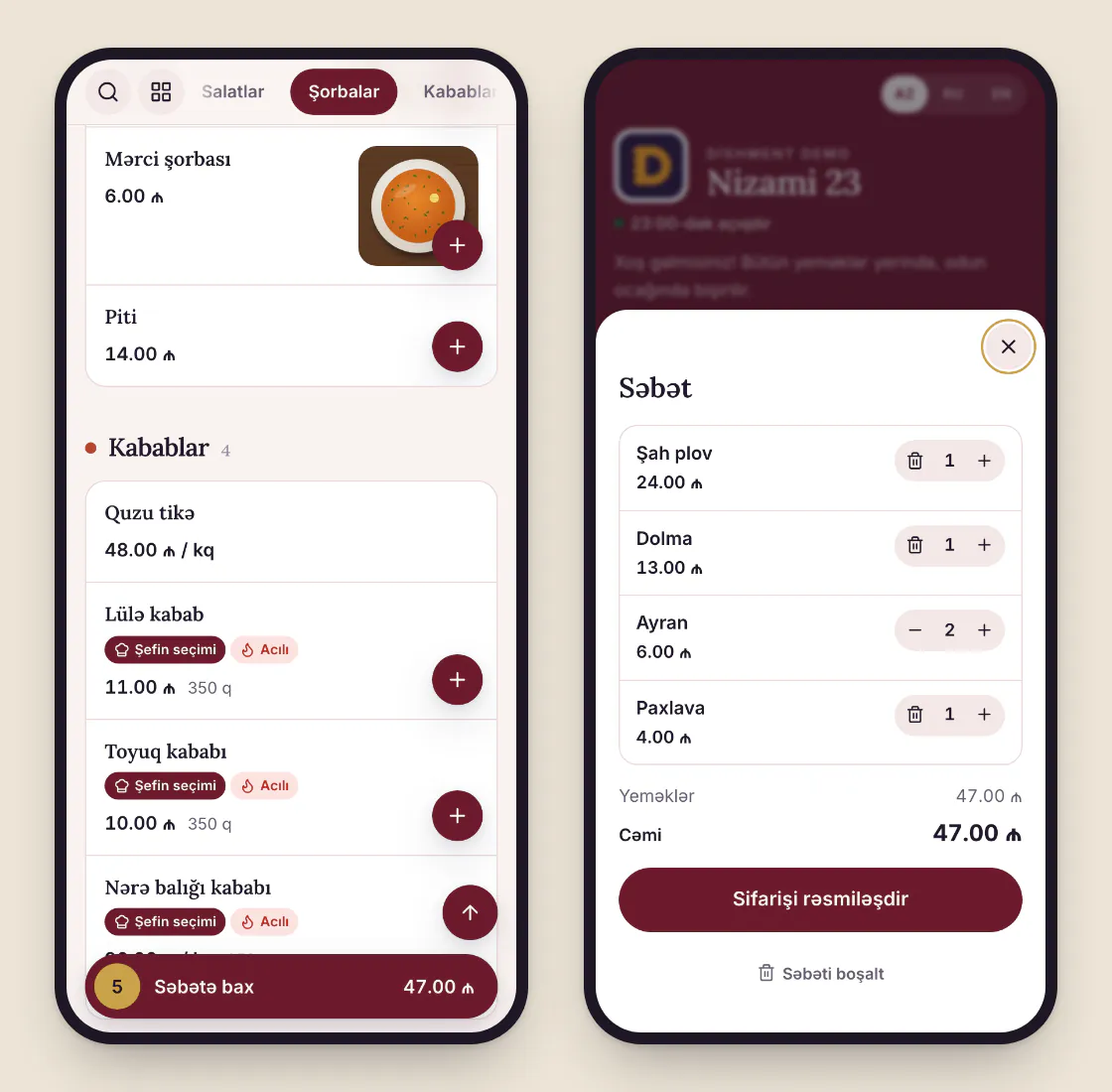
- Online ordering. The guest opens the menu from the restaurant's link, chooses delivery or pickup, and enters the address and time. The till chimes; you accept the order or decline it with a reason.
- QR ordering from the table. The guest sends an order from the code on the table, the waiter confirms it, and it lands on the table's check and in the kitchen.
- Phone orders at the till. Type the number and a regular, their addresses and past orders come up.
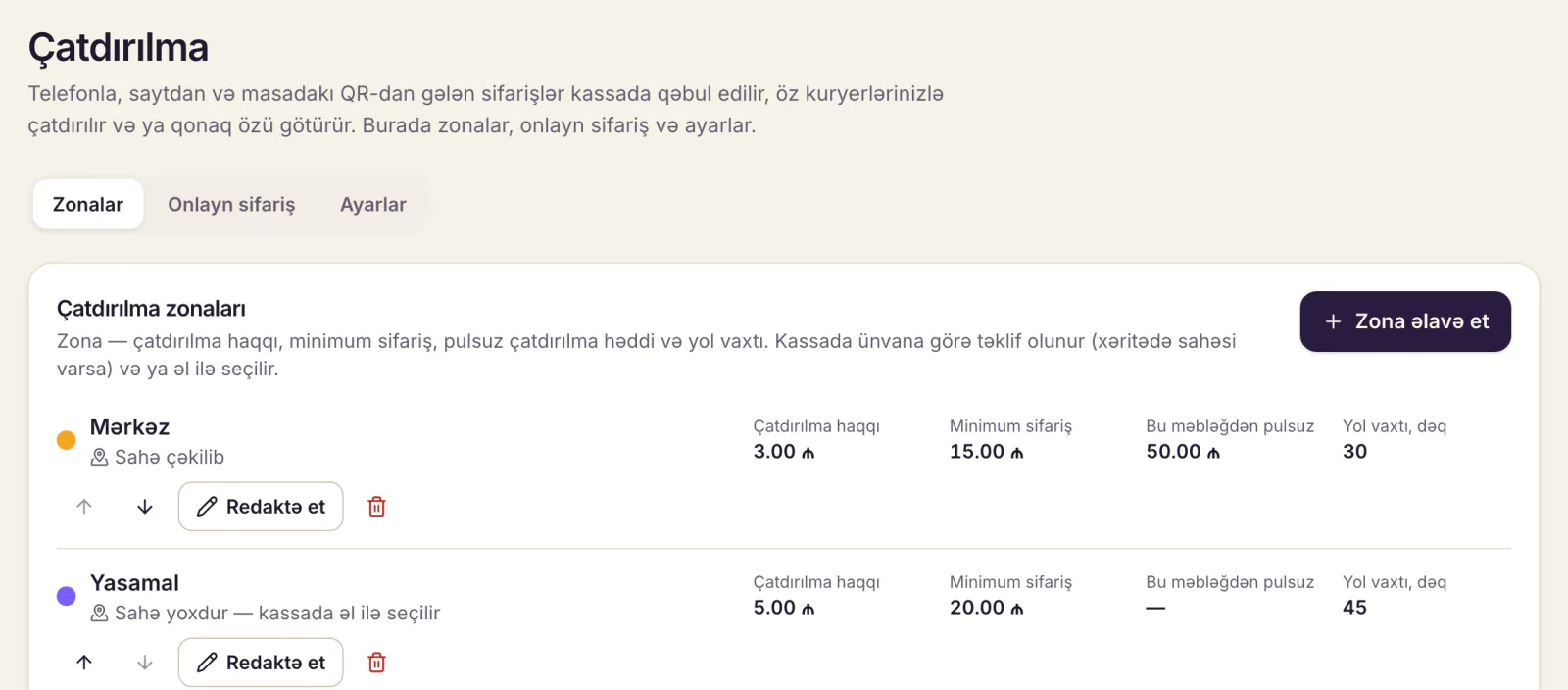
- Zones and fees. Each zone has its own delivery fee, minimum order, free-delivery threshold and travel time.
- Separate prices and menu. A dish can have its own delivery price, and some dishes can be excluded from delivery.
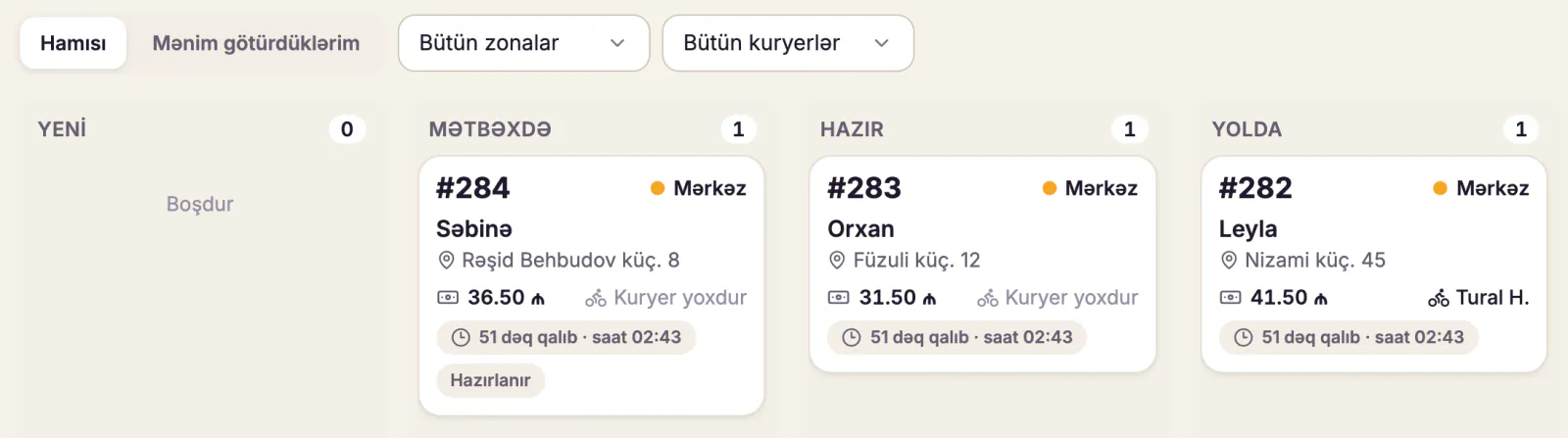
- The courier slip and the cash. The slip shows the address, phone, amount to collect, change and a QR code for the route. The courier's cash goes into the shift when it is handed in, and any shortfall shows up in loss control.
- The delivery report. Orders, fees, average time and on-time share, by courier and by zone.
For now, payment is by cash or card, to the courier or at the till; there is no online card payment. The Wolt integration is in preparation: it opens after testing with Wolt, and Wolt orders will then arrive at the same till. Bolt Food is planned after that. Until then, platform orders are accepted in the platforms' own apps.
The module is added separately; current terms are on the pricing page. To work out the total cost of a system, see our article on restaurant POS cost in Azerbaijan.
A short checklist for the decision
- I know the food cost of my 10 best-selling dishes.
- I know the commission rate in the contract and what amount it is charged on.
- The delivery menu is separate, and dishes that travel badly are removed.
- I have worked out the packaging cost per order.
- For my own delivery, courier, transport and advertising costs are written down per month.
- The courier's cash is counted and recorded every shift.
- I see the order count and average check for each channel separately.
FAQ
Can I work with Wolt, Bolt Food and my own delivery at the same time?
Usually yes, but check the contract for an exclusivity clause. With several channels the main risk is overloading the kitchen: in the peak hour you need to be able to pause orders.
How does a restaurant join a food delivery service?
With the delivery menu and food cost. Then choose packaging, decide on the channel (a platform, your own couriers or both) and record orders at the till, so that sales and stock live in one place.
Which food delivery companies operate in Baku?
The best-known platforms for restaurants are Wolt and Bolt Food, and Yango Food has operated since September 2024. There are also separate courier companies and restaurants' own couriers. The market changes, so ask each company for its current terms.
When does my own courier pay off?
When the fixed costs are spread over many orders. As the table above shows, after a few hundred orders a month the cost per order drops sharply. Without that volume, it is safer to start with a platform and move regulars to your own channel step by step.
Does Dishment accept Wolt orders?
Not yet. The Wolt integration is in preparation and opens after testing with Wolt; Bolt Food comes after it. Your own delivery, online ordering and QR ordering work today.
DISHMENT
Try it free for 30 days
We open the account and move your menu over together. No card needed.
30 days free