Guides· 10 min read· Dishment team
Recipe costing sheet: what costing is and how to fill one in
What costing means in a restaurant, how a costing sheet differs from a recipe card, how markup and food cost relate, a worked düşbərə example, a menu-wide costing table and full cost per portion.
Your accountant asks for "the costing for each dish", and your chef hands over the recipe cards. Are they the same thing? Not quite. This article explains, in plain terms and in manat, what a recipe costing sheet is, how it differs from a recipe card and how to set menu prices from it. In Azerbaijan the word you will hear is "kalkulyasiya", and the document is the "kalkulyasiya kartı".
All prices are illustrative, so use your own suppliers' figures. This isn't accounting advice: agree your accounting policy with your accountant.
What costing means
"Costing" (kalkulyasiya, from the Latin calculatio, "calculation") is working out the cost of one unit of product: what one item, one kilo or one portion costs you.
In a restaurant, costing answers two questions:
- What does a portion cost? From the weight and price of every ingredient.
- What should it sell for? By adding a markup to the cost, or by working back from a target food cost percentage.
The document holding that calculation is the recipe costing sheet (kalkulyasiya kartı). The summary for the whole menu is the costing table (kalkulyasiya cədvəli).
Recipe costing sheet vs recipe card: the difference
The two get mixed up all the time, but they do different jobs:
| Recipe card (tech card) | Recipe costing sheet | |
|---|---|---|
| Main question | How is the dish made? | What does it cost and what does it sell for? |
| Who uses it | Cooks, the chef | The owner, manager, accountant |
| What's on it | Ingredients, gross and net, method, plating, allergens | Ingredients, prices, cost, markup, selling price |
| When it changes | When the recipe changes | When the recipe or ingredient prices change |
The costing sheet is the money side of the recipe card: same ingredients, but the focus is on price and margin. A small venue can keep both in one document, but the costing part has to be revisited every time prices move. We showed how to write the recipe card itself in restaurant recipe card template.
What goes on a costing sheet
- Dish name and sheet number, date, who approved it.
- Costing unit: 1 portion, 10 portions or, traditionally, 100 portions. Costing 100 portions keeps the qəpiks from getting lost; you divide by 100 at the end.
- Ingredients: the gross quantity of each.
- Price: the purchase price of each (last invoice or average price; note which you use).
- Amount: quantity × price, line by line.
- Total ingredient cost and cost per portion.
- Markup % or target food cost.
- Selling price: the calculated one and the one on the menu (rounded).
- Yield: weight or volume of a portion.
Example: a costing sheet for düşbərə
Düşbərə are small Azerbaijani dumplings served in broth. Costing unit: 10 portions, each about 300 g with broth. Prices are illustrative.
| Ingredient | Quantity (gross), 10 portions | Price, ₼ | Amount, ₼ |
|---|---|---|---|
| Flour | 0.600 kg | 1.20 / kg | 0.72 |
| Eggs | 2 | 0.25 each | 0.50 |
| Lamb (for mince) | 0.800 kg | 16.00 / kg | 12.80 |
| Onion | 0.200 kg | 1.20 / kg | 0.24 |
| Bones (for broth) | 1.000 kg | 3.00 / kg | 3.00 |
| Dried mint, vinegar, garlic, salt, pepper | 1 set | 0.60 / set | 0.60 |
| Total ingredients, 10 portions | 17.86 |
- Cost per portion: 17.86 ÷ 10 = 1.79 ₼.
- Markup 200%: 1.79 × (1 + 2.00) = 5.36 ₼.
- Menu price (rounded): 5.50 ₼.
- Actual food cost: 1.79 ÷ 5.50 = 32.5%, margin per portion 3.71 ₼.
Notice that meat is 72% of the pot's cost (12.80 ÷ 17.86). If lamb goes from 16 ₼ to 18 ₼, the total becomes 19.46 ₼, the portion 1.95 ₼, and at the same 5.50 ₼ price food cost rises to 35.4%. That's why costing is redone on the day the meat price changes.
A blank costing sheet to copy
At the top, write the dish name, sheet number, date, costing unit (say, 10 portions) and portion yield. Then the ingredients:
| Ingredient | Quantity (gross) | Unit | Price, ₼ | Amount, ₼ |
|---|---|---|---|---|
| Total ingredients |
Below the table, four lines: cost per portion (total ÷ number of portions), markup %, calculated selling price and menu price. At the bottom, who costed it and who approved it. Also note which invoice and date the prices come from: when you review the sheet a month later, that will be the first question.
Markup vs food cost: don't confuse them
There are two ways to set a price from a costing sheet, and mixing them up is the most common mistake:
- Markup is based on cost: selling price = cost × (1 + markup).
- Food cost is based on the selling price: food cost = cost ÷ selling price.
They are linked like this: food cost = 1 ÷ (1 + markup).
| Markup | Food cost | Margin as a share of price |
|---|---|---|
| 100% | 50.0% | 50.0% |
| 150% | 40.0% | 60.0% |
| 200% | 33.3% | 66.7% |
| 233% | 30.0% | 70.0% |
| 300% | 25.0% | 75.0% |
A "30% markup" and a "30% food cost" are completely different things. With the first, a düşbərə costing 1.79 ₼ would sell for 2.33 ₼ and the kitchen would lose money; with the second, it sells for 5.97 ₼.
The costing table: the whole menu on one sheet
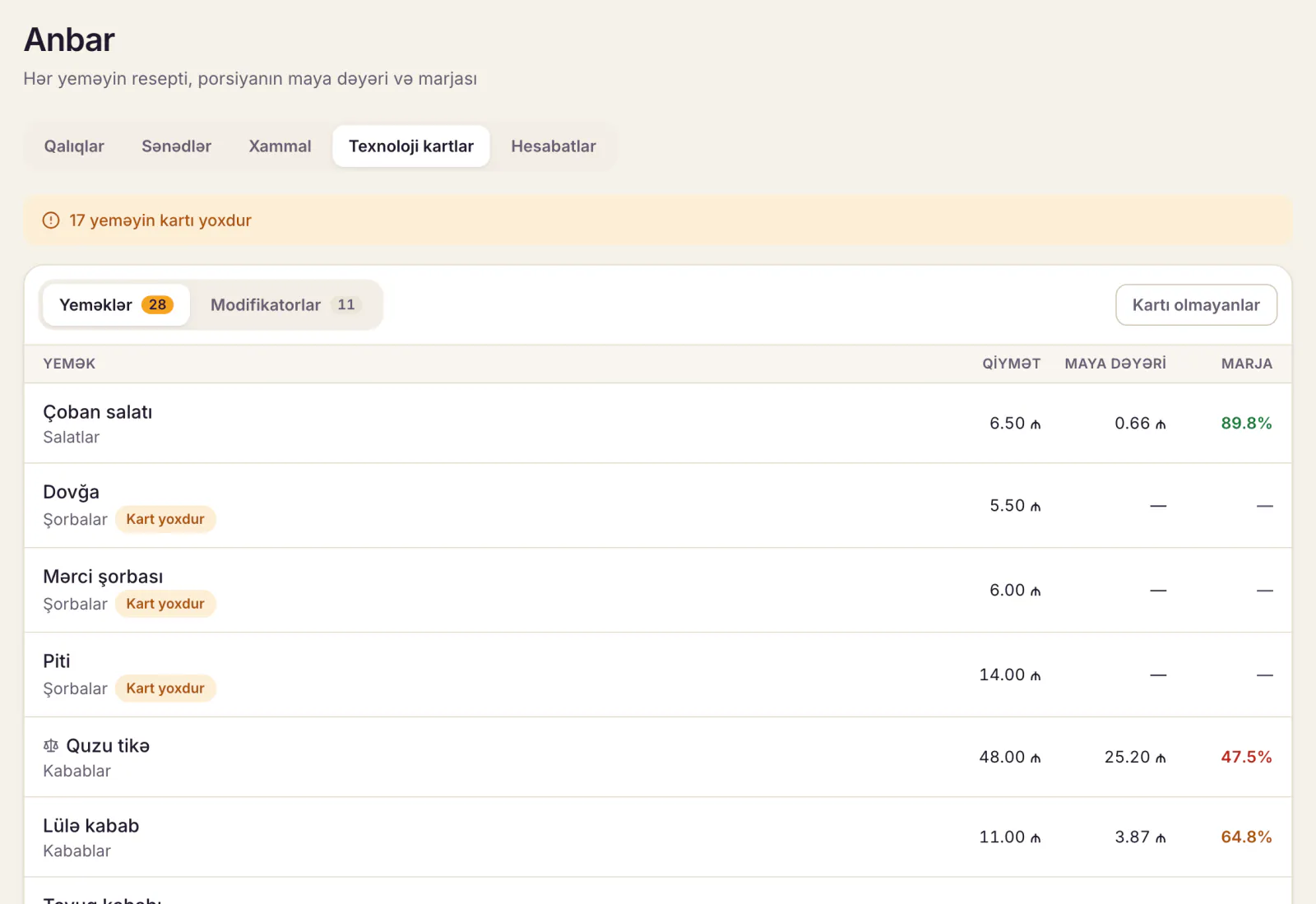
A costing table pulls the totals from every dish's sheet into one place. One look shows which prices need revisiting:
| Dish | Cost, ₼ | Markup | Calculated price, ₼ | Menu price, ₼ | Actual food cost |
|---|---|---|---|---|---|
| Düşbərə | 1.79 | 200% | 5.36 | 5.50 | 32.5% |
| Herb qutab | 1.46 | 230% | 4.82 | 5.00 | 29.2% |
| Lentil soup | 0.66 | 500% | 3.96 | 4.50 | 14.7% |
| Tea set | 2.40 | 300% | 9.60 | 12.00 | 20.0% |
| Lula kebab | 5.07 | 180% | 14.20 | 14.00 | 36.2% |
The markup doesn't have to be the same across the menu. Soup and tea are made from cheap ingredients and guests judge them by value, so the markup is high. Kebab ingredients are expensive and guests know what the restaurants nearby charge, so the markup is lower. The kebab even sells below its calculated price: that can be a deliberate choice, but the table should make it visible.
We published a ready-made Excel template with formulas separately: food cost calculator Excel template.
DISHMENT
Want to see this in your restaurant?
We'll show you Dishment on your own menu in 30 minutes.
Free demoTypes of costing
- Planned (preliminary) costing. Before a new dish goes on the menu, to check the price makes sense in the market.
- Standard costing. Using approved quantities and current prices. A restaurant's everyday costing sheet is usually this.
- Actual costing. At the end of a period, using real usage and real purchase prices. The gap between standard and actual shows your losses: over-portioning, spoiled stock, unrecorded write-offs.
From ingredient cost to full cost
In food service, a costing sheet usually covers ingredients only. Wages, rent, gas and electricity are paid out of the markup. That's convenient, but it hides how much weight the markup is carrying.
Sometimes it helps to work out a dish's full cost, especially when it involves a lot of hand work. An illustrative example for düşbərə:
| Item | Per portion, ₼ |
|---|---|
| Ingredients (from the costing sheet) | 1.79 |
| Labour: 1.5 hours to fold 10 portions, a cook at 5 ₼ an hour | 0.75 |
| Share of gas, electricity, dishwashing | 0.20 |
| Full cost | 2.74 |
At 5.50 ₼, the margin over ingredients looks like 3.71 ₼; after full cost, 2.76 ₼ is left. A dish at the same price that takes a minute to make doesn't carry that labour. Look at hand-made dishes (düşbərə, dolma, qutab, şəkərbura) through this lens too. For the venue's overall profit: restaurant profit margin.
When to update the costing
- when a supplier's price changes, especially for expensive items like meat, butter or saffron;
- when you change supplier (the loss percentage may change too);
- when the recipe or portion size changes;
- when the season changes (tomatoes, herbs, fruit);
- at least once a month, even if nothing seems to have changed.
Common costing mistakes
- Multiplying net weight by price. You pay for gross weight. A sheet costed on trimmed weight understates the cost, and the stockroom comes up short.
- Forgetting what's served on the side. The vinegar and garlic with düşbərə, the lavash with kebab, the lemon with tea all belong on the sheet.
- Old prices. The costing was done once, while invoice prices change every week.
- Confusing markup with margin. When someone says "we make 30%", ask which one they mean.
- One markup for the whole menu. Price cheap and expensive dishes by the same rule and some end up above the market, others below it.
- No costing for prep items. Without separate sheets for the broth and the dough, the cost of düşbərə stays a guess.
Costing in software: cost that updates itself
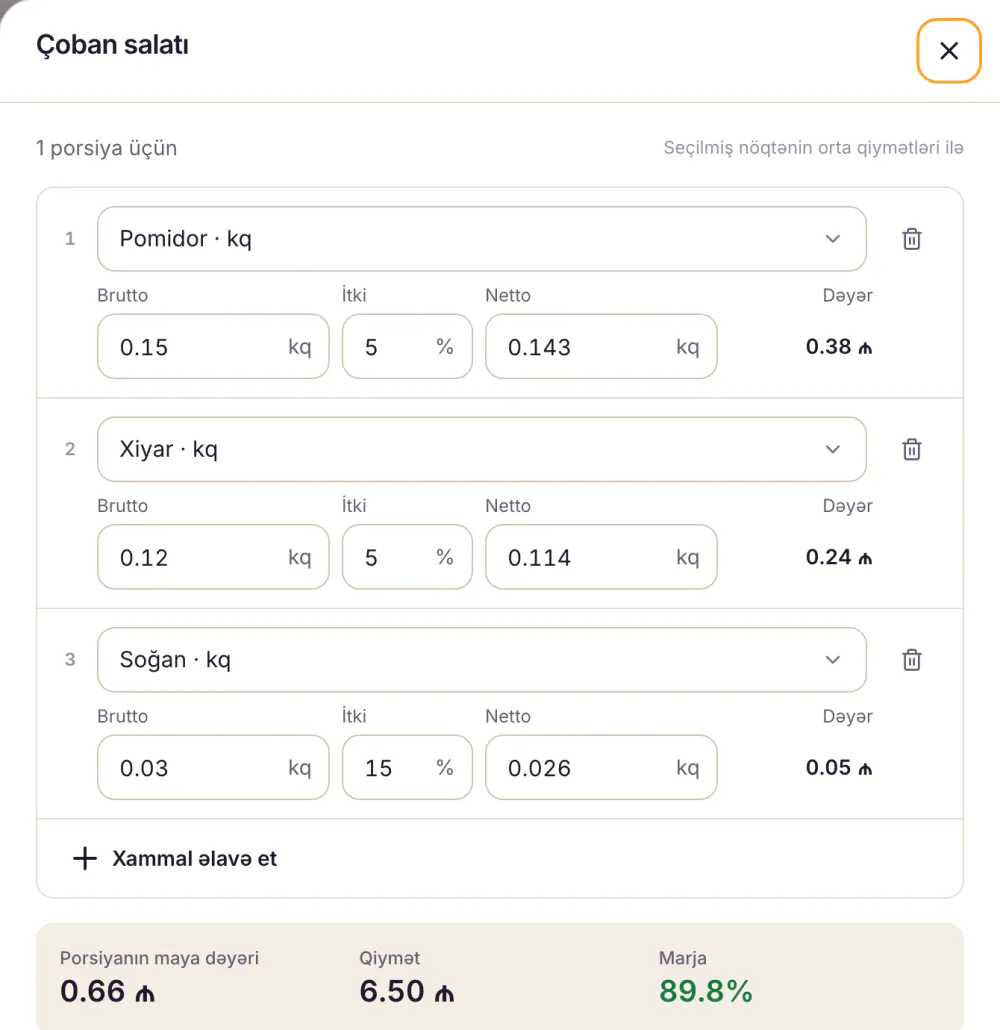
The weak spot of paper and spreadsheet costing is prices: the invoice price changes and the sheet stays the same. In Dishment's Inventory and recipes module you write the recipe card once with gross, loss % and net, and the cost is worked out automatically from the average purchase price of the stock. When a new invoice is entered, the cost and margin of every dish update. Every dish sold deducts its ingredients from stock, and the stock count shows the difference between book and actual stock in manat. Prep items (dough, broth, sauces) get their own cards too.
FAQ
What is a recipe costing sheet, in short?
A document that works out what one portion costs and what it sells for: ingredients, quantities, prices, total ingredient cost, markup and menu price.
How is a costing sheet different from a recipe card?
A recipe card tells you how to make the dish. A costing sheet tells you what it costs and what it sells for. The ingredients may be the same; the purpose is different.
How do I fill in a costing sheet?
Multiply each ingredient's gross quantity by its price, add them up and divide by the number of portions to get the cost. Then multiply by (1 + markup), or divide by your target food cost, and round the price.
What markup should I use?
There's no single number: it depends on the dish category, competitors' prices and the hand work involved. Choose a target food cost (say 30–35%) and work the markup out from it: markup = 1 ÷ food cost − 1.
Is there a mandatory costing sheet form in Azerbaijan?
We didn't find a single mandatory form for restaurants in the official sources we checked. Agree the form and its fields with your accountant.
Information as of October 2026; this is not accounting or tax advice.
DISHMENT
Try it free for 30 days
We open the account and move your menu over together. No card needed.
30 days free