Finance· 12 min read· Dishment team
Restaurant profit margin: how to calculate it, with a Baku cafe example in AZN
Restaurant profit margin in plain words: revenue, food cost, prime cost and net profit, a monthly P&L for a 40-seat Baku cafe in AZN, the tax line, break-even and payback.
The till is full every night, yet at the end of the month the money you expected isn't in the account. It's the most common complaint from restaurant owners, and the reason is usually simple: revenue is visible, profit isn't calculated. This guide works through restaurant profit margin step by step: the terms, the formulas and a monthly profit and loss statement (P&L) for a 40-seat cafe in Baku.
All figures are examples, not industry "norms". Plug in your own: a P&L is useful when it shows your venue.
Key terms: from revenue to net profit
- Revenue (turnover): money from sales in the period, cash and card.
- Cost of goods sold (COGS): the ingredients that went into the dishes and drinks sold. How to work it out is in our food cost guide.
- Gross profit: revenue − COGS.
- Prime cost: COGS + payroll (with every cost the employer pays). These are a restaurant's two biggest and most controllable costs.
- Operating profit: gross profit − payroll − rent, utilities and other operating costs.
- Net profit: operating profit − tax − loan interest. What is left for the owner.
What net profit is and how to calculate it
Net profit is the money the owner keeps after every cost, the tax and the loan interest. You work it out in order: from revenue, take away the cost of food and drink first, then wages, rent, utilities and other operating costs, and finally the tax and interest. Divide net profit by revenue and you have the net profit margin.
One month for the 40-seat cafe from the example below:
| Line | ₼ |
|---|---|
| Revenue | 54,000 |
| − cost of food and drink | 17,820 |
| − payroll | 13,500 |
| − rent, utilities and other operating costs | 12,136 |
| − simplified tax | 3,672 |
| − loan interest | 350 |
| = Net profit | 6,522 |
The net profit margin is 6,522 ÷ 54,000 = 12.1%. That money is not in anyone's pocket yet: the owner can take part of it and keep the rest for a summer terrace, a new fridge or a second site. That split is the distribution of net profit, and what stays in the business is what accountants call retained earnings.
Restaurant profit margin: the formulas
Net profit margin, % = net profit ÷ revenue × 100
This answers the question "how many manat do I keep from every 100 manat of sales".
Gross margin, % = (revenue − COGS) ÷ revenue × 100
Prime cost, % = (COGS + payroll) ÷ revenue × 100
Return on investment, % = annual net profit ÷ amount invested × 100
Payback period, months = amount invested ÷ monthly net profit
One important rule: calculate profit by the month, not by the day. Rent, wages and tax are monthly. A busy Thursday doesn't make a profitable month.
Example: a monthly P&L for a 40-seat cafe in Baku
The cafe sells 54,000 ₼ a month: about 1,800 ₼ a day, or roughly 100 guests at an average of 18 ₼ per guest. 60% of payments are by card. The cafe pays the 8% simplified tax and takes cards through a POS terminal integrated with its fiscal cash register (NKA). All amounts are examples.
| Line | Per month, ₼ | Share of revenue |
|---|---|---|
| Revenue | 54,000 | 100% |
| of which cash | 21,600 | 40% |
| of which card | 32,400 | 60% |
| Food and drink cost (COGS) | 17,820 | 33.0% |
| Gross profit | 36,180 | 67.0% |
| Payroll (with employer costs) | 13,500 | 25.0% |
| Prime cost (COGS + labour) | 31,320 | 58.0% |
| Rent | 6,000 | 11.1% |
| Utilities: electricity, gas, water | 2,400 | 4.4% |
| Bank fee on card payments (1.5% in this example) | 486 | 0.9% |
| Marketing | 900 | 1.7% |
| Software, NKA service, internet | 450 | 0.8% |
| Repairs, cleaning, packaging, supplies | 1,100 | 2.0% |
| Other | 800 | 1.5% |
| Operating profit | 10,544 | 19.5% |
| Simplified tax: 8% × 21,600 + 6% × 32,400 | 3,672 | 6.8% |
| Interest on the equipment loan | 350 | 0.6% |
| Net profit | 6,522 | 12.1% |
This cafe's net profit margin is 12.1%: the owner keeps about 12 ₼ from every 100 ₼ of sales.
The tax line under different regimes
The tax line depends on the tax regime. We cover the changes in force since the start of 2026 in our guide to restaurant taxes in Azerbaijan. In short, for this example:
| Regime | Tax per month | Net profit |
|---|---|---|
| 8% simplified tax, cards through a POS terminal integrated with the NKA | 3,672 ₼ | 6,522 ₼ (12.1%) |
| 8% simplified tax on all turnover (integration condition not met) | 4,320 ₼ | 5,874 ₼ (10.9%) |
| VAT payer | work it out with your accountant | — |
The difference is 648 ₼ a month, or 7,776 ₼ a year. According to the State Tax Service, from 1 January 2026, for 3 years, catering turnover from cashless payments for services to the public made through a POS terminal is taxed at 6% under the simplified tax, provided the POS terminal is integrated with the NKA in a single operating system.
For a VAT payer the maths is different: VAT is 18%, from 2026 half of the cashless turnover through a POS terminal integrated with the NKA is deducted from taxable turnover, input VAT on purchases is taken into account, and profit tax (income tax for a sole trader) comes on top. Build that line with your accountant.
Smaller venues can also move to a 2% rate. The conditions: turnover over the previous full 12 months of no more than 100,000 ₼ (cashless POS turnover counted with a 0.5 coefficient), at least a year in the current regime, and an application to the tax authority. A cafe selling 54,000 ₼ a month is far above that line.
DISHMENT
Want to see this in your restaurant?
We'll show you Dishment on your own menu in 30 minutes.
Free demoBreak-even: how much you need to sell each month
Split costs into two groups:
- Fixed costs are paid whatever you sell: payroll, rent, utilities, marketing, software, repairs, other and loan interest. In the example, 25,500 ₼ in total.
- Variable costs grow with sales: COGS (33%), the bank fee (0.9%) and the turnover tax (6.8%). In total 40.7% of revenue.
Break-even revenue = fixed costs ÷ (1 − variable cost share)
25,500 ÷ (1 − 0.407) ≈ 43,000 ₼ a month, or about 1,430 ₼ a day. At an 18 ₼ average check that is roughly 80 guests a day. Below that line the month closes at a loss; above it, every extra 100 ₼ of sales brings about 59 ₼ of profit.
In reality part of the utilities and payroll also moves with sales, so this is a rough calculation. But it's enough to answer "did we hit plan today?"
Payback period
Say opening the cafe cost 120,000 ₼: renovation, kitchen equipment, furniture, the rent deposit, the first stock and the launch. We cover opening budgets in our guide to opening a restaurant in Baku.
- Simple maths: 120,000 ÷ 6,522 ≈ 18.4 months.
- A realistic scenario: for the first 3 months the cafe builds its guest base and profit is close to zero; in months 4–6 about 3,500 ₼ a month is left; after that 6,522 ₼. The investment then comes back in about month 23.
Annual return on investment: 6,522 × 12 ÷ 120,000 ≈ 65%. It looks attractive, but it only describes the steady months. Always plan with the realistic scenario and keep a cash reserve.
Seven profit levers
| Lever | Effect in the example |
|---|---|
| 1. Cut food cost by 2 points (33% → 31%): portion control, supplier prices, write-offs | +1,080 ₼ a month |
| 2. Fix the menu with numbers: price for plowhorses, visibility for puzzles | depends on the menu |
| 3. Raise the average check by 1 ₼ (3,000 guests a month) | revenue +3,000 ₼, profit ≈ +1,780 ₼ |
| 4. Match the rota to sales: no extra shifts in quiet hours | e.g. +600 ₼ a month |
| 5. Review fixed costs: rent, utilities, subscriptions | depends on contracts |
| 6. Cut losses: voids, discounts, cash shortages, stock that "evaporates" | depends on hidden losses |
| 7. Tax regime and payment method: every 10,000 ₼ of card payments through a POS terminal integrated with the NKA is taxed at 6% instead of 8% | +200 ₼ |
The strongest levers are usually the first three: food cost, the menu and the average check. For the menu, see our guide to restaurant menu engineering; for the check, how to increase the average check.
Profit and cash are not the same thing
You can show a profit on paper and still have no money in the account. Why:
- Loan principal doesn't appear in the P&L (only the interest does), but it leaves the account every month.
- Buying ahead: before a holiday you bought a lot of stock; the cash is gone, but the cost only appears when it sells.
- Money the owner takes out is a distribution of profit, not a cost.
- Equipment wear: the fridge or the coffee machine will need replacing one day. Setting money aside monthly is wise.
So track cash flow alongside the P&L.
Common mistakes when calculating profitability
- Treating revenue as profit. "We did 2,000 ₼ today" means little on its own: food, wages, rent and tax still come out of it.
- Using purchases instead of cost of goods sold. Stock left on the shelf at month end isn't this month's cost. Work out COGS from recipe cards or with "opening stock + purchases − closing stock".
- Forgetting the owner's and family's work. A relative working for free inflates profit on paper. What would you pay an employee in their place?
- Forgetting annual and seasonal costs. Air-conditioning repairs, annual subscriptions, Novruz and New Year decorations. Divide them by 12 and charge each month.
- Leaving tax "for later". The simplified tax is charged on turnover and is due even when the month closes at a loss. Plan it as a variable cost.
- Judging by a single month. A holiday month, Ramadan or the summer season changes the numbers. Look at an average of at least 3 months and at the same month last year.
From Excel to an automatic P&L
You can keep a P&L in Excel. The problem is that every month someone has to gather till sales, supplier invoices, payroll and expenses by hand, and at best that happens a week or two after the month ends.
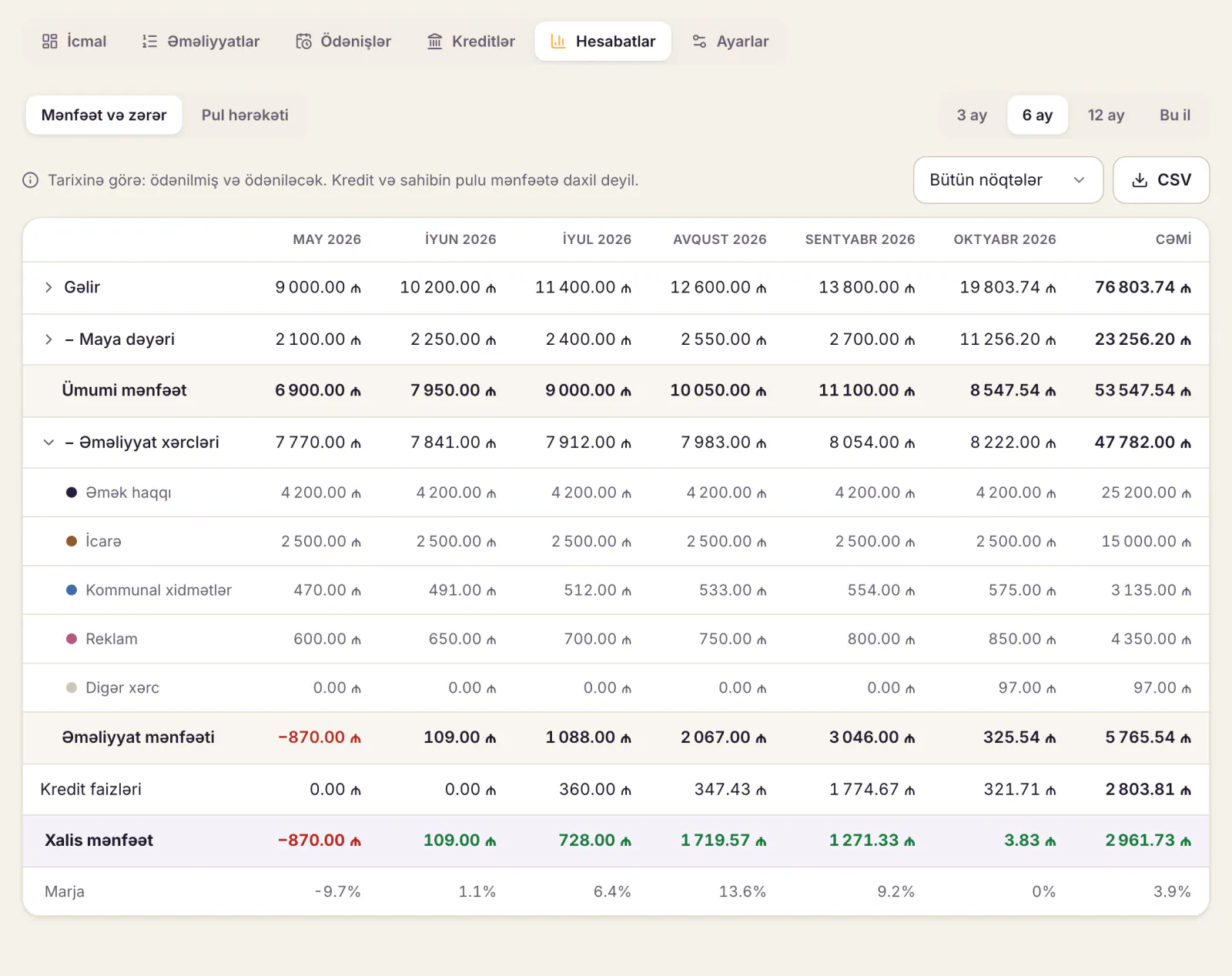
In Dishment's Finance module, till sales come in as income by themselves when the day closes. With the Inventory and Staff & payroll modules on, stock receipts and payroll land under To pay automatically. Recurring payments such as rent, internet and utilities appear each month on their own, and loan schedules and interest are worked out for you. You record only the remaining expenses. The P&L shows gross, operating and net profit by month and by venue, there is a cash flow view, and everything exports to CSV.
The Inventory module shows the cost and margin of every dish, and its cost of goods sold report shows gross profit by dish. Finance is management accounting: it doesn't replace official bookkeeping or tax reporting.
FAQ
How do I calculate restaurant profit margin, in short?
Divide net profit by revenue and multiply by 100. If 54,000 ₼ of sales leaves 6,522 ₼ of net profit, the margin is 12.1%.
What is a normal profit margin for a restaurant?
There is no single official "norm". The figure depends heavily on format, rent, tax regime and whether you own the premises. Track your own number month by month and compare it with your business plan.
How much does a cafe in Baku make a month?
It depends on each venue's revenue and costs. In our example a 40-seat cafe with 54,000 ₼ of revenue leaves the owner about 6,500 ₼ a month, but that is an illustration, not a market average.
What is the difference between net profit and gross profit?
Gross profit is revenue minus only the cost of food and drink. Net profit is what remains after wages, rent, utilities, tax and interest are taken off as well. In the example cafe, gross profit is 36,180 ₼ and net profit is 6,522 ₼.
What is prime cost?
The sum of food cost and payroll. They are a restaurant's two biggest costs, so tracking them monthly as a share of revenue is worthwhile.
Is Excel enough for a P&L?
To start with, yes. But when sales, invoices and payroll are gathered by hand, the report runs late. An automatic P&L shows where you stand mid-month too.
DISHMENT
Try it free for 30 days
We open the account and move your menu over together. No card needed.
30 days free