Management· 9 min read· Dishment team
Employee time sheet: what a tabel is, a restaurant example and an Excel template
What a time sheet (tabel) is under Azerbaijani labour law, which codes to use, a month for 8 restaurant staff, an Excel layout with formulas, employee numbers, late arrivals, overtime and night hours.
Free Excel templateTime sheetThe article’s tables and formulas, ready to use — opens in Excel and Google Sheets.Download (.xlsx)End of the month. The cook says he worked sixteen shifts; the manager's notebook says fifteen. A waiter doesn't remember leaving early twice. The bartender asks whether his night hours were counted. Every one of these conversations comes back to one document, the employee time sheet, known in Azerbaijan as the tabel. Here is what it is, how to keep one in a restaurant and how to get from it to payroll, with a worked example in manat.
The labour law points come from Azerbaijan's current Labour Code, linked at the end.
What a time sheet is
A time sheet records how many hours each employee worked on each day of the month and why they were absent on the days they weren't there. Rows are people, columns are days, cells hold hours or a code. The monthly totals are the basis for pay.
It isn't optional paperwork. Article 102 of the Labour Code requires the employer to keep an accurate, truthful record of each employee's actual working time and overtime hours. The same article leaves the form and procedure to the employer. There is no mandatory national template; you choose the format, but the record has to be accurate.
Why restaurants find it harder than offices
In an office everyone works nine to six. In a restaurant the cook is on 2-on/2-off twelve-hour shifts, a waiter doubles up at the weekend, the bartender works 16:00 to 01:00. Before Novruz and New Year banquets keep everyone late; during Ramadan shifts move around iftar. You can't reconstruct that from memory at month end. It needs a daily record.
Codes to use
| Code | Meaning |
|---|---|
| 8, 11, 12 | Hours worked, breaks deducted |
| O | Scheduled day off |
| L | Annual leave |
| U | Unpaid leave |
| S | Sick leave (with a medical certificate) |
| A | Absent without good reason |
| H | Work on a public holiday or rest day (hours in a separate column) |
Keep night hours and overtime in separate columns because they are paid differently, and write the key at the bottom of the sheet.
Example: one month, 8 staff
Example: a 60-seat restaurant in Gənclik with eight staff. The first week of the month looks like this (hours net of breaks):
| No. | Role | Mon | Tue | Wed | Thu | Fri | Sat | Sun |
|---|---|---|---|---|---|---|---|---|
| 001 | Cook, 2/2 | 11 | 11 | O | O | 11 | 11 | O |
| 002 | Cook, 2/2 | O | O | 11 | 11 | O | O | 11 |
| 003 | Kitchen assistant | 8 | 8 | 8 | 8 | 8 | O | O |
| 004 | Waiter | 8 | O | 8 | 8 | 8 | 10 | O |
| 005 | Waiter | O | 8 | 8 | S | S | 10 | 8 |
| 006 | Bartender | 8 | 8 | O | 8 | 8 | 8 | O |
| 007 | Cashier | 8 | 8 | 8 | 8 | O | O | 8 |
| 008 | Dishwasher | 8 | 8 | 8 | O | A | 8 | 8 |
At month end each person gets a totals line (illustrative; monthly norm, say, 168 hours):
| No. | Role | Hours worked | Norm | Over norm | Night hours (22:00–06:00) | Late arrivals | L / S / U / A, days |
|---|---|---|---|---|---|---|---|
| 001 | Cook, 2/2 | 176 | 168 | 8 | 0 | 1 | 0 / 0 / 0 / 0 |
| 002 | Cook, 2/2 | 165 | 168 | 0 | 0 | 0 | 0 / 0 / 0 / 0 |
| 003 | Kitchen assistant | 168 | 168 | 0 | 0 | 3 | 0 / 0 / 0 / 0 |
| 004 | Waiter | 172 | 168 | 4 | 12 | 0 | 0 / 0 / 0 / 0 |
| 005 | Waiter | 152 | 168 | 0 | 8 | 2 | 0 / 2 / 0 / 0 |
| 006 | Bartender | 176 | 168 | 8 | 66 | 0 | 0 / 0 / 0 / 0 |
| 007 | Cashier | 168 | 168 | 0 | 0 | 0 | 0 / 0 / 0 / 0 |
| 008 | Dishwasher | 152 | 168 | 0 | 0 | 4 | 0 / 0 / 0 / 1 |
Take the monthly norm from the official production calendar, which under Article 96 is set by the end of each December for the following year.
Excel template
- Column A: employee number. B: name. C: role.
- D to AH: days 1 to 31, with the weekday in the header row.
- AI: hours worked, =SUM(D5:AH5). Each cell holds either hours (a number) or a code (a letter), never both.
- AJ–AM: code counts, =COUNTIF(D5:AH5,"L") and the same for S, U, A.
- AN: monthly norm; AO: hours over norm, =MAX(0,AI5-AN5).
- AP: night hours and AQ: late arrivals, from the daily record.
- At the bottom: the key, and signatures of whoever prepared and checked it.
Excel's weak point is the cells themselves: 1 typed instead of 11, a formula that slipped a row, two versions of the file in a WhatsApp group. Let one person own it.
What an employee number is
An internal number given at hiring so that two people called Elvin don't get mixed up on the time sheet and the payroll list. It should be unique within the business and not reused after someone leaves. The law sets no format; a simple sequence from 001 works.
Lateness, overtime and night hours
- Lateness and early leaving. On hourly pay, unworked minutes aren't paid; on a monthly salary the rule belongs in your internal work regulations. Record every late arrival, in minutes, the same day.
- Overtime. Normal working time is at most 8 hours a day and 40 a week (Article 89). Shift rosters may use cumulative accounting, with no shift longer than 12 hours (Article 96). Each hour over the norm is paid at no less than double the hourly rate and can't be swapped for a day off (Article 165).
- Night hours. 22:00 to 06:00 counts as night time (Article 97). Night work is paid at a higher rate set in the employment or collective agreement (Article 166).
A real case: in June 2021 the State Tax Service reported an operational tax check at a restaurant in Baku's Binəqədi district that found 35 people working without employment contracts; a protocol was drawn up against the owner and sent to court (taxes.gov.az, 25 June 2021). A time sheet doesn't replace a contract, but together they are the first record of who worked, when and for how long.
From time sheet to pay
Bartender 006: 7 AZN an hour, 20% night supplement in the contract.
| Item | Calculation | AZN |
|---|---|---|
| Hours within the norm | 168 × 7 | 1,176.00 |
| Overtime | 8 × 7 × 2 | 112.00 |
| Night supplement | 66 × 7 × 20% | 92.40 |
| Gross pay | 1,380.40 |
On a monthly salary, pay is prorated: 700 AZN, 22 working days, 2 days of unpaid leave gives 700 × 20 ÷ 22 = 636.36 AZN. Income tax and social contributions for 2026 are covered in restaurant payroll in Azerbaijan.
Example: a cafe manager in Nəsimi builds the time sheet from a notebook. The cook says 16 shifts, 15 are recorded, and the missing one turns up on another cook's line. At 12-hour shifts and 7 AZN an hour that's an 84 AZN argument between two colleagues. A daily record would have settled it in two minutes.
Who keeps it and how to check it
In a small cafe the manager or the owner usually keeps the time sheet; in a bigger restaurant it's HR or the accountant. The rules are the same either way. Record every day, not from memory at month end. Write down a reason for every correction ("forgot to clock out, checked on camera"). Before the month closes, each person sees their own line and agrees to it. And a closed month doesn't get quietly rewritten later. That last rule matters most: once a time sheet can be changed after the fact, neither staff nor owner trusts it.
Clocking in at the till
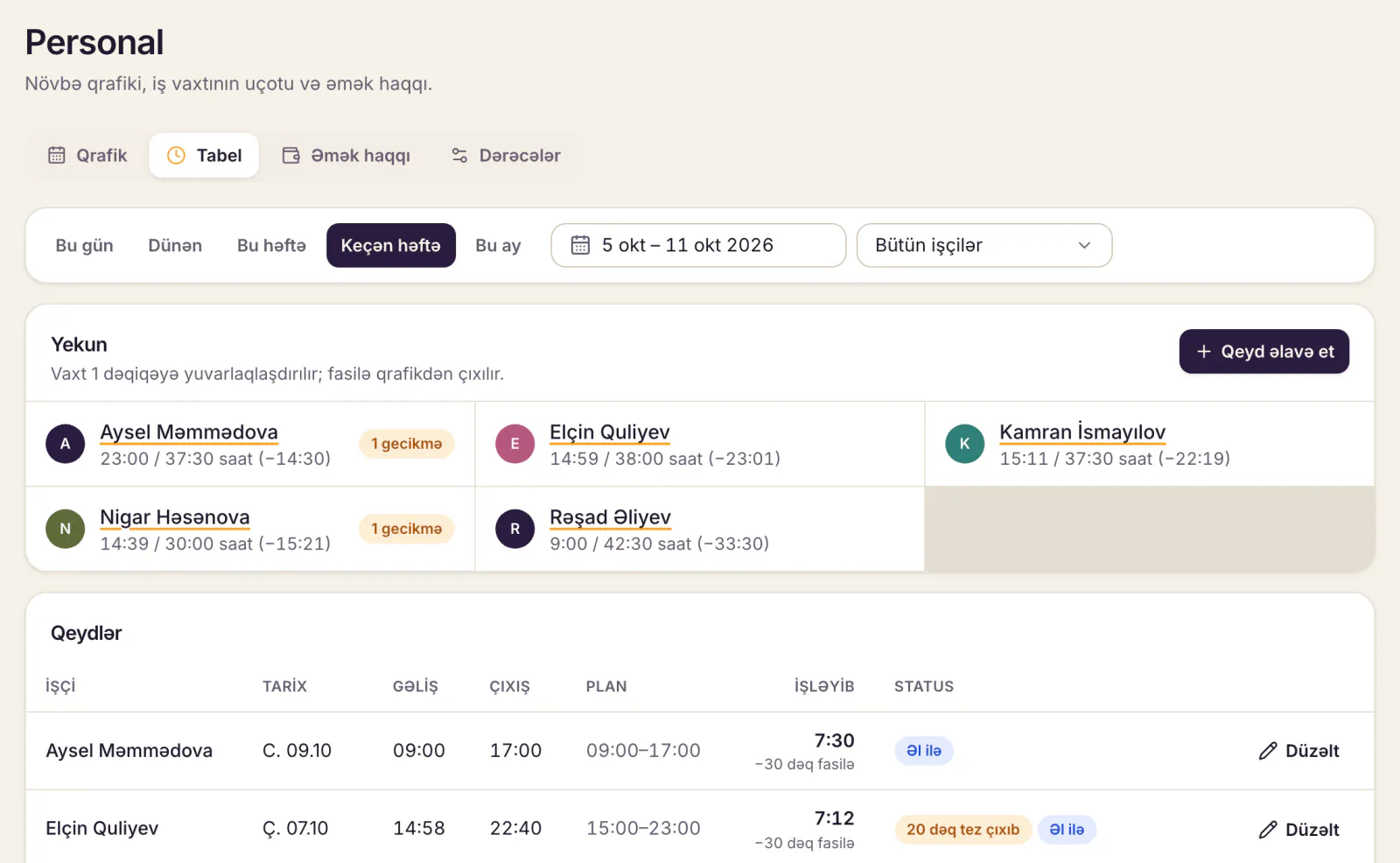
The weak spot of paper and Excel is the record itself: if the manager didn't see it, it doesn't get written down. The staff and payroll module in Dishment ties it to the till:
- staff clock in and out on the POS lock screen with a PIN, card or QR badge, offline too;
- the time sheet shows planned against actual, with late arrivals, early leaving, missing clock-outs and unscheduled shifts flagged;
- a forgotten entry can be added or corrected only with a reason, and the change goes into the audit log;
- time is rounded to the step you choose, breaks come off per the schedule, and hours over the weekly norm show as overtime;
- pay can be hourly, a monthly salary or a share of sales; a locked period is frozen and exports to CSV.
Annual leave (M), unpaid leave, sick leave, business trips and absences are marked on the time sheet with their code: the salary drops for those days by itself, and vacation pay is worked out from the last 12 months’ earnings. Night hours (22:00–06:00) show on every entry, and with night pay switched on (20 %, 40 % in a night shift) it goes onto the payroll sheet by itself. Sick pay is worked out by your accountant and DSMF, and the returns stay with your accountant too. Above all, Dishment gives you an undisputed record of who came, who left, when, and who corrected it.
DISHMENT
Want to see this in your restaurant?
We'll show you Dishment on your own menu in 30 minutes.
Free demoFAQ
Is there a mandatory time sheet form in Azerbaijan?
No. Under Article 102 of the Labour Code the employer sets the form and procedure; the record must be accurate.
Who keeps the time sheet?
Whoever the employer appoints, usually the manager, HR or the accountant. Legal responsibility stays with the employer.
How long should time sheets be kept?
Check with your accountant. Because they underpin pay and tax reporting, keep them for as long as those periods can be inspected.
Information as of October 2026; not legal advice. Examples are illustrative. Source: Labour Code of Azerbaijan, Articles 89, 96, 97, 102, 165, 166 (e-qanun.az).
DISHMENT
Try it free for 30 days
We open the account and move your menu over together. No card needed.
30 days free