Management· 12 min read· Dishment team
Restaurant Staff Schedule Template: a Weekly Shift Rota for a Café (Excel)
A ready weekly shift rota for a 12-person café, Excel columns and formulas, Azerbaijan's working-time and rest rules, holidays and peak days, and the most common rota mistakes.
Free Excel templateStaff scheduleThe article’s tables and formulas, ready to use — opens in Excel and Google Sheets.Download (.xlsx)A familiar scene: Thursday, 6 pm, the manager's phone rings. The evening waiter isn't coming in, because "my name wasn't on the schedule". The rota went into the staff WhatsApp group as a photo on Sunday, was corrected on Wednesday, and the second photo never reached everyone. A restaurant staff schedule looks like a simple table, yet it causes more arguments than almost anything else: who works when, who covers for whom, and how many hours go on the time sheet at the end of the month.
Below is a ready weekly shift schedule template for a 12-person café, the columns to set it up in Excel, the limits Azerbaijan's Labour Code puts on shift work, and the mistakes we see most often.
Why a restaurant needs a written staff schedule
A schedule shows which day and which hours each person works and when they rest. An office writes it once: 9 to 6, weekends off. A restaurant can't. The doors open at 10, the last guests leave at 11 pm, Friday lunch brings the plov orders and Saturday night fills every table. One shift won't cover that, so the rota has to be built week by week.
A good schedule puts enough people on the floor and in the kitchen at peak times without paying for idle hands in the quiet ones. It tells everyone their shifts in advance. And at the end of the month it is the base for the time sheet and payroll: planned hours on the rota, actual hours from clock-ins.
What the law says: working time, rest and shift rotas
| Rule | Labour Code article | What it means for a restaurant |
|---|---|---|
| Normal working day up to 8 hours, week up to 40 hours | 89 | 8-hour shifts on a five-day week; longer shifts only with aggregated accounting |
| On a six-day week with a 40-hour norm, no more than 7 hours a day | 90 | A cook on six days can't be rostered for 8-hour shifts |
| With aggregated accounting, a shift is at most 12 hours and the accounting period at most a year | 96 | 12 hours on a 2-on/2-off pattern is the ceiling |
| 22:00 to 06:00 is night time | 97 | A shift ending at midnight includes 2 night hours |
| At least 12 hours of rest between working days | 103 | No morning shift the day after a closing shift |
| Weekly rest: 2 days on a five-day week, 1 on a six-day week | 104 | Every person's days off must show on the rota |
| Catering may work on public holidays | 107 | You can open, but holiday work is paid at a higher rate |
The working-time regime (number of shifts, start and end times, aggregated accounting) is set in the internal work rules, the employment contract or a collective agreement, approved by the employer's order, and staff must be made familiar with it (article 95). Article 103 also says shift rotas are entered into the electronic information system. Ask your accountant or HR adviser how you do that in practice; a photo in a group chat isn't enough.
This is not paperwork for its own sake. In the first half of 2026 the State Tax Service checked 34 sites, catering among them, for people working without employment contracts. At 17 of them it found 65 people without one, and employers were fined a total of 130,000 manat (State Tax Service, 31 July 2026). The waiter on a "trial day" who is already on the rota but has no contract in the system is exactly who turns up in such a check.
Types of schedules: fixed, rotating, variable, flexible
These labels aren't word-for-word in the Code, but they are how HR people talk.
Fixed: the same days and hours every week. Accountants, buyers, sometimes the head chef.
Rotating shifts: the day splits into two or more shifts, or into long shifts such as 2-on/2-off. Most cafés and restaurants work this way.
Variable: shift times change from week to week. The usual pattern for waiters, and the one where the 12-hour rest rule breaks most often.
Flexible: the employee picks the hours and the employer looks at results. In a restaurant this only works off the floor: social media, bookkeeping, purchasing.
Part-time is agreed between the parties as a shorter day or week (article 94). Students, weekend waiters and the evening dishwasher belong here.
Staff schedule template in Excel: the columns
| Column | What goes in | Note |
|---|---|---|
| A: Employee | Name | One row per person |
| B: Role | waiter, cashier, cook | Sort by role and gaps jump out |
| C–I: Days | Shift code: M, E, Off | Codes explained under the table |
| J: Weekly hours | Formula | Over 40 turns red |
| K: Night hours | Formula | Needed for payroll |
| L: Note | Leave, sick day, swap | With the date of the change |
Codes: "M — 10:00–19:00, 1-hour break, 8 paid hours" and "E — 15:00–24:00, 1-hour break, 8 paid hours, 2 of them at night". Breaks don't count as working time (article 103).
Formulas: weekly hours =COUNTIF(C2:I2,"M")*8+COUNTIF(C2:I2,"E")*8, night hours =COUNTIF(C2:I2,"E")*2. The most useful check catches evening-then-morning: =IF(AND(C2="E",D2="M"),"no 12h rest","").
Example: a weekly shift schedule for a 12-person café
A 40-seat café near Ganjlik, open daily 10:00–23:00; the evening shift cleans up and closes the till by midnight. M = morning (10:00–19:00), E = evening (15:00–24:00), Off = day off.
| Employee | Role | Mon | Tue | Wed | Thu | Fri | Sat | Sun | Hours |
|---|---|---|---|---|---|---|---|---|---|
| Elvin | manager | Off | Off | M | M | E | E | E | 40 |
| Nigar | cashier | M | M | Off | Off | M | M | M | 40 |
| Ruslan | cashier | E | E | E | E | Off | Off | M | 40 |
| Aysel | waiter | E | E | Off | Off | M | E | E | 40 |
| Murad | waiter | E | Off | Off | E | E | E | E | 40 |
| Leyla | waiter | Off | Off | E | E | E | E | E | 40 |
| Tural | waiter | M | E | E | Off | Off | M | M | 40 |
| Sabina | waiter | M | M | M | M | E | Off | Off | 40 |
| Rauf | cook | Off | Off | M | M | M | M | M | 40 |
| Samir | cook | E | E | Off | Off | M | E | E | 40 |
| Gunel | cook | M | M | E | E | E | Off | Off | 40 |
| Sevda | dishwasher | E | Off | Off | E | E | E | E | 40 |
Everyone has 40 hours and two days off, mostly back to back. There is no evening-then-morning anywhere: Tural closes on Wednesday, has two days off and comes back on Saturday morning. Shifts overlap from 15:00 to 19:00, and there are three waiters on the floor on Friday, Saturday and Sunday evenings. Friday morning has two cooks, for the Friday plov. The till is never empty: two cashiers work 10 shifts and cover 9 of the 14 till shifts (both are on Sunday morning), and the manager takes the other five, which is normal for a small café as long as the manager has till rights and a personal PIN. And the manager is on site on weekend evenings, when most complaints, voids and cash differences happen.
The weak spot, honestly: on weekend evenings the kitchen has one cook. With three cooks, each on 40 hours with 12 hours of rest between shifts, putting two on Friday and Saturday nights barely works out. The fix is a fourth part-time cook or kitchen helper for Friday and Saturday, 18:00–24:00. It costs less than a full-time hire and covers the hardest hours.
Checking the hours: 40 a week, 2/2 and aggregated accounting
Kitchens often run 2-on/2-off with 12-hour shifts. Cooks like it, but the weekly hours swing between 36 and 48. That pattern is only possible with aggregated accounting: total hours over the accounting period must stay within the legal norm, and the rule must be written into internal documents or the contract (article 96). Example: 15 shifts × 11 paid hours (12 minus a 1-hour break) = 165 hours. If the month's norm in the production calendar is, say, 168, you're fine. Take monthly norms from the production calendar approved each December for the following year.
How overtime, night hours and holiday work are paid is covered with manat examples in restaurant payroll in Azerbaijan.
Holidays and peak days
For a restaurant a holiday is a working day, sometimes the best one of the year: Novruz family tables, Ramadan evenings when the room fills up for iftar in half an hour, New Year's Eve and the corporate party season.
- Publish the holiday rota 2–3 weeks ahead; your people have families too.
- Rotate: whoever works Novruz gets Gurban Bayram off. Write it down.
- Say up front how holiday work is paid: at least double on a non-working public holiday, or another day off if the employee prefers.
- During Ramadan consider a short 18:00–22:00 shift for a part-timer.
- The working day before a public holiday is one hour shorter (article 108). Easy to forget on a shift rota.
Changing the schedule and telling staff
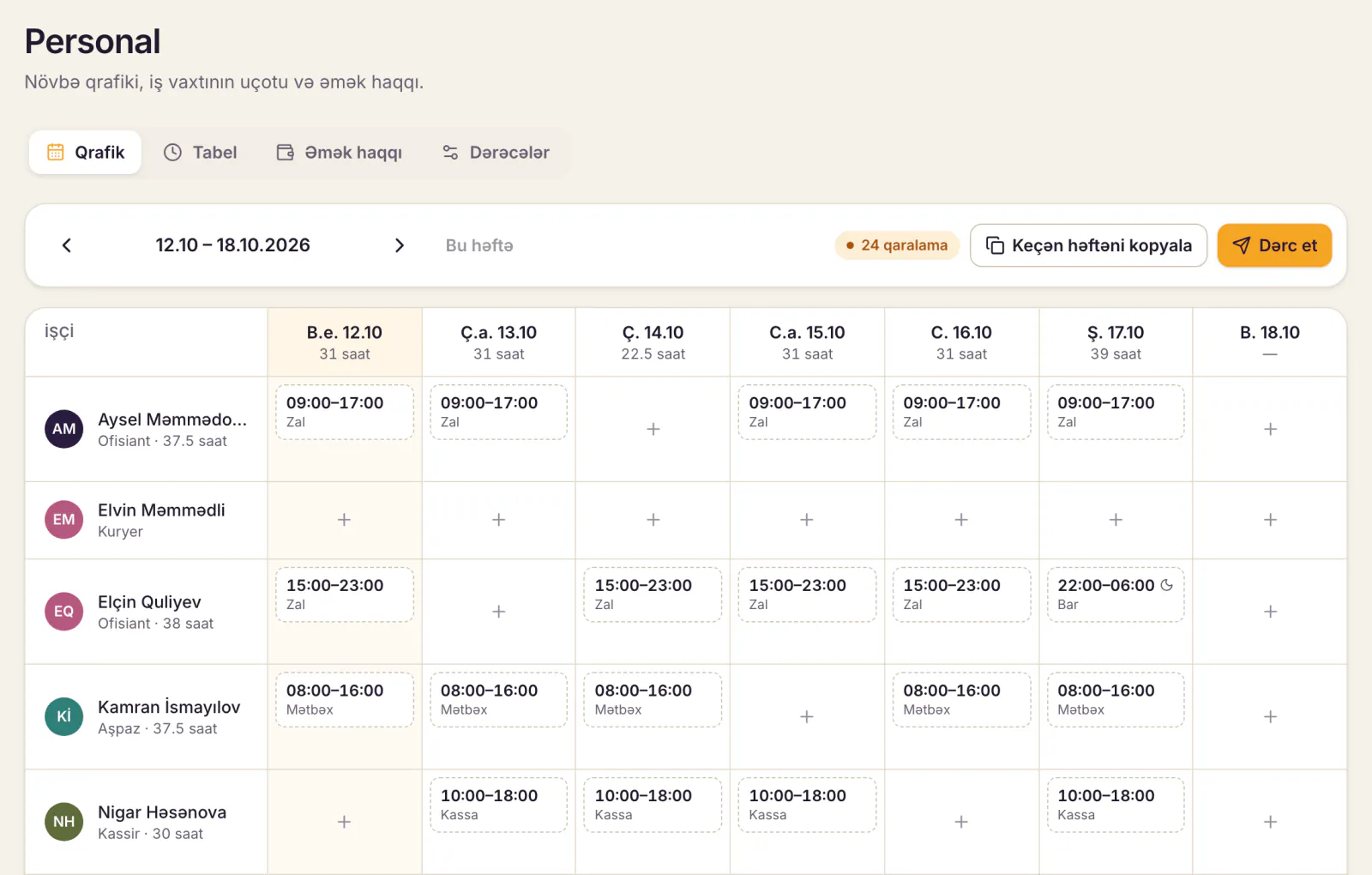
The Labour Code gives no specific number of days' notice for a shift rota. Set your own rule in the internal work rules. Our advice: publish next week's rota by Friday, and tell a person about a change in their shift at least 24 hours ahead, in person. If specific hours are written into the employment contract, they can't be changed unilaterally (article 43); you need the employee's consent.
Make every change in one place, with a date and reason, and tell both people involved, the one giving up the shift and the one taking it. Check the time sheet against the final version.
From schedule to time sheet: actual hours
The rota is the plan; pay follows actual hours. The employer must keep an accurate record of each person's actual working time and overtime, in a form the employer chooses (article 102). In a paper log people round: 10:12 becomes "10:00". Clocking in at the till with a code or card is more reliable.
Common mistakes
- Posting the rota as a photo and sending corrections as separate messages.
- A morning shift straight after a closing shift.
- 8-hour shifts on a six-day week.
- Counting the break as working time, or not recording it at all.
- Not tracking hours after 22:00 separately.
- The same headcount on a quiet Monday and a busy Saturday, instead of staffing by sales per hour.
- Leaving the manager off the rota, so they quietly work 250 hours a month.
Shift scheduling in software: clocking in at the till
Excel copes with 10–15 people. Two venues, 30 staff and weekly changes make the file a mess.
In Dishment's Staff and payroll module you build the weekly schedule in Back Office: draft, publish, copy last week, with overlapping shifts flagged straight away. Each person sees their published shifts on the till under "My shifts". Clock-ins and clock-outs happen on the POS lock screen with a PIN, card or QR badge, offline too. The time sheet shows late arrivals, early leaves and missed clock-outs, and a correction needs a reason and goes into the audit log.
To be clear about the limits: the software doesn't check the 12-hour rest rule for you and doesn't file the rota with the government system. It keeps plan and actual hours in one place; legal compliance stays with you and your HR adviser. Module terms are on the pricing page.
DISHMENT
Try it free for 30 days
We open the account and move your menu over together. No card needed.
30 days freeFAQ
What is a variable work schedule?
One where shift times change from week to week. The general rules still apply: the weekly norm, at least 12 hours' rest between working days, and weekly days off.
How far in advance should a shift schedule be published?
Azerbaijan's Labour Code sets no specific number of days. Put the rule in your internal work rules; in practice, a week ahead for the regular rota and 2–3 weeks for holidays.
How do I make a staff schedule in Excel?
Staff in rows, days in columns, a shift code in each cell. Count weekly and night hours with COUNTIF and highlight anything over 40 hours with conditional formatting.
How long can one shift be?
Normally up to 8 hours a day. With aggregated accounting a shift can't exceed 12 hours, and total hours over the period must stay within the norm.
Sources
- Labour Code of the Republic of Azerbaijan, articles 43, 89, 90, 94–97, 102–105, 107 and 108: e-qanun.az
- State Tax Service, results of checks in January–June 2026: taxes.gov.az