Management· 14 min read· Dishment team
Shift work under Azerbaijan’s Labour Code: shift length, holidays and leave
Shift work under Azerbaijan’s Labour Code: how long a shift can be, summarised working time, night shifts, holiday work and pay, annual leave, with 2/2 and 5/2 restaurant rotas.
A restaurant opens at ten, the dining room runs until midnight, and public holidays are the busiest days of the year. Nobody works nine to six here, so cooks, waiters and bartenders work in shifts. The trouble is that the rota often lives as a photo in a WhatsApp group, while Azerbaijan's Labour Code sets specific rules for shift work: shift length, rest, night work, holidays and leave.
Below are the basics of shift work under the Labour Code, put into restaurant language: with article numbers, examples in manat and the mistakes that keep appearing in 2/2 and 5/2 rotas. The text of the Code was checked on e-qanun.az (in Azerbaijani), but this is not legal advice: draft contracts and orders with an accountant or lawyer.
What shift work means
Shift work means the business runs longer than one shift and staff take over from each other. In a restaurant that is usually a morning and an evening shift, or a pattern like 2/2: two days on, two days off.
The Code has no separate chapter on shift work, but it regulates every important part of it. Under Article 95, the working-time regime, including the number of shifts per day, shift documents, moving staff between shifts and summarised working time, is set by internal work rules, the employment contract or a collective agreement, and approved by the employer's order. Staff must be made familiar with these rules.
One point that matters for restaurants: in trade and service businesses with up to 50 employees, the employer may set working-time rules that differ from this article's procedure, as long as employees' rights under the Code are not restricted (95.3). A small cafe can work with simpler paperwork, but it can't cut rights.
Shift work in the Labour Code: the key articles
Print this table and keep it in the manager's folder. These are the articles you'll need most when building a rota:
| Topic | Rule | Article |
|---|---|---|
| Normal working time | No more than 8 hours a day and 40 a week | 89 |
| Six-day week | With a 40-hour week, no more than 7 hours a day | 90 |
| Summarised working time | Reference period up to 1 year, shifts up to 12 hours | 96 |
| Night time | 22:00 to 06:00 | 97 |
| Night work limits | Staff under 18 may not work nights | 98 |
| Overtime | No more than 4 hours over two consecutive working days | 100 |
| Records | Accurate record of each worker's actual hours | 102 |
| Daily rest | At least 12 hours between working days; for shifts, per the rota | 103 |
| Holiday work | Allowed in food service, paid under Article 164 | 107, 164 |
| Night and multi-shift pay | At a higher rate, the exact supplement in the contract | 166 |
Shift length and rest
How long can a shift be? Normally 8 hours a day. The 12-hour shifts common in restaurants are possible with summarised working time: over the reference period (a month, quarter or year) the hours stay within the legal norm, and no single shift exceeds 12 hours (96.1). How summarised time works must be written into the collective agreement, internal rules or employment contract (96.2).
Breaks don't count as working time. Rest and meal breaks are not working time, and the employee uses them as they wish (103.5). A 10:00–23:00 shift with a one-hour break is 12 working hours. Thirteen hours straight without a break is over the 12-hour limit.
Rest between shifts. The general rule is at least 12 hours of rest between working days (103.4). Under a shift regime, rest is governed by the rota, but in practice keeping those 12 hours fits both the spirit of the law and the cook's health.
Example. The bar closes at 01:00; the bartender finishes closing and leaves at 01:30. In the morning another bartender calls in sick, and the manager asks the same person to come in at 10:00. That's eight and a half hours of rest. Once might pass, but if it becomes a regular part of the rota, miscounted cash, broken glasses and a resignation letter follow.
Weekly rest. Two days off in a five-day week, one in a six-day week (104.1). Under summarised working time, days off follow the rota; where there is no trade union, the rule goes into the employment contract (104.2).
Rotas now go into an electronic system
In 2024 a sentence was added to Article 103: except for cases set out in the Code, shift rotas are entered into the electronic information system. Employment contracts are now concluded in an electronic system too. Your accountant handles this, but the practical consequence is simple: the rota in WhatsApp and the rota in the official system must match. Check with your accountant how it is entered.
A law of 30 December 2025, published in January 2026, added another part to Article 98: when organising shift work and assigning night shifts, employees' justified needs linked to family duties must be taken into account where possible. A waitress with a small child asking «please don't put me on nights» is no longer just making a request.
Public holidays and night shifts
Public holidays
Article 105 lists the public holidays. Of these, the following are non-working days: New Year (1 and 2 January), Women's Day (8 March), Victory over Fascism Day (9 May), Independence Day (28 May), National Salvation Day (15 June), Armed Forces Day (26 June), Victory Day (8 November), National Flag Day (9 November), World Azerbaijanis Solidarity Day (31 December), Novruz (five days), Gurban (two days) and Ramadan (two days). The dates of Novruz, Gurban and Ramadan are announced separately each year.
Calling staff in on these days is generally prohibited, but Article 107 lists exceptions, and food service is one of them. So a restaurant can legally open on Novruz and New Year's Day; it just has to pay correctly (Article 164):
- Hourly or daily pay: at least double the rate.
- Monthly salary, if the work is within the monthly norm: at least one day's (hour's) rate on top of the salary; if beyond the norm, at least double.
- At the employee's request, another day off can be given instead of money.
Example (illustrative figures). A cook on 6 ₼ an hour works 12 hours on one day of Novruz: at least 2 × 6 × 12 = 144 ₼. A waiter's monthly salary is 750 ₼ and the month has 21 working days, so the daily rate is 750 ÷ 21 ≈ 35.71 ₼. If the holiday was worked within the monthly norm, at least 35.71 ₼ is added to the salary; beyond the norm, at least 71.43 ₼.
A small rule people forget: the working day immediately before a non-working holiday is one hour shorter (108.1). If a weekly day off falls on such a holiday, it moves to the next working day after the holiday (105.5).
Night shifts
Night time is 22:00 to 06:00 (97.1). In a restaurant, that's the closing shift and the late bar.
- Staff under 18 may not work at night (98.1). A 17-year-old student taken on as a waiter for the summer can't stay on the floor after 22:00.
- Pregnant women, women with children under 14, men raising children under three on their own and some other employees can work nights only with their written consent (98.3).
- Night work and multi-shift work are paid at a higher rate: not below the level set by the government, with the exact supplement written into the employment or collective agreement (166). Put the percentage in the contract and check with your accountant that it's not below the minimum.
How to count night hours and add them to pay, with examples in manat, is covered in restaurant payroll in Azerbaijan.
Annual leave on shifts
Shift work doesn't reduce leave entitlement. The main rules:
- Length. Paid basic leave is at least 21 calendar days (114.2). Positions classed as managers and specialists get 30 days (114.3); check with your accountant whether a restaurant manager falls into that category.
- Extra days for length of service. 2 calendar days for 5–10 years, 4 for 10–15, 6 for more than 15 (116).
- Calendar days, not shifts. Leave is counted in calendar days (113.1). For a cook on a 2/2 rota, 21 days means 21 calendar days, not «10 shifts».
- Holidays inside leave. Non-working public holidays don't count as leave days, and the leave is extended by that number (114.6).
- First year. The right to leave for the first year of work arises after six months (131.1).
- Holiday pay. Earnings for the last 12 calendar months are divided by 12, then by 30.4, and multiplied by the days of leave (140.3). The money is paid no later than 3 days before the leave starts (140.5).
Example (illustrative figures). A cook's average monthly pay over the last 12 months is 900 ₼. The daily amount is 900 ÷ 30.4 ≈ 29.61 ₼. Leave of 21 days: about 621.71 ₼. With six years' service, 23 days: about 680.92 ₼. Which payments count towards average pay (night supplements, bonuses) is decided by the accountant under the Cabinet of Ministers' rules.
The real difficulty with leave in a restaurant is timing, not money. Everyone wants summer, which may be your busiest season. The Code allows a leave schedule to be drawn up by the end of January each year (133.1). Do it: knowing in March who'll be away is better than getting three requests for the same dates in July.
2/2 and 5/2 rota examples for a restaurant
Kitchen: 2/2, 12-hour shifts
Two kitchen teams (A and B) alternate. The shift is 10:00–23:00 with a one-hour break inside it, so 12 working hours.
| Day | Mon | Tue | Wed | Thu | Fri | Sat | Sun |
|---|---|---|---|---|---|---|---|
| Team A | on | on | — | — | on | on | — |
| Team B | — | — | on | on | — | — | on |
The following week the sequence shifts. That's about 15 shifts, or 180 hours, a month. If this is above the monthly norm (say 168 hours, for illustration), the difference has to be balanced within the reference period of summarised working time: a month with fewer shifts, an extra day off. Hours still above the norm at the end of the period count as overtime and are paid at least double (165), and overtime itself is strictly limited (99–101). So plan a 2/2 rota for the whole period in advance and update the norm from the official working-time calendar every year; the government approves the calendar by the end of December (96.3).
A quick check. If the same person who finished at 23:00 is back at 10:00 the next morning, they've had 11 hours of rest. On a 2/2 rota two working days come back to back, so either shorten the shift by an hour (10:00–22:00) or give the closing to someone else.
Floor: 5/2, 8-hour shifts
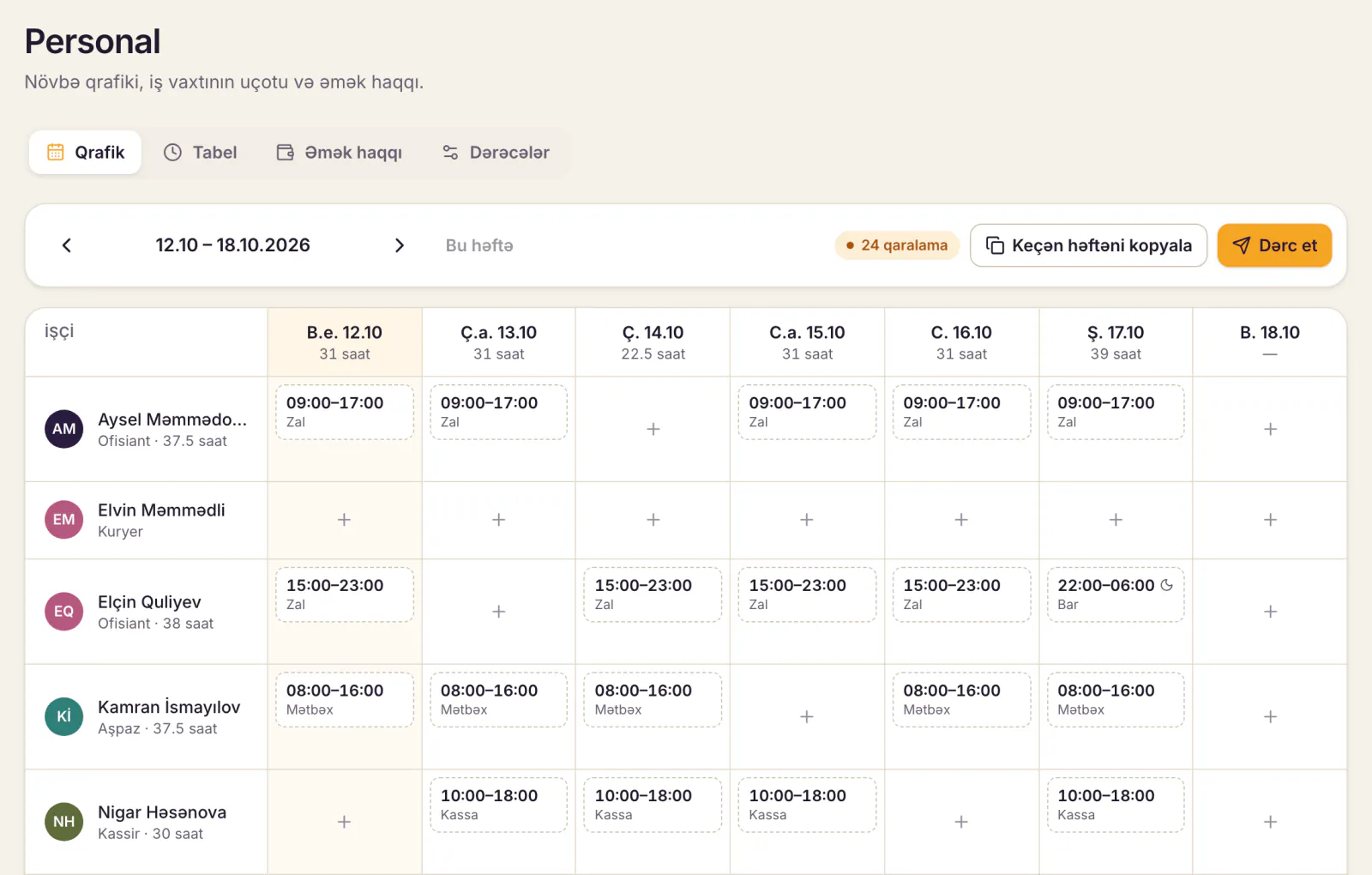
Waiters work five days and rest two. The morning shift is 09:00–17:00, the evening shift 15:00–23:00 (each with its own break). From 15:00 to 17:00 the shifts overlap: the two most useful hours of the day, covering the tail end of lunch and setting up for the evening. One hour of the evening shift (22:00–23:00) falls in night time, so the contract's night supplement applies.
| Pattern | Suits | Risk |
|---|---|---|
| 2/2, 12 hours | Kitchen, long trading days | Fatigue, needs summarised time |
| 5/2, 8 hours | Floor, bar, till | Needs more people |
| 6/1, 7 hours | A small cafe | One day off, burnout |
| Mixed | A large restaurant | Hard to manage the rota |
How to build a rota like this in Excel, with a ready example, is in our staff schedule template.
Writing shift work into the employment contract
Under Article 43 the employment contract must state working and rest time, pay and supplements. For shift work, put these into the contract or internal work rules:
- the regime: shift work, the pattern (for example 2/2) or «according to the rota»;
- if summarised working time applies, the reference period (month, quarter, year);
- shift start and end times and breaks;
- when and how the rota is announced;
- the exact percentage supplement for night hours;
- how holiday work is paid;
- when an employee may refuse night shifts (the categories in Article 98).
Show the wording to a lawyer before you copy it into a contract: this list is a reminder of what to cover, not a contract template.
Pay and timesheets
Hours cause more arguments on shifts than anything else: who worked how long, how much fell at night, who came in on the holiday. Article 102 obliges the employer to keep an accurate record of each employee's actual hours, and the employer chooses the format. A paper logbook is a format too, but turning it into payroll at the end of the month takes two days. Gross, net, tax and contributions are covered in restaurant payroll in Azerbaijan.
Shift rotas and clock-in in Dishment
The Staff and payroll module takes the day-to-day side of shift work off paper:
- Weekly shift rota. Draft, publish, copy last week. Overlapping shifts show up immediately.
- «My shifts» on the till. Everyone sees their published shifts on the till instead of an old photo in WhatsApp.
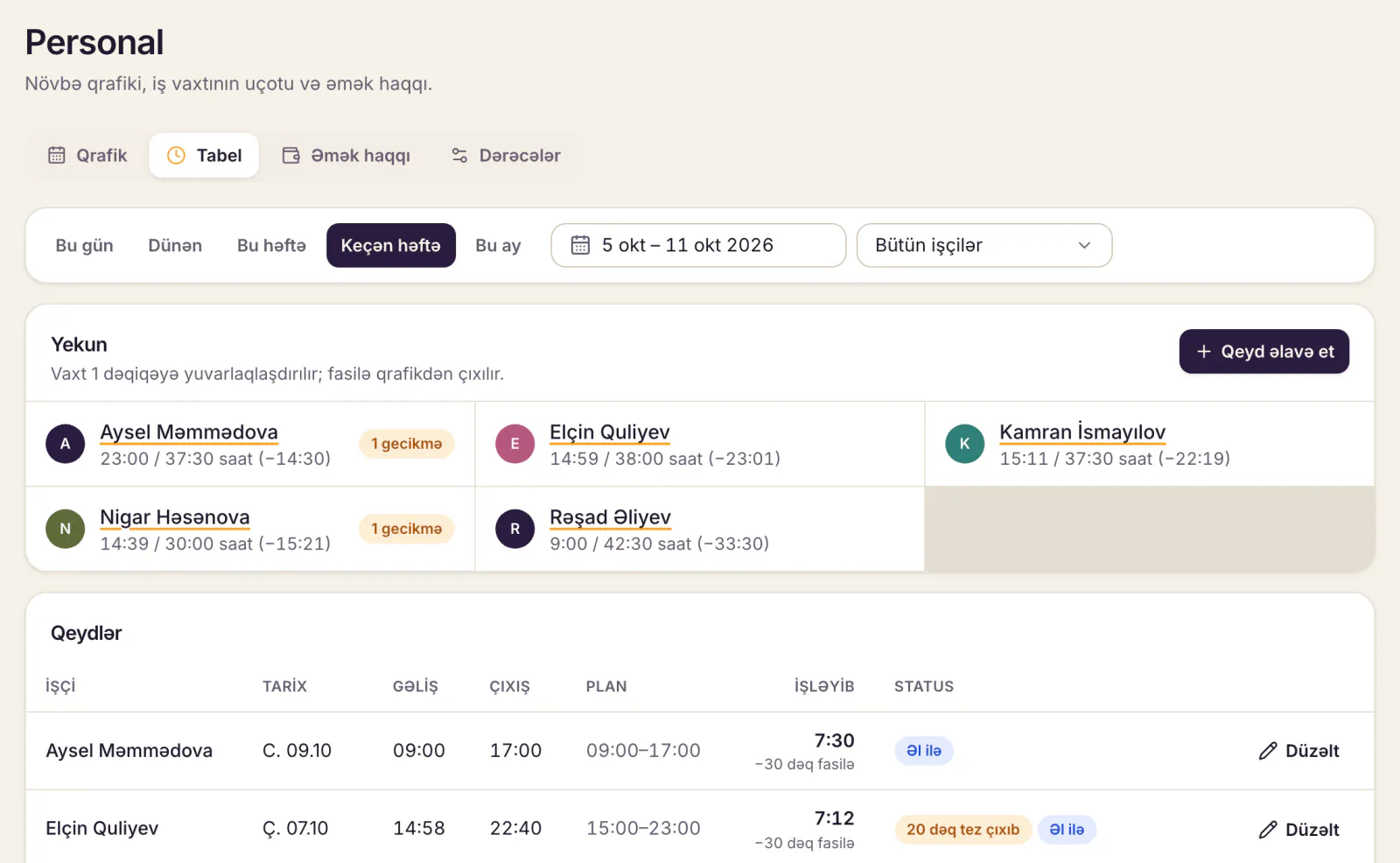
- Clock-in and clock-out on the till. By PIN, card or QR badge; works without internet too.
- Timesheet. Lateness, early departures, missing clock-outs. Corrections only with a reason, written to the audit log.
- Rates and payroll. Hourly, monthly or a percentage of sales; overtime, bonuses and deductions; closing the period and CSV export.
Dishment counts night hours (22:00–06:00) itself: they show separately in the timesheet and the payroll, and night pay is worked out too once it is switched on in Pay rates. To be honest about the limits: it doesn't send the rota to the government's electronic system, and you add holiday supplements as a bonus; the monthly payroll sheet works out income tax and contributions with it included, and the accountant files the official reports. The module's price is on the pricing page.
DISHMENT
Want to see this in your restaurant?
We'll show you Dishment on your own menu in 30 minutes.
Free demoFAQ
How long can a shift be?
Normally 8 hours a day. With summarised working time a shift can be up to 12 hours, as long as hours over the reference period stay within the norm (Article 96). Breaks don't count as working time.
How is holiday work paid?
At least double for hourly and daily pay. For salaried staff, at least one day's rate on top of the salary if the work is within the norm, double if beyond it. At the employee's request another day off can be given instead (Article 164).
How is shift work written into the employment contract?
The regime (shift work, the pattern), summarised working time and its period, shift times and breaks, the night supplement percentage and how holiday work is paid. Put these in the contract or the internal rules and have the employee sign that they've read them.
How much leave does a shift worker get?
At least 21 calendar days, plus 2–6 days for length of service. Leave is counted in calendar days, not shifts; non-working holidays falling inside it extend it.
Can a 17-year-old work the evening shift?
Until 22:00 yes, after 22:00 no: staff under 18 may not work at night (Article 98). Their working hours must also be reduced (Article 91).
Sources
- Labour Code of the Republic of Azerbaijan, Articles 43, 89–91, 95–98, 100–105, 107, 108, 113, 114, 116, 131, 133, 140 and 164–166 (in Azerbaijani): e-qanun.az
This information is current as of October 2026 and is not legal advice. Labour law can change; check contracts, orders and rotas with an accountant or lawyer.