Guides· 16 min read· Dishment team
How to open a restaurant or cafe in Baku: a 2026 step-by-step guide
Starting a restaurant business in Azerbaijan: premises and lease, sole trader or LLC, tax regime, food safety registration, the cash register, staff, menu and budget, plus a 30-day pre-opening checklist.
Starting a restaurant business in Azerbaijan usually begins with a good location and a great menu. Opening day, though, depends on registration, the tax regime, the cash register, food safety and a team that is ready. Miss one of these and the opening slips by weeks, or the first months start with a fine.
This guide is for anyone planning to open a cafe, restaurant, tea house or small fast-food outlet in Baku, whether you are a local owner or a foreign entrepreneur. The steps follow the order they happen in practice: premises and lease, registration and tax regime, the Food Safety Agency, the cash register, staff, the menu, the budget and the final 30 days. Always check the current rules and fees with the official source; links are at the end.
What you need to open a restaurant or cafe: the short answer
To open a restaurant or cafe in Azerbaijan you need premises that fit the concept, registration with the tax service and a tax regime, registration with the food safety agency (AQTA), an e-kassa (NKA) and a card terminal, a team on written contracts, a costed menu with recipe cards, and a budget that includes at least three months of working capital. In short:
- Concept and location: who you are opening for, the expected average check, the lease.
- Registration: sole trader or LLC, and the tax regime.
- Food safety: AQTA registration and a kitchen laid out to sanitary rules.
- Payments: a contract with an e-kassa operator, a card terminal from a bank, a POS.
- Team: employment contracts, roles, training before opening.
- Menu: recipe cards, food cost, prices.
- Money: the opening budget and a working capital reserve.
The list is the same for a cafe; only the scale differs. A cafe usually has a smaller menu, dining room and budget, so each mistake hurts more.
Documents needed to open a cafe in Azerbaijan
Copy this table and use it as your preparation checklist. Each item is explained in the sections below.
| Document or step | Where | When |
|---|---|---|
| Sole trader tax registration or LLC state registration (VÖEN) | Tax service (DVX), Internet Tax Office | Before you start trading |
| Choice of tax regime | DVX, with your accountant | At registration |
| Enhanced electronic signature | An e-signature certificate centre | Before registration |
| Lease or proof of ownership | The landlord | Before the fit-out |
| Tax registration of the premises (venue code) | DVX | Before the NKA contract |
| Registration as a food business | AQTA; in Baku also the SME House (KOB evi) | Before handling food |
| E-kassa operator contract and NKA registration sheet | Operator, your online tax account | Before opening |
| Card terminal agreement | Your bank | Before opening |
| Written employment contracts | Your business, your accountant | Before staff start |
Depending on your format (selling alcohol, a terrace, a street sign, for example) you may need extra permits or approvals. Check the current list with the relevant authority and your accountant.
1. Concept, location and lease
The concept decides who your guests are and what the average check will be: qutab and tea for students in Yasamal, national cuisine for tourists in the Old City (İçərişəhər), business lunches next to an office block. The location has to fit: foot traffic, parking, a visible frontage, and a street that is alive in the evening.
Before you sign a lease, check:
- Proof of ownership. Ask the landlord to show they own the premises or have the right to let them.
- Rent and currency. Is rent fixed in manats or dollars, and when and by how much can it rise?
- Utility capacity. Electrical capacity for the kitchen, gas, water and drainage, and room for ventilation and extraction. Upgrading these later is slow and expensive.
- Fit-out period. Do you pay rent during renovation? Negotiate a rent-free period of a few weeks.
- Term and exit. The lease should run at least long enough to earn back what you invest. What happens if you leave early?
- Terrace and signage. Whose approval do you need for a terrace, a street sign or changes to the frontage?
2. Registration: sole trader or LLC, and the tax regime
In Baku, food businesses are usually registered in one of two forms:
- Sole trader (fərdi sahibkar). Simple and quick, a good fit for a small cafe or family business. The owner is personally liable for the business's obligations.
- Limited liability company (MMC). Better with several founders, an investor or a larger restaurant. Liability is limited to the company's assets.
Commercial legal entities are registered by the State Tax Service (DVX). According to the DVX website, electronic state registration of a legal entity through its online portal ("İnternet Vergi İdarəsi"), signed with a qualified electronic signature, is free; fast-track registration is immediate and standard registration takes no more than 1 day. You can also apply on paper, but then a state fee applies.
A sole trader must apply for tax registration before starting business. From 2026 the penalty for missing this rose from 40 AZN to 200 AZN, and the application can only be filed electronically or in person, no longer by post.
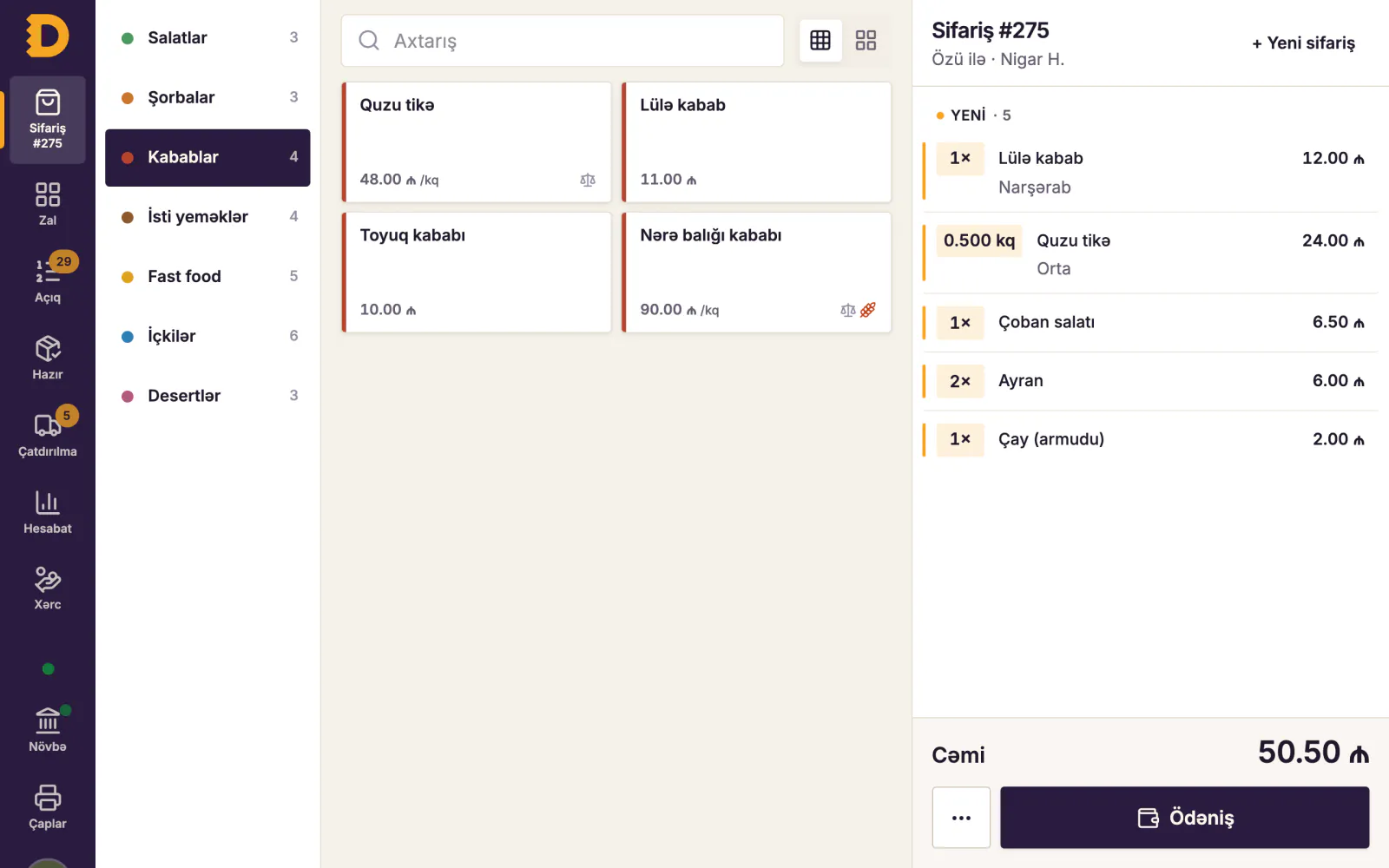
At registration you also choose a tax regime. In catering this is usually the 2% simplified tax for turnover up to 200,000 AZN; above that, the choice is between the 8% simplified tax and VAT. Since 2026 there are also benefits for cashless payments. We explain all of this with AZN examples in restaurant taxes in Azerbaijan 2026. Choose your regime with an accountant before you open.
3. Registering with the Food Safety Agency (AQTA)
Every food business, cafes and restaurants included, must register with the Azerbaijan Food Safety Agency (AQTA, also known as AFSA). The food safety register is governed by Cabinet of Ministers Decision No. 303 of 16 July 2018, and unregistered operators may not carry out food activities.
In Baku, AQTA services, including registration and approval of food facilities and extracts from the state register, are also available at the Baku SME House (KOB evi), according to the SME Development Agency (KOBİA) in 2023. Procedures and required documents can change, so check the current process and any fees on afsa.gov.az or at the SME House before you apply.
A practical tip: plan sanitary requirements into the fit-out from the start: separate flows for raw and cooked food, hand-wash stations, where the cold rooms go, and waste removal. Rebuilding a finished kitchen costs more.
4. The cash register (NKA) and card terminal
In catering, cash settlements must go through a registered e-kassa. The device and its servicing come from an e-kassa operator, and both the model and the operator must be in the register on e-kassa.gov.az. The penalty for not issuing a receipt within a calendar year is 1,000 AZN the first time, 3,000 AZN the second and 6,000 AZN after that.
The operator handles the registration and you finish by confirming the acceptance record in your online account with an enhanced electronic signature, so have the signature and the venue's tax registration ready in advance.
When you arrange a card terminal with your bank, ask the operator whether it can be integrated with the NKA. The 2026 tax benefits apply only to payments through an integrated terminal. We explain how the NKA differs from restaurant software, and how the two share a shift, in fiscal cash register (NKA) vs restaurant POS.
5. Staff: pay, tax and contracts
- Minimum wage. 400 AZN since 1 January 2025, the figure also used in the DVX's 2026 booklet. Check the current amount before hiring.
- Income tax. In the non-oil, non-state sector, wages up to 2,500 AZN a month are taxed at 3% in 2026, 5% in 2027 and 7% from 2028.
- Employment contracts. Sign a written employment contract with every employee and formalise it as the law requires; confirm the procedure with your accountant.
A small cafe's core team is usually a cook and an assistant, one or two waiters, a cashier or barista, a cleaner and a shift manager. Bring everyone in a week before opening to taste the menu, run orders through the till and hold a soft-opening evening.
6. Menu, recipe cards and food cost before opening
Don't price the menu by "what the cafe next door charges". Write a recipe card for every dish (gross weight, loss percentage, net), work out the cost and set the price from the margin you need. We walk through this in two guides: restaurant recipe card template and food cost calculation.
Keep the opening menu short: 20 to 30 items the kitchen can turn out consistently at peak time. A few dishes such as plov, dolma, qutab, lula kebab and dushbara, plus one or two signatures, are enough. Think of tea service (jam, lemon, sweets) as an item of its own: in Baku it has a real effect on the average check.
7. Budget template (AZN)
There is no single "cost to open" a restaurant: location, size and concept change everything. So instead of figures we give you a template to fill in. Example prices for the POS hardware come from how much restaurant POS software costs in Azerbaijan.
| Cost item | What to include | Amount |
|---|---|---|
| Rent deposit and first month | Per the lease | your figure |
| Fit-out and utilities | Electrics, water, ventilation, design | your figure |
| Kitchen equipment | Hobs, oven, fridges, work tables | your figure |
| Dining room | Furniture, lighting, tableware | your figure |
| POS hardware | Computer, tablets, printers, UPS | example: 1,500–2,900 AZN |
| Restaurant software | Subscription or licence | vendor's price |
| Cash register (NKA) | Device and operator's service | operator's price |
| First stock purchase | Opening week's stock | your figure |
| Marketing | Signage, Instagram, opening offer | your figure |
| Working capital reserve | At least 3 months of fixed costs | see formula |
Working capital formula: (monthly rent + monthly payroll + utilities + software and other subscriptions) × 3. Example: 3,000 + 6,000 + 800 + 200 = 10,000 AZN a month, so a reserve of 30,000 AZN. A new cafe rarely runs full in its first months, and this money keeps wages and rent on time.
8. Starting a restaurant business in Azerbaijan: the last 30 days
Copy this table and write the person responsible next to each line.
| When | What to do |
|---|---|
| 30 days out | Registration and tax regime confirmed; AQTA application filed; contract signed with the NKA operator |
| 25 days out | Card terminal agreed with the bank, NKA integration checked |
| 21 days out | Menu, recipe cards and prices ready; suppliers chosen |
| 18 days out | POS chosen, hardware bought, menu entered |
| 14 days out | Employment contracts signed; roles and PINs issued |
| 10 days out | Kitchen equipment tested; printers and kitchen display assigned to stations |
| 7 days out | Team training: menu, service standards, closing a check at the till |
| 5 days out | First stock purchase received; Instagram and Google Maps pages ready |
| 3 days out | Soft opening for friends and family; NKA and POS daily totals reconciled |
| 1 day out | Float in the till, receipt rolls, spare printer paper; final clean |
Organising a restaurant business: who owns what after opening
Once you have opened, the restaurant stops being a project and becomes work that repeats every day. By organisation we mean three things: every process has a named owner, money and stock are checked daily, and the owner sits down with the numbers once a week.
| Process | Who owns it | When it is checked |
|---|---|---|
| Purchasing and suppliers | The chef orders, the manager approves the price | With every delivery note |
| Stock and counts | Storekeeper or manager | Expensive items weekly, the rest monthly |
| Till shift and cash | The cashier opens and closes, the manager checks | At the end of every shift |
| Permission for voids and discounts | Only the manager or owner | Daily, in the report |
| Rota and timesheet | Manager | Weekly |
| Menu and prices | Chef and owner together | Quarterly, and at once when a supplier raises prices |
| Revenue, food cost, labour cost | Owner | At the weekly meeting |
In a small cafe the same name appears three or four times in this table, usually the owner's. Nothing wrong with that. The trouble starts on the line with no name at all: the supplier put the price of meat up by 15% and nobody looked at the delivery note, or the till is 40 manat short in the evening and nobody knows who will look into it. Why voids and discounts should be restricted from day one is covered in our article on restaurant theft, and how to run a count in the one on inventory counts.
Is a cafe business profitable? A simple calculation
It can be, but profit depends on numbers rather than the idea: rent, payroll, food cost and footfall. Before you open, work out at least one figure: the monthly sales that cover your fixed costs (the break-even point).
Formula: monthly fixed costs ÷ (1 − food cost as a share of sales).
Example (the figures are illustrative): fixed costs of 10,000 AZN a month, as above, and food cost at 35% of sales. The break-even point is 10,000 ÷ 0.65 ≈ 15,385 AZN of sales a month, or about 513 AZN a day. With an average check of 15 AZN, that is roughly 34 guests a day. Everything above that goes to profit; anything below comes out of the working capital reserve. Add taxes and card fees and the threshold rises a little.
If you are starting a cafe on a small budget, these keep the risk down:
- A short menu. 15–25 items sharing ingredients: less stock, less waste.
- A small dining room plus takeaway. Coffee, qutab and pastries sell without a big dining room. Our page for coffee shops shows how that format is set up in the system.
- Food cost from day one. When prices rise, food cost calculation shows you in time where the margin is going.
- Fixed costs sized to real sales. Rent and wages are due even in slow first months, so take the reserve formula seriously.
How Dishment helps you open
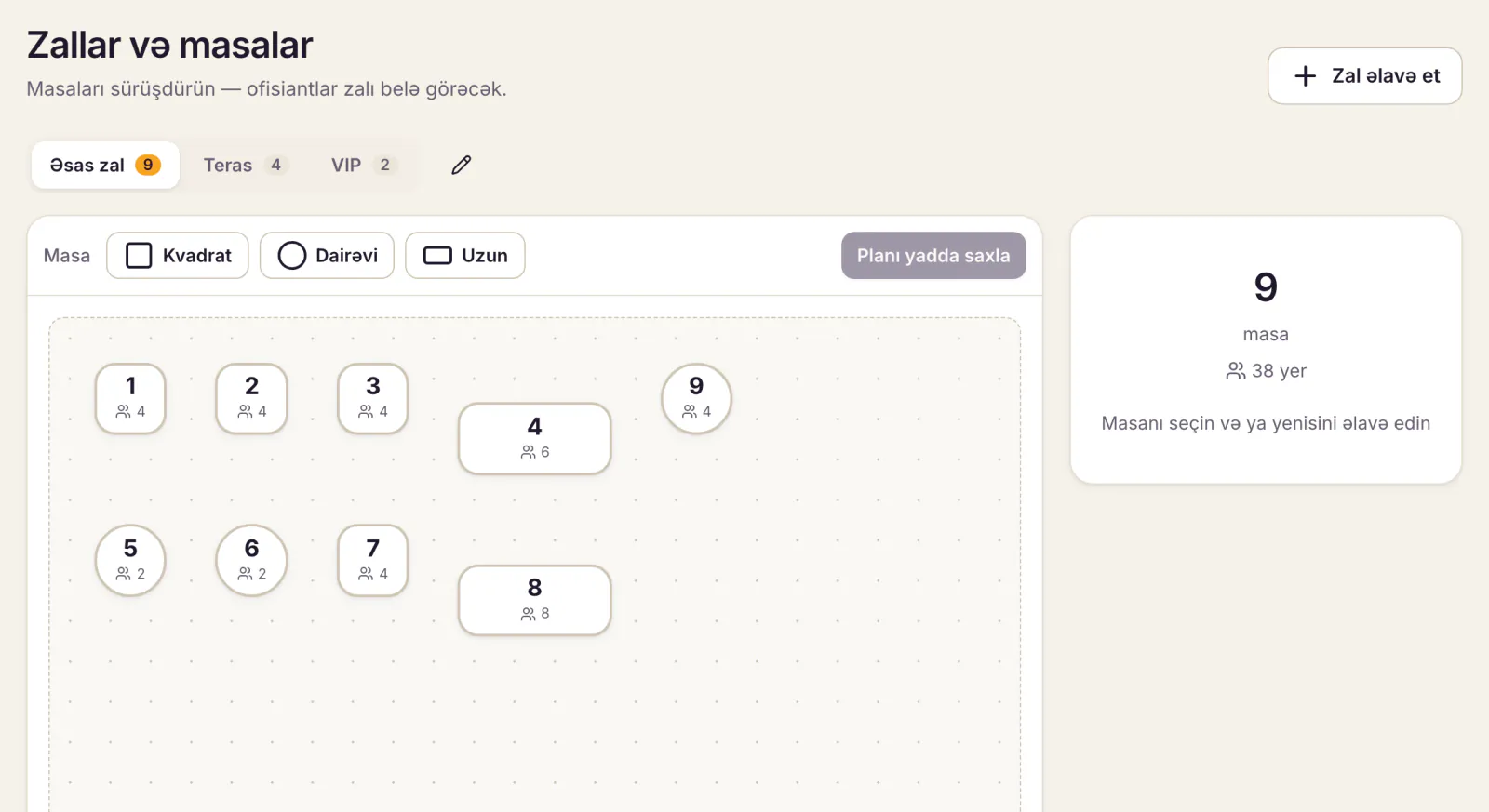
With Dishment you don't build the menu from scratch: the POS starts from ready setups for fast food, cafes, bars, family restaurants, fine dining and food courts. Pick the closest one and adjust the menu, rooms and tables to your venue. You can work out recipe cards and food cost before opening in the inventory and recipes module, so every sale deducts its ingredients from day one.
We show how the system fits cafes and restaurants on dedicated pages: for cafes and for restaurants. Dishment does not issue fiscal receipts and does not replace an NKA; it works alongside the venue's cash register. For the other selection criteria, see how to choose restaurant management software.
DISHMENT
Want to see this in your restaurant?
We'll show you Dishment on your own menu in 30 minutes.
Free demoFAQ
What do you need to open a restaurant?
Premises that fit the concept and a lease, registration with the tax service and a tax regime, AQTA registration, an e-kassa and a card terminal, a team on employment contracts, a menu with recipe cards, and a working capital reserve of at least three months of fixed costs. The order of the steps is in the sections above.
What documents do I need to open a cafe in Baku?
The main steps: registering as a sole trader or LLC with the DVX and choosing a tax regime, a lease or proof of ownership for the premises, registration with AQTA as a food business, an NKA contract with an e-kassa operator, and employment contracts with staff. Check the current document list for each step with the relevant agency.
How much does it cost to open a cafe in Baku?
It depends heavily on the location, size and scope of the fit-out, so there is no single figure. Fill in the template above, and always keep a working capital reserve of at least three months of fixed costs.
Is a cafe business profitable?
Profit depends on rent, payroll, food cost and footfall. Before opening, work out the break-even point: divide monthly fixed costs by (1 − food cost as a share of sales) and see how many guests a day that means.
Are the steps the same for a tea house?
Yes. A tea house (çayxana) is also a catering business, so the requirements for registration, tax, AQTA, the NKA and staff are the same. The difference is in the concept and the menu.
Can I register after I open?
No. A sole trader must apply for tax registration before starting business; from 2026 the penalty for being late is 200 AZN. A food business must also be registered with AQTA before it starts food activities.
When should I set up the POS?
At least two to three weeks before opening. The menu has to be entered, the printers tested, and the team should run real orders through the system at the soft opening.
Sources
- DVX, registration of commercial legal entities with local investment: taxes.gov.az
- DVX, "Tax Code changes in questions and answers", 2026 (the 200 AZN penalty, 3% income tax): taxes.gov.az
- DVX, simplified tax booklet, 2026 (tax regimes, minimum wage): taxes.gov.az
- DVX, financial sanctions related to the NKA and card terminals: taxes.gov.az
- KOBİA, AQTA services at the Baku SME House (2023): smb.gov.az
- Azerbaijan Food Safety Agency: afsa.gov.az
Information as of October 2026. This is not legal or tax advice. Procedures and fees can change; confirm them with the relevant agency and your accountant before you apply.