Guides· 13 min read· Dishment team
How to open a coffee shop in Baku: budget, equipment and menu
Choosing a format, an equipment budget in AZN, registration and the cash register, costing a cappuccino, a fast counter till and the numbers to watch in the first three months.
In the morning commuters hurry out of the metro with a coffee in hand, at midday students settle in with laptops, and in the evening friends meet over a flat white. Coffee is now a daily habit in Baku, and opening a coffee shop can look simple: a machine, a barista, a few tables. In practice a coffee shop's fate is decided before it opens, by its format, location, equipment, menu prices and the rhythm of its first months.
This guide is a step-by-step plan to open a coffee shop in Baku: formats, an equipment budget, registration, the menu and the cost of a cappuccino, the till, and the numbers to watch in the first three months. Prices are in Azerbaijani manat (₼, AZN; check the current exchange rate yourself). Every figure is an example, so always check your own quotes and contracts. At the end there is a one-page coffee shop business plan you can fill in.
Coffee shop vs cafe: what's the difference
A coffee shop is a hospitality business built around espresso-based drinks, with a short menu and fast service. The main difference from a cafe is the kitchen: a cafe usually cooks hot food, while a coffee shop runs on a bar, ready-made desserts and simple snacks.
- Service. In a coffee shop the guest usually orders and pays at the counter; in a cafe a waiter often serves the table.
- Trading hours. A coffee shop peaks in the morning; a cafe at lunch and in the evening.
- Equipment and investment. In a coffee shop the big costs are the espresso machine and grinder; in a cafe it is a full kitchen.
- Legally both are public catering businesses: the same rules apply to registration, AQTA and the cash register.
Choosing a format: to-go, sit-down or kiosk
Pick the format first, because budget, headcount and menu all follow from it.
| Format | Size and location | Strength | Risk |
|---|---|---|---|
| To-go | 8–20 m², metro exit, office building, university | Low investment, fast turnover | Revenue depends on footfall, small average check |
| Mall kiosk | 6–12 m², inside a shopping centre | Built-in footfall, weather-proof | High rent, the mall's hours and rules |
| Sit-down coffee shop | 40–80 m², 20–40 seats | Higher check, desserts and food | Fit-out and furniture are expensive, guests linger |
Before you choose a site, spend at least two mornings and two evenings across the street from it. Count how many people pass between 08:00 and 10:00 and how many already carry a coffee. That is more honest market research than any report.
In the lease, check the electrical capacity (a commercial espresso machine and water heater draw a lot), whether water and drainage can reach the counter, permission for signage and a shopfront, a rent-free period for the fit-out, and the term of the lease.
Budget for opening a coffee shop in Baku (AZN)
The ranges below are for planning. Espresso machine prices are based on listings we saw on a Baku classifieds site (lalafo.az) in October 2026, where commercial two-group machines ranged from about 2,650 ₼ to 8,500 ₼. The other lines are estimates to confirm with suppliers.
| Item | Kiosk / to-go, ₼ | Sit-down, ₼ | Note |
|---|---|---|---|
| Espresso machine (commercial, 2 groups) | 2,650 – 4,000 | 3,500 – 8,500 | Used is cheaper; check who services it |
| Grinder | 800 – 2,500 | 1,500 – 4,000 | A sit-down shop usually needs two |
| Water filter | 150 – 400 | 150 – 400 | Protects the machine |
| Milk fridge | 500 – 1,200 | 800 – 2,000 | Under the counter |
| Blender, scales, jugs, tamper, etc. | 400 – 900 | 600 – 1,500 | |
| Pastry display | — | 1,200 – 3,000 | |
| Fit-out and furniture | 3,000 – 8,000 | 15,000 – 40,000 | The biggest variable |
| Till: PC or tablet, receipt printer | 700 – 1,500 | 1,000 – 2,500 | |
| Opening stock: beans, milk, cups, syrups, pastries | 1,500 – 2,500 | 2,500 – 4,500 | |
| Signage, branding, printed cups | 500 – 1,500 | 1,000 – 3,000 | |
| Rough total | 10,200 – 22,500 | 27,250 – 69,400 | Excludes rent deposit and reserve |
Not in the table but essential in the plan:
- Rent deposit and rent for the first months.
- The fiscal cash register (NKA) and card terminal. Their cost depends on the operator and the bank; we explain why the NKA is separate from POS software in NKA cash register vs restaurant POS.
- A reserve of at least 2–3 months of fixed costs. A coffee shop rarely breaks even from day one.
Registration, AQTA and the cash register
A coffee shop is a catering business, so the main steps match a restaurant's:
- Register with the tax authority as an individual entrepreneur or an LLC (MMC) and choose a tax regime. The 2026 benefits for catering are explained in restaurant taxes in Azerbaijan 2026.
- Food safety. A business handling food must be registered with the Azerbaijan Food Safety Agency (AQTA). Confirm the current procedure and requirements with AQTA or at a KOB evi (SME house) service centre before opening.
- An NKA and card terminal, before your first sale.
- Employment contracts with your staff.
The full list of steps and a 30-day checklist are in how to open a restaurant in Baku.
The menu: espresso base, tea and the season
Keep the menu short. A long menu slows the morning rush, tires the barista and raises waste.
- Espresso base: espresso, americano, cappuccino, latte, flat white, raf (a creamy, sweet coffee popular in Baku). These 5–7 drinks make most of your revenue.
- Modifiers: size (S / M / L), milk (cow's, oat, almond, lactose-free), syrup, extra shot. Give every modifier a price; free "extras" quietly eat your margin.
- Tea: people in Baku ask for tea even in a coffee shop. Black tea in a pear-shaped armudu glass with lemon or thyme, a teapot for two. Low cost, high margin.
- Seasonal: pomegranate and pumpkin in autumn. Pomegranate lemonade, pomegranate and ginger tea, pumpkin latte. A seasonal drink gives guests a reason to come back.
- Food: croissants, sandwiches, cheesecake, local sweets such as pakhlava. Bought-in desserts are simple; your own kitchen may need extra permits and equipment.
Example prices (Baku, 2026, illustrative): espresso 3.00 ₼, americano 4.00 ₼, cappuccino 5.50 ₼, latte 6.00 ₼, raf 6.50 ₼, seasonal drink 6.50–7.50 ₼, croissant 4.00 ₼.
We cover growing the check separately in how to increase the average check.
Costing a cappuccino: a recipe card example
Every drink needs a recipe card; without one you know neither its cost nor how many cups a kilo of beans makes. A 300 ml cappuccino at illustrative prices:
| Ingredient | Quantity | Purchase price | Cost, ₼ |
|---|---|---|---|
| Coffee beans | 18 g | 48 ₼/kg | 0.86 |
| Milk 3.2% | 200 ml (incl. steaming loss) | 2.60 ₼/l | 0.52 |
| 300 ml cup + lid | 1 | 0.22 ₼ | 0.22 |
| Sugar stick, stirrer | 1 | 0.03 ₼ | 0.03 |
| Cost | 1.63 |
At a price of 5.50 ₼ the food cost is 1.63 ÷ 5.50 = 30%, and the gross profit per cup is 3.87 ₼.
Now a modifier. A guest wants oat milk: 200 ml at 6.50 ₼ per litre is 1.30 ₼, so the cost rises by 0.78 ₼ to 2.41 ₼. Charge +1.00 ₼ for oat milk and food cost climbs to 37%; charge +1.50 ₼ and it is 34%. An extra shot (9 g of beans, 0.43 ₼) at +1.00 ₼ earns a healthy margin. Without this sum, modifier prices are guesswork.
How to build a recipe card: restaurant recipe card template; how to calculate food cost: food cost calculation.
The till and the counter: built for the morning rush
At eight in the morning a guest in the queue will wait three minutes, not five, and every extra tap at the till makes the queue longer. A coffee shop till needs:
- order, payment and order number on one screen;
- size, milk and syrup picked with buttons and printed clearly on the bar ticket;
- the ready order's number shown on a screen in the room, so the barista does not shout names;
- sales that keep going when the internet drops.
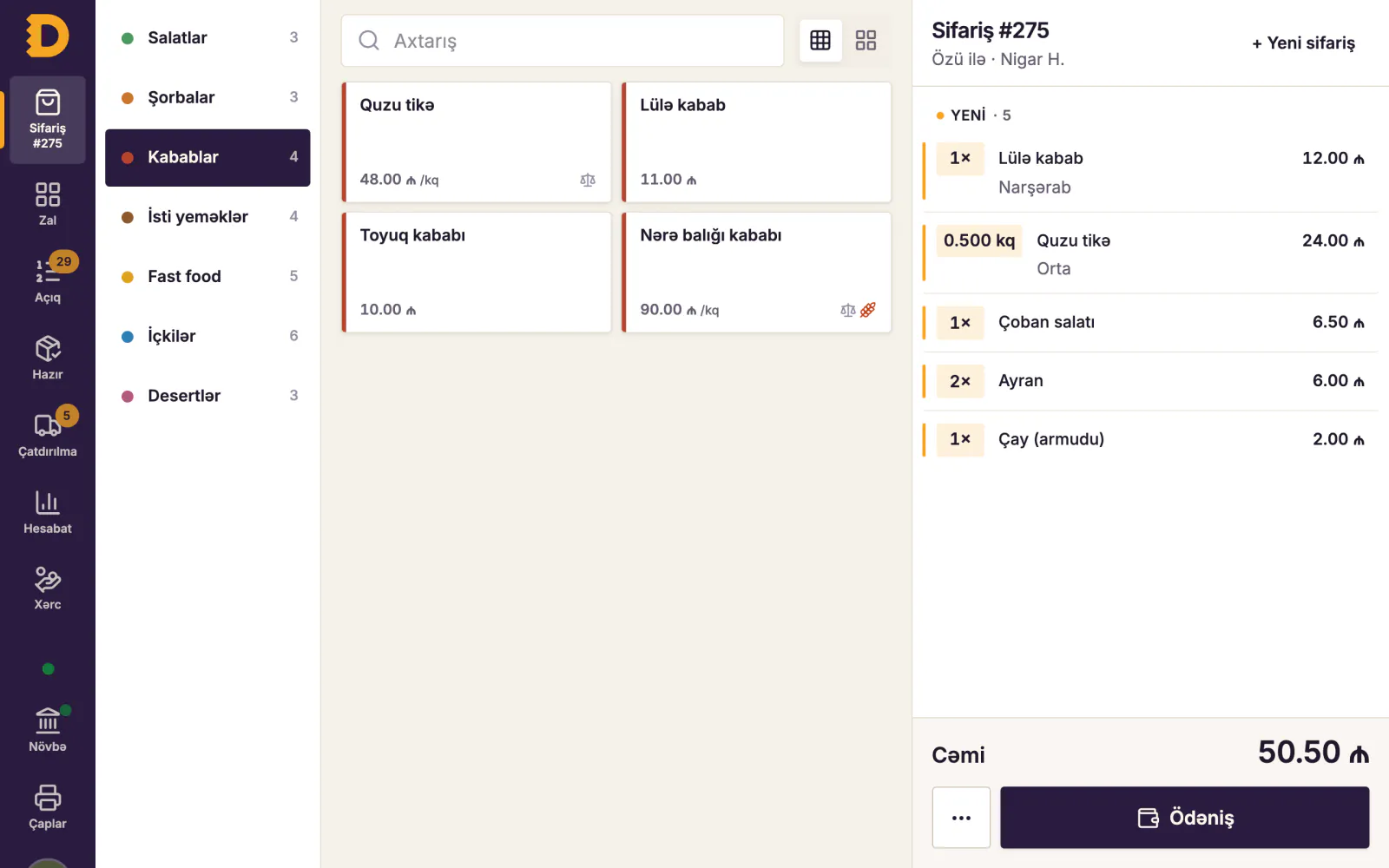
Dishment has exactly this counter mode for coffee shops: each order gets a daily number, goes to the bar printer or screen, and its number appears on the Ready screen when it is done. Modifiers take one tap. With the Inventory and recipes module, each latte deducts its milk and beans by recipe card, including oat milk and extra shots. The QR menu also shows the Wi-Fi password, so laptop guests do not interrupt the barista. The till runs on a Windows PC or an Android tablet and keeps selling offline.
Dishment does not replace the NKA: the fiscal receipt is issued on your cash register, while Dishment runs orders, the bar, stock and reports.
DISHMENT
Try it free for 30 days
We open the account and move your menu over together. No card needed.
30 days freeBreak-even: how many cups a day
The most important number before opening: how many checks a day do you need to cover fixed costs?
Checks per day = monthly fixed costs ÷ gross profit per check ÷ 30
An illustrative example:
| Kiosk / to-go | Sit-down | |
|---|---|---|
| Rent | 1,500 ₼ | 3,000 ₼ |
| Staff | 1,800 ₼ | 3,800 ₼ |
| Utilities, internet | 300 ₼ | 600 ₼ |
| Software, NKA, other | 400 ₼ | 600 ₼ |
| Monthly fixed costs | 4,000 ₼ | 8,000 ₼ |
| Average check | 6.50 ₼ | 6.50 ₼ |
| Gross profit per check (30% food cost) | 4.55 ₼ | 4.55 ₼ |
| Break-even: checks per day | ≈ 29 | ≈ 59 |
Taxes and card fees are not included, so take them off too. If the numbers look achievable, the next question is whether your site's morning footfall can deliver that many guests a day.
A one-page coffee shop business plan
A small coffee shop does not need a thick business plan, but one page should answer: who it's for, where, what you sell, what it costs and how many checks a day you need. Copy the table and fill in your own numbers.
| Section | What to write | Where in this guide |
|---|---|---|
| Concept and guest | Who it's for, which hours, expected average check | Choosing a format |
| Location | Address, morning footfall (count it yourself), lease terms | Choosing a format |
| Menu and prices | 5–7 core drinks, modifiers, desserts, prices | The menu |
| Cost of goods | A recipe card for every drink, food cost % | Costing a cappuccino |
| Start-up investment | Equipment, fit-out, first stock, deposit, reserve | Budget |
| Monthly fixed costs | Rent, staff, utilities, software, NKA | Break-even |
| Sales plan | Checks a day, average check, monthly revenue | Break-even |
| Team | Number of baristas, shifts, training | The first 3 months |
| Risks and reserve | Slow first months, equipment breakdowns | Budget |
Then work out one more figure: payback period = start-up investment ÷ monthly net profit. An illustrative example: 15,000 ₼ invested in a kiosk, and 1,500 ₼ a month left after fixed costs, taxes and fees. The money comes back in about 10 months. If sales hover near break-even, payback stretches out, which is why the reserve is an essential part of the plan.
The first 3 months: plan and numbers
| Month | Main job | What to watch |
|---|---|---|
| 1 | Speed up the morning rush, test the menu | Checks per day, sales by hour, morning queue time |
| 2 | Drop what doesn't sell, launch a seasonal drink | Sales and margin per drink, share of modifiers |
| 3 | Control costs, settle the team's rhythm | Food cost %, write-offs, labour cost as a share of revenue |
Five numbers to check every week:
- Checks per day by weekday.
- Average check and how it moves week to week.
- Sales by hour: where the morning peak sits and when you need a second barista.
- Food cost from recipe cards, and the actual figure after a stock count.
- Write-offs: expired milk, unsold pastries. How to record them: restaurant food write-off log.
In Dishment the basic reports on revenue, days, dishes and till shifts come with every plan, while sales by hour and the heat map are in the Advanced reports module.
Common mistakes
- Choosing a site by its rent. Cheap often means no footfall.
- A long menu. Twenty-five drinks slow the morning and raise waste.
- Free modifiers. Oat milk and syrups quietly eat your margin.
- Opening without recipe cards. If you don't know how many cups a kilo of beans makes, you can't plan purchasing.
- Opening without a reserve. The first two months may run at a loss; be ready for it.
- Training baristas after opening. Write the standard (dose, milk temperature, cup sizes) and practise it before day one.
FAQ
How much does it cost to open a coffee shop in Baku?
It depends on the format. By our illustrative estimate, equipment, fit-out and opening stock for a small kiosk or to-go spot come to roughly 10,000–22,500 ₼, and a sit-down coffee shop 27,000–69,500 ₼, before the rent deposit and reserve.
What paperwork do I need?
Registration with the tax authority (individual entrepreneur or LLC), registration of the food business with AQTA, an NKA and card terminal, a lease and employment contracts. Confirm the current procedures with the relevant authorities.
Is a coffee shop business profitable?
It can be, if the location is right, the menu is short and food cost is under control. Work out the break-even point before you open: in our example a small kiosk needs about 29 checks a day and a sit-down coffee shop about 59. If the location doesn't have that many guests, the business will lose money.
How do I write a coffee shop business plan?
One page is enough: concept, location, menu and prices, cost of goods, start-up investment, fixed costs, sales plan, team and risks. Fill in the template above and work out the payback period.
Which espresso machine should I buy?
If you expect a real morning rush, many shops choose a commercial two-group machine, so two baristas can work at once. Look past the brand to the service: who in Baku will fix it, and how fast, when it breaks?
Does a coffee shop need waiter tablets?
Not for a counter format; the till's counter mode is enough. If you serve tables, you can add an Android tablet in Dishment with no per-device fee; see the pricing page.
Information as of October 2026. This is not legal or tax advice; confirm registration and tax questions with an accountant and the relevant authorities.
DISHMENT
Want to see this in your restaurant?
We'll show you Dishment on your own menu in 30 minutes.
Free demo