Management· 13 min read· Dishment team
Restaurant advertising in Baku: 12 ways to bring in guests
Google Maps, Instagram and TikTok, Wolt and Bolt Food, QR menus and regulars: 12 restaurant advertising channels that work in Baku, the maths of a discount and a sheet to measure results.
The owner of a new cafe spends a few hundred manat on Instagram ads in the first month. The follower count goes up, but the dining room is still half empty. The tea house on the next street does no advertising at all, yet in the evening you struggle to find a free table there. Restaurant advertising is measured in guests who walk in and come back, not in likes and views.
This article walks through 12 channels that work for cafes and restaurants in Baku: Google Maps, Instagram, Wolt and Bolt Food, the QR menu on the table and your regulars. For each one we cover what to do, how to price a discount without losing money and how to tell which advertising actually worked. All amounts are examples; adjust them to your budget.
Where restaurant advertising starts: how a guest finds you
Before you pay for ads, walk the guest's path. In Baku it usually goes like this:
- They see you or search. "Cafe near me" on Google Maps, a friend's post on Instagram, a category list in Wolt, the sign on the street.
- They check. Reviews, photos, the menu, prices, opening hours.
- They come in or order.
- They come back, or they don't.
Most advertising budgets go on step one. But if the guest can't find a menu or prices at step two, or waits 50 minutes for food at step three, the money spent on step one is wasted. So our list starts with the channels that get you found and ends with the ones that bring guests back.
| Stage | Channels | What to measure |
|---|---|---|
| Found | Google Business Profile, Instagram, TikTok, Wolt and Bolt Food, the street | Profile views, calls, direction requests |
| Chosen | Reviews, photos, QR menu, online menu | Rating, menu views |
| Order | Dining room, your own online ordering link, aggregators | Receipts, guests, average check |
| Return | Stamp card, customer list, events | Repeat orders, share of regulars |
12 restaurant advertising ideas that work in Baku
1. Google Business Profile and Maps
For searches like "restaurant near me", "cafe Narimanov" or "breakfast Baku", Google shows the map and venue listings first. A Google Business Profile is free, and for many restaurants it is the cheapest advertising there is.
- Address, an exact pin on the map, phone, opening hours. Set holiday hours separately.
- Category: "Restaurant", "Cafe", "Tea house" or "Coffee shop", with one primary and a few secondary ones.
- At least 15–20 good photos: the front of the building (so guests recognise it), the dining room, your 5–6 key dishes, the menu.
- A menu link: your QR menu or your online ordering page.
- Reply to every review, especially the negative ones: short, calm and specific.
Use the profile's own statistics to measure it: views, calls and direction requests. Write them down in a sheet once a month.
2. Your Instagram profile as a shop window
In Baku, guests often "check" a restaurant on Instagram. Before you run ads, the profile has to work as a shop window:
- Bio: cuisine, district, opening hours and one link, to the menu or to ordering.
- Highlights: Menu, Prices, Address, Reviews, Delivery.
- Three pinned posts: your best seller, the room, the current offer.
- Show prices. "Price in DM" loses half your guests on the spot.
3. Short video: Reels and TikTok
When people hear "restaurant promo video" they picture an expensive shoot. In practice most videos that work are shot on a phone:
- Process: qutab on the saj, bread out of the tandir, lula kebab going onto skewers, plov resting under its lid. 7–15 seconds is enough.
- People: the cook's hands, the tea master setting out armudu glasses, the team before the shift.
- "A day in 30 seconds": from opening in the morning to a full room at night.
- A concrete offer: "what 10 manat gets you here", "this week's business lunch".
Post the same video to Reels and TikTok. Two or three simple videos a week usually do more than one expensive clip, because the algorithms reward regular posting and guests like a kitchen that looks alive.
4. Targeted ads: small budget, tight radius
The most common mistake with Instagram and Facebook ads is targeting the whole of Baku. People who come to a cafe usually live, work or walk nearby. A test might look like this: a 2–3 km radius, weekdays 11:00–14:00, 5–10 ₼ a day, for one week. One concrete offer in the ad: "Business lunch: soup, main and tea, 9 ₼".
Judge it by the number of receipts in those hours, not by likes: how do the lunches in the ad week compare with the same days the week before?
5. Bloggers and food bloggers
Blogger advertising only works when the audience lives in your city, ideally in your district. Look at their statistics, not their follower count: what share of the audience is in Baku?
- Barter (food in exchange for posts) or paid: either way, agree the terms in writing. How many stories, how many Reels, which day, which dishes.
- Give them a code word so you can measure it: "mention the blogger's name and the tea is on us". The cashier records it as a named discount, so it's easy to count later.
- Three or four small local bloggers often bring more real guests than one big name.
6. Visibility on Wolt and Bolt Food
An aggregator is both a delivery service and a shop window: people often open the app just thinking "what shall I eat" and scroll.
- Photos. Every dish gets its own photo. Dishes without one get scrolled past.
- Name and description. Not "Lula kebab" but "Lamb lula kebab with lavash and grilled vegetables, 350 g".
- Stop list. Switch off a sold-out dish straight away: a cancelled order costs you the guest and your rating.
- Prep time. Set a realistic one and beat it.
- Platform promotions. Work out in advance how much of your margin the discount eats once commission is taken.
We did the commission and own-delivery maths in a separate article: Wolt, Bolt Food or your own delivery. Dishment's Wolt integration is in preparation and will open after testing with Wolt; Bolt Food comes after that.
7. Your own online ordering link
Alongside the aggregators, give guests a link to order from you directly: in your Instagram bio, on your Google profile, in your WhatsApp status, on a poster in the room. When a regular orders through it, there's no platform commission, and the guest sees your prices and your menu.
With Dishment's Delivery module, a guest orders delivery or pickup from the restaurant's link, and phone orders are taken at the till. Everything goes to the same till and kitchen as the dining room and is delivered by your own couriers. For now guests pay in cash or by card, to the courier or at the till.
8. The QR menu on the table and at the door
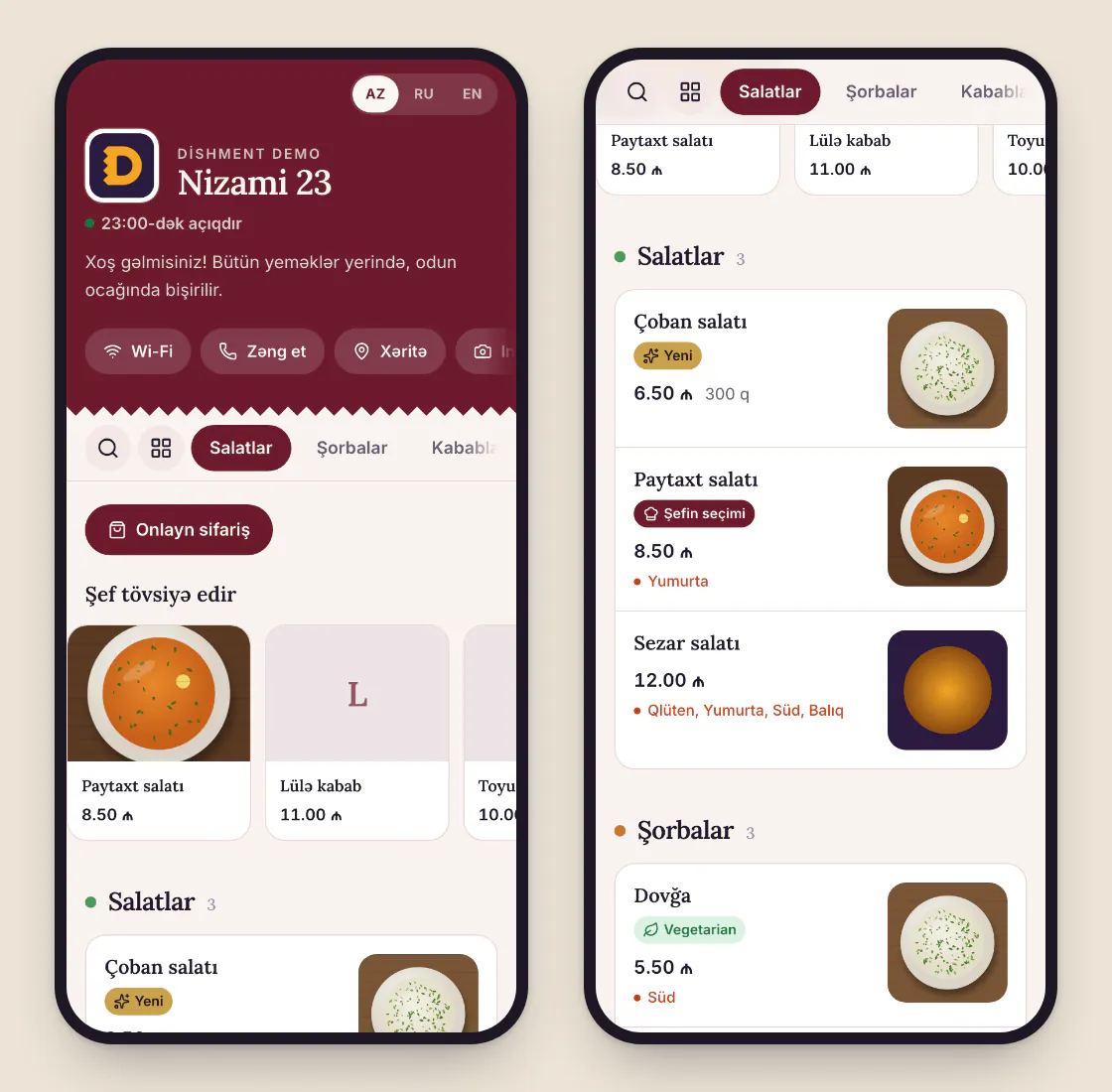
A QR menu doesn't look like advertising, but it's where the guest decides what to order. Photos, descriptions in three languages (important for tourists), links to Instagram and WhatsApp, the Wi-Fi password in one tap. With a QR code on a poster at the entrance, passers-by can see the menu and prices before they walk in.
Dishment's QR menu also shows anonymous statistics: which dishes people look at, at what times and what they search for in the menu without finding it. That's a good hint at what to show in your ads. More on this: QR code menus for restaurants.
9. The street, the window and the neighbours
- The front. A sign that's lit in the evening, a readable name, opening hours on the door.
- A daily board. A chalkboard at the door: "Today: dovga, qutab, lentil soup".
- Nearby offices. Drop off a printed business lunch menu or send it on WhatsApp, and make an offer just for that office.
Billboards, banners and advertising structures on buildings are governed by Azerbaijan's Law on Advertising. Before installing one, ask the local executive authority or an advertising agency what permits are needed. The law also has separate restrictions on advertising alcohol.
10. Repeat guests and loyalty
You have already paid for the guest who came from an ad. If they don't return, that money bought one visit. Simple tools:
- A stamp card: "your sixth coffee is on us", "a free dessert after five business lunches".
- Birthdays: a dessert or a tea set on the house.
- A customer list: phone numbers, collected with the guest's consent. At most one WhatsApp message a week, no spam.
- Recognition: a waiter asking "dovga again?" beats any bonus scheme.
Dishment has no separate loyalty module: you keep the stamp card on paper and ring up the reward at the till as a named discount. In the Delivery module, customers are recognised by phone number, and their addresses and order history show at the till.
11. Events and seasons
An event brings guests and gives you photos and video: an autumn menu with pomegranate, quince and chestnuts, Novruz, football screenings, live music nights, family days. Towards the end of the year the corporate parties start; we covered preparing for them separately: New Year corporate party checklist.
12. Reviews and service: the cheapest advertising
- Ask for reviews. Hand over a small card with a QR code to your Google review page along with the bill.
- Reply to negative ones. Apologise, say what you fixed, don't argue.
- Keep your promises. If the ad says "business lunch in 15 minutes", the kitchen has to deliver in 15 minutes. A bad experience travels faster than a good ad.
DISHMENT
Want to see this in your restaurant?
We'll show you Dishment on your own menu in 30 minutes.
Free demo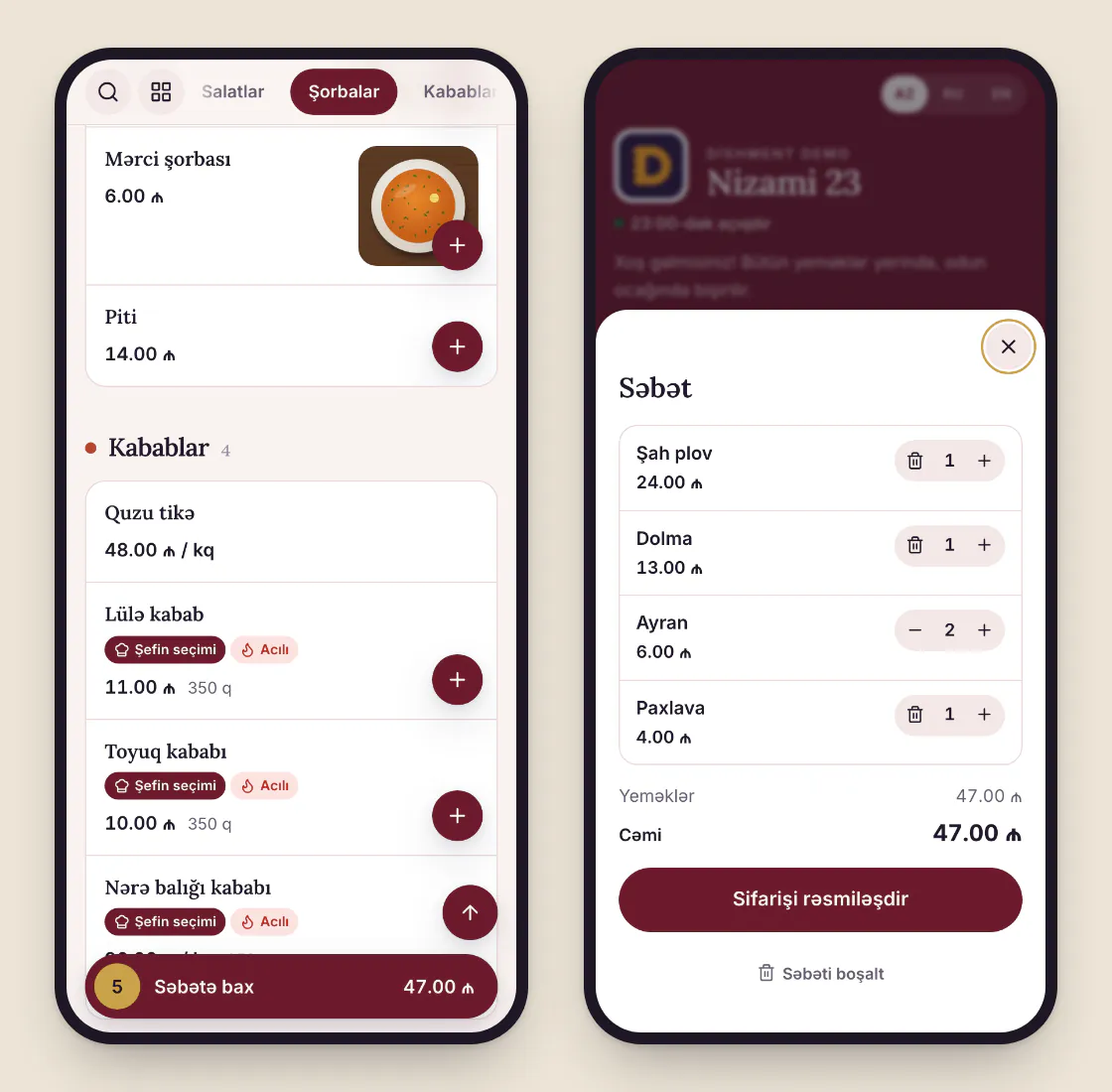
Discounts that don't lose money
A discount is the easiest advertising, but it isn't free. How much do sales need to grow for you to earn the same after a discount? The formula:
Required sales increase = discount % ÷ (margin % − discount %)
Margin % = (price − food cost) ÷ price. Example: lula kebab at 14.00 ₼, food cost 5.07 ₼, a margin of 63.8%. With 20% off, the price is 11.20 ₼ and your earnings per portion fall from 8.93 ₼ to 6.13 ₼. To earn the same, you need to sell 46% more kebabs.
For a dish with a 30% food cost, the numbers are:
| Discount | Sales need to grow by |
|---|---|
| 10% | +17% |
| 15% | +27% |
| 20% | +40% |
| 30% | +75% |
Rules of thumb:
- Add value instead of cutting price. "Free tea with the business lunch" is worth 1.50 ₼ to the guest and costs you 0.20–0.30 ₼.
- Aim promotions at quiet hours. An offer for 15:00–18:00 makes more sense than a discount on a full Friday night.
- Set an end date. "This week", "all of October". A promotion that never ends becomes your new price.
- Record every discount by name. "Blogger", "birthday", "stamp card". Otherwise you won't know at the end of the month which one worked.
You can't price a discount without knowing your food cost: how to calculate food cost.
How to measure whether advertising worked
- Record a baseline. The 2–4 weeks before the campaign: revenue, number of receipts, guests, average check, sales by hour.
- Give each channel its own trace. A separate code word, its own QR code or link, a "how did you hear about us?" question at the till.
- Compare like with like. Friday with Friday, lunch with lunch. Mark holidays and rainy days.
- Work out the cost per guest. Spend ÷ extra guests. If a 300 ₼ campaign brought 60 extra guests, each cost you 5 ₼. If a guest spends 18 ₼ on average at a 65% margin, you earn 11.70 ₼ on the first visit alone: the campaign has paid for itself.
A sheet to fill in once a month:
| Channel | Spend, ₼ | Extra guests / orders | Cost per guest, ₼ | Average check, ₼ | Decision |
|---|---|---|---|---|---|
| Instagram ads | |||||
| Blogger | |||||
| Google profile | |||||
| Aggregator promotion | |||||
| Stamp card |
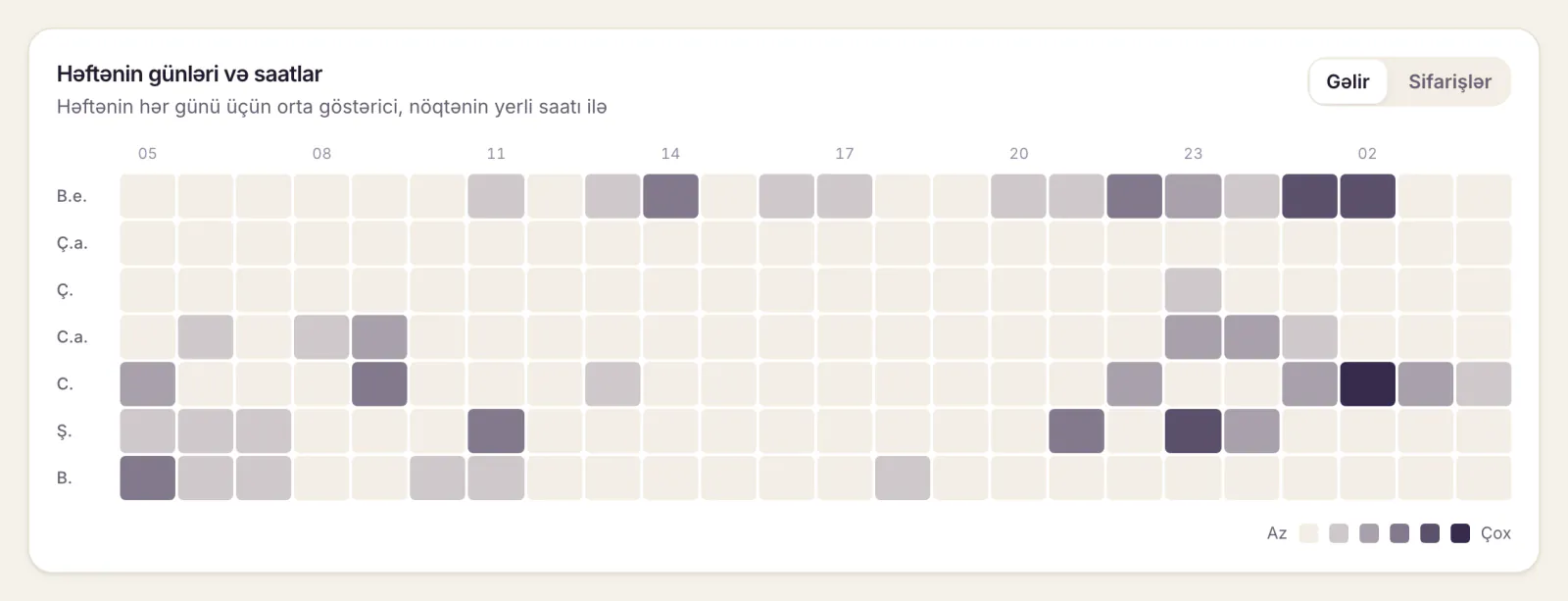
In Dishment you don't collect these numbers by hand. Reports put two periods side by side: revenue, average check, discounts and voids. The Advanced reports module adds an hourly heat map and ABC analysis. At the till, a discount is picked from a preset list by name (say, "blogger" or "birthday") and shows on the receipt, and reports show discounts by period and by staff member. The Notifications module sends revenue, orders and average check to Telegram when the day closes, and tells you straight away about any discount above a threshold you set. We covered raising the average check separately: how to increase the average check.
Common mistakes
- Launching everything at once. With a blogger, targeted ads and a discount in the same week, you can't tell what worked.
- Measuring likes. A like isn't a guest. Look at the receipts.
- Advertising before the kitchen is ready. If waiting times grow with the extra guests, the bad reviews outlive the campaign.
- Discounts without the maths. Sales go up, profit goes down.
- Out-of-date details. Old opening hours on Google and old prices on Instagram lose guests at the worst moment.
FAQ
How do I start advertising a restaurant?
Start with the free channels: Google Business Profile, a tidy Instagram profile, replies to reviews and a QR menu. Then test one paid channel on a small budget, measure it against your till receipts and only scale up what works.
What are free ways to promote a restaurant?
A Google Business Profile, regular short videos on Instagram and TikTok, reviews, a board at the door, deals with nearby offices and care for your regulars. These cost time rather than money.
How much should I spend on Instagram ads?
There's no universal figure. Start small, for example 5–10 ₼ a day for a week, with a tight radius and one concrete offer. Work out what one guest costs you, and only then raise the budget.
Are bloggers worth it?
Yes, if their audience is in Baku and suits your format. Agree terms in writing, give them a code word and judge the result by the number of guests who came.
How do I know if an ad campaign worked?
Use the weeks before the campaign as a baseline, compare the same days, give each channel its own trace (code word, QR, link) and divide the spend by the number of extra guests. If a guest costs less than you earn from them, the channel works.
DISHMENT
Try it free for 30 days
We open the account and move your menu over together. No card needed.
30 days free