Guides· 10 min read· Dishment team
Stock count sheet and inventory report template for restaurants
A restaurant stock count sheet and inventory report you can copy: the columns, a filled-in example, a stock count order and team, an equipment count, how to work out variances, and sign-offs.
Free Excel templateStock count sheetThe article’s tables and formulas, ready to use — opens in Excel and Google Sheets.Download (.xlsx)The count is done and the sheets are full, but tomorrow nobody knows what to do with the numbers. That is what an inventory report, or stock count sheet, is for: it brings the count into one document, compares book stock with what is actually there, shows the variance in manat and records who is responsible with signatures. This article gives you a restaurant stock count sheet template, a filled-in example, a stock count order and an equipment count sheet, all as tables you can copy.
How to run the count itself (how often, by zone, prepped items, theoretical vs actual usage) is covered in our restaurant inventory count guide. This one is about the paperwork.
What an inventory report is
An inventory report (in Azerbaijan usually called an "inventarizasiya aktı") lists the products that are physically in the store room, kitchen and bar on a given date. Compared with book stock, it shows a shortage or surplus for each item. People also call it a stock count sheet or stocktake report.
A restaurant usually has three documents:
- Stock count order: who counts, when and where.
- Count sheets: rough sheets filled in by hand, zone by zone.
- Inventory report: the final document with variances in manat and signatures.
The stock count order and team: a template
Counting should never be left to one person, especially the person responsible for that area. So you appoint a count team first. In a small cafe that is two or three people: the manager, the head chef or storekeeper and, if possible, the accountant.
Copy this text and fill in your details:
ORDER No. ___ , Baku, ___ ________ 20__
On carrying out a stock count
- A count of food, drink and packaging stock at ________ restaurant is to be carried out on ___ ________ at ___:___.
- The count team is: chair, manager ________; members, head chef ________, accountant ________.
- Person with material responsibility: storekeeper ________.
- All receipt, write-off and transfer documents are to be handed in before the count starts; deliveries and transfers stop for the duration of the count.
- Results are to be submitted to the director by ___ ________.
Director: ________ (signature)
Stock count sheet and inventory report: fields you need
Header:
- Report number, date, and start and finish time of the count.
- Restaurant and storage area: for example "kitchen fridge 1", "dry store", "bar".
- Count team members and the person with material responsibility.
- The last document included in book stock: the number of the last delivery and the last write-off.
Table columns:
- Line number.
- Item name, exactly as in your system.
- Unit: kg, l, pcs. The same as on the recipe card.
- Book stock: what the documents say should be there.
- Counted stock: what was actually counted.
- Variance in quantity: counted − book.
- Unit cost: at the average purchase price.
- Variance in manat: variance × unit cost.
- Note: recounted, document found, reason.
At the bottom: totals for shortages, surpluses and the net variance, plus signatures of the team and the person with material responsibility.
Inventory report example: a filled-in sheet
A cafe in Baku, month-end count. Prices and quantities are examples:
| No. | Item | Unit | Book | Counted | Variance | Unit cost, ₼ | Variance, ₼ | Note |
|---|---|---|---|---|---|---|---|---|
| 1 | Rice | kg | 42.0 | 41.6 | −0.4 | 4.20 | −1.68 | |
| 2 | Beef (for lula) | kg | 18.5 | 16.9 | −1.6 | 21.00 | −33.60 | counted twice |
| 3 | Butter | kg | 6.0 | 5.2 | −0.8 | 16.50 | −13.20 | |
| 4 | White cheese | kg | 4.0 | 4.3 | +0.3 | 11.00 | +3.30 | checking the delivery |
| 5 | Black tea | kg | 3.0 | 2.9 | −0.1 | 24.00 | −2.40 | |
| 6 | Lemons | pcs | 80 | 64 | −16 | 0.25 | −4.00 | tea add-on has no recipe card |
| 7 | Cola 0.33 l | pcs | 96 | 90 | −6 | 0.90 | −5.40 | |
| 8 | Herbs for qutab | kg | 2.5 | 2.5 | 0 | 6.00 | 0.00 | |
| Shortages | −60.28 | |||||||
| Surpluses | +3.30 | |||||||
| Net variance | −56.98 |
Copy the table into Word or Excel; the columns are ready. In Excel, put =E2-D2 in the Variance column and =F2*G2 in Variance, ₼.
Sign-offs:
- Chair of the count team: ________ (name, signature)
- Team members: ________
- Person with material responsibility: "The count was carried out in my presence and I have seen the results" ________ (signature)
A short weekly count: a mini report for expensive items
Between full monthly counts, it is enough to count 10–15 expensive or easily vanishing items once a week: meat, butter, cheese, saffron, coffee beans, alcohol. The form is the same, just shorter, and two signatures will do: whoever counted and whoever checked. The real value shows when you put the weeks side by side:
| Item | Week 1 | Week 2 | Week 3 | Week 4 |
|---|---|---|---|---|
| Beef, kg | −0.3 | −1.1 | −0.2 | −1.3 |
| Butter, kg | −0.2 | −0.2 | −0.3 | −0.1 |
| Cheese, kg | +0.1 | 0 | −0.1 | 0 |
In this example the beef shortage jumps every other week. Look at the rota for those weeks: who was on shift, which day had a banquet, who signed for the deliveries. One week's variance can be chance; a repeating one is a pattern.
The storekeeper's statement
Before the count starts, the person with material responsibility writes a short statement: "By the start of the count, all receipt and issue documents have been handed in and every item I received has been booked." That one sentence prevents the later argument that an invoice was still in someone's pocket.
Equipment count sheet
Equipment and furniture don't need counting every week like food, but checking at least once a year is worth it: what you have, where it is and what state it is in. The form is simple:
| Asset No. | Item | Location | Book, pcs | Counted, pcs | Condition | Note |
|---|---|---|---|---|---|---|
| 0012 | Combi oven | kitchen | 1 | 1 | working | |
| 0015 | Walk-in cooler | store | 1 | 1 | needs repair | noisy compressor |
| 0021 | Coffee machine | bar | 1 | 1 | working | |
| 0034 | Till tablet | dining room | 2 | 2 | working | |
| 0040 | Table | dining room | 15 | 15 | working | |
| 0041 | Chair | dining room | 60 | 57 | 3 unusable | write-off form |
Writing off unusable equipment is a separate document, done with your accountant.
Counting the cash in the till
Counting cash is a stock count too, done at every shift close: notes and coins are counted by denomination and compared with the expected amount. We show how in our guide to X and Z reports.
DISHMENT
Want to see this in your restaurant?
We'll show you Dishment on your own menu in 30 minutes.
Free demoYou found a variance: what to do next
- Recount first. Check any large variance again with a different person.
- Check the paperwork. A delivery not entered, a write-off not recorded, a transfer to the wrong venue. How to record write-offs is in our article on food write-offs.
- Check the recipe cards. A lemon variance like the one in the example usually means the lemon served with tea has no recipe card, so sales never deduct it. See our recipe card template.
- Write the reason in the Note column and fix the process.
- Bring book stock in line with the count, so the next count starts from real numbers.
Can you deduct a shortage from wages? Under Article 175 of Azerbaijan's Labour Code, an employer can deduct from pay by its own order only the amounts the law lists, including damage caused by the employee's fault, capped at one month's average pay (except where the employee carries full material liability). Anything else needs the employee's written consent. Docking everyone equally without proving fault is both a legal risk and a blow to trust in the team. Talk to an accountant or lawyer in such cases.
Common mistakes
- Showing book stock before the count. Whoever sees the number tends to write down what is expected. Count first, compare later.
- Mixed units. "3 packs" on the sheet, grams in the system: someone converts it later and the error looks like theft.
- Watching percentages, forgetting manat. A 20% variance on lemons costs less than 9% on meat. Sort the table by value.
- Keeping an unsigned report. An unsigned report proves nothing in a dispute.
- Taking deliveries during the count. New stock gets counted twice or not at all.
Stock counts in Dishment
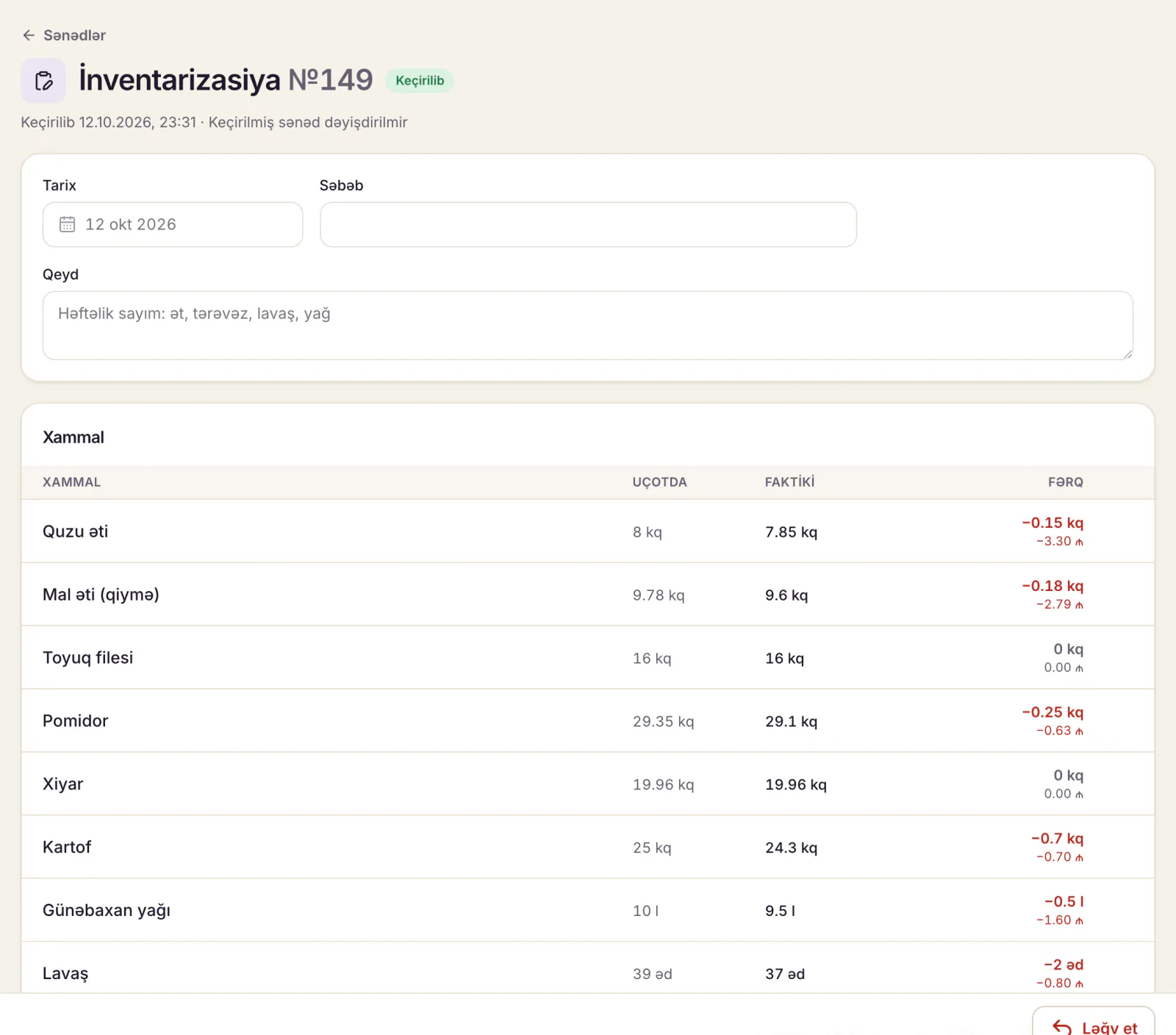
In Dishment's Inventory and recipes module, a stock count is its own stock document:
- The Add all ingredients button adds every active ingredient as a line, pre-filled with book stock, and you overwrite it with the counted quantity. So count blind on paper first, then type the numbers in. To count just a few items, such as expensive ones each week, add lines by hand.
- The variance on each line is valued at the venue's average purchase price, and the document shows shortages, surpluses and the total.
- You record a reason and a note. When the count is posted, book stock at that moment is stored in the document and balances are set to the counted figures.
- A posted document never changes: to fix a mistake, the system creates a reversing document that undoes every movement, and both stay in the history.
- The ingredient consumption report shows count variances separately from sales and write-offs, and it exports to CSV.
For the count sheet, print the form above without the Book column. Losses at the till are shown separately by theft and loss control. Prices are on the pricing page.
FAQ
Who signs the inventory report?
The chair and members of the count team, plus the person with material responsibility, who confirms by signing that the count took place in their presence and that they have seen the results.
How many people should be on the count team?
For an internal restaurant count, at least two: one counts, one writes, and the person responsible for an area never counts it alone. For an official stock count, agree the team with your accountant.
How do I build a stock count sheet in Excel?
Copy the table above into Excel, set Variance to counted minus book and Variance, ₼ to variance times unit cost, and add totals at the bottom. Continue the same file on a new sheet each month.
When should a restaurant do a stock count?
Expensive items are usually counted weekly and everything monthly, plus whenever the person responsible for stock changes and after big holidays. More in our restaurant inventory count guide.
How is an equipment count different?
It covers equipment and furniture, not food: each item with its asset number, location and condition. Instead of unit cost, you record the condition: working, needs repair or unusable.
DISHMENT
Try it free for 30 days
We open the account and move your menu over together. No card needed.
30 days free